Surface Cleaner Sizer & Tiger Stripe Predictor
Buying the biggest surface cleaner possible is the fastest way to ruin a driveway. If your pressure washer doesn't have enough water flow (GPM) to spin the internal spray bar fast enough, you will leave ugly, permanent "tiger stripes" etched into the concrete.
The "4 Inches Per GPM" Rule
To avoid tiger striping and pump damage, the industry standard formula is 4 inches of surface cleaner diameter for every 1 Gallon Per Minute (GPM) your machine produces. For example, a standard 2.5 GPM residential machine can only handle a 10-inch to 12-inch cleaner.
Visualize Your Tiger Stripe Risk
Use the calculator below to input your machine's GPM and the surface cleaner size you want to use. The speedometer will instantly show you if that combination is safe, or if you are in the red zone for tiger striping.
Interactive Surface Cleaner Sizer & Risk Speedometer
Live CalculationYour selected 20" surface cleaner requires at least 5.0 GPM to spin effectively. With your 2.5 GPM machine, the spray bar will spin too slowly and drag, etching permanent circular tiger stripes into the concrete.
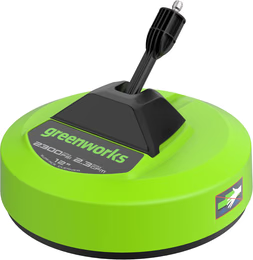
Greenworks 12" Surface Cleaner
The ideal matched diameter for machines producing up to 3.0 GPM. Spins freely without lagging or leaving etched overlap ridges.
Surface Cleaner & Tiger Striping FAQs
What causes tiger striping on concrete?
Tiger striping happens when the spray bar inside the surface cleaner does not spin fast enough to overlap its cleaning paths. This is caused by pushing a large surface cleaner with too little water flow (GPM), or walking too fast for the GPM you have.
Does PSI matter for surface cleaners?
Yes, but GPM dictates the size of the cleaner. High PSI gives you the stripping power to clean the concrete, but GPM provides the rotational force to spin the bar. You need both to clean efficiently without striping.
Why does my surface cleaner hover or float instead of cleaning?
If your surface cleaner feels like it is hovering uncontrollably, your internal nozzle orifices are likely too small for your machine's PSI/GPM, creating excessive back-pressure. Conversely, if it drags heavily, your nozzles might be too large, causing a loss of pressure.
How do I unclog a surface cleaner that stops spinning?
If one side of the spray bar clogs with a tiny pebble or debris, the bar becomes unbalanced and will instantly stop spinning. You must remove the nozzle with a wrench and use a nozzle cleaning tool (or a fine needle) to clear the orifice, then flush the bar before reinstalling the tip.
Do I need a 2-bar or 3-bar rotor for my surface cleaner?
For standard residential and commercial machines (under 8.0 GPM), a 2-bar rotor is always preferred. A 3-bar or 4-bar rotor divides your machine's GPM into too many spray points, severely reducing the impact pressure (PSI) hitting the concrete. Only machines pushing 8.0 to 10.0+ GPM should consider 3-bar or 4-bar rotors.