
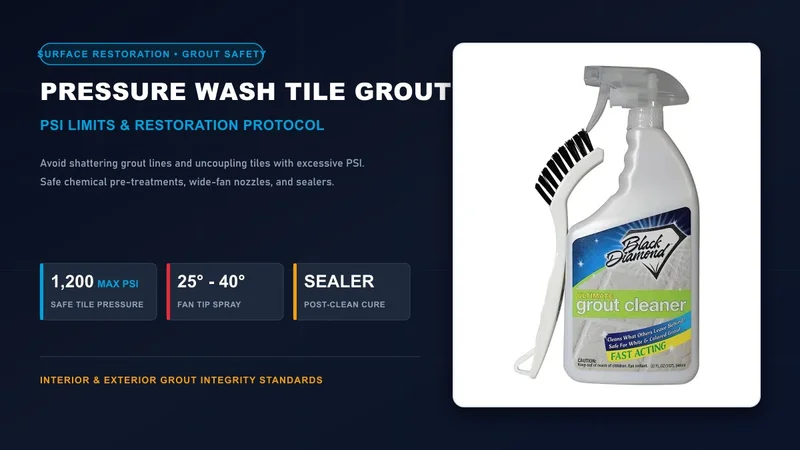
Never hit indoor tile grout with a direct, pinpoint pressure washer spray tip. A 2,500 PSI zero-degree or 15-degree jet exerts brutal shear force. It carves straight through cementitious grout, excavates the sand aggregate, and drives water under the subfloor. To safely deep-clean tile and grout, dial your pressure down to 800–1,000 PSI. Pair that low pressure with an enclosed hard-surface spinner wand.
I've seen homeowners blow thousands of dollars on bathroom tile tear-outs. Why? They figured a 3,000 PSI fan tip would save them thirty minutes of scrubbing. Don't blast it. If you're asking can you pressure wash tile grout, the answer is yes—but only if you respect your floor's mechanical limits. Standard grout is essentially porous concrete bonded by mineral crystals. Hit it with raw hydraulic blast force, and you won't just clean grout. You'll shatter tile glaze, strip color pigments, and soak the plywood subflooring beneath.
Najam's Shop Rule: How to Pressure Wash Tile and Grout Safely
- The Safe Pressure Ceiling (800 to 1,000 PSI): What's the best psi for cleaning tile floors? Keep it strictly between 800 and 1,000 PSI. Grout carries downward weight easily, but high-velocity water shears weak cement bonds instantly. High pressure chips grout.
- Ditch the Open Spray Lance: Never point a bare pressure wand at tile. An enclosed tile spinner wand attachment locks dual spinning nozzles exactly one inch above the floor. Its vacuum port sucks up dirty water before it can puddle.
- Let Chemistry Do the Heavy Lifting: Soak dirty joints in an alkaline cleaner (pH 9–11) for 8 to 10 minutes first. Surfactants dissolve greasy dirt. That lets gentle water pressure rinse it away without gouging joints.
Compressive Strength vs. Tensile Shear Stress: Why Pressure Blows Out Grout
People spot "3,500 PSI compressive strength" on a mortar bag and assume their 3,000 PSI washer is harmless. Don't fall for that. It's a costly trap.
Compressive strength only measures downward dead weight before a joint crushes. It tells you zero about how that joint handles high-velocity water scraping across its surface. Standard sanded and unsanded cementitious grout carries a compressive rating of 3,000 to 5,000 PSI. But its tensile shear bond is weak—often under 400 PSI.
Standard grout behaves like a hard ceramic sponge. It drinks 10% to 18% water by volume. On the flip side, 100% solid epoxy grout is a non-porous synthetic resin. Epoxy boasts total chemical immunity and handles aggressive pressure without flinching. Portland cement grout won't.
When high-pressure water slams into flat tile, the jet stalls instantly. That impact converts kinetic energy into hydrodynamic stagnation pressure:
At 3,000 PSI, water blasts out of a narrow point-blank nozzle tip at over 450 miles per hour. That stream acts like a hydraulic chisel. High pressure chips grout fast. Water rams into microscopic capillary pores, creates internal bursting pressure, and shears the cement crystals holding the sand grains together. Within seconds, you get three severe failures:
- Pore-Water Hydraulic Wedging: Pressurized water jams into porous capillary channels. Water won't compress. It blows the cement matrix apart from the inside out.
- Sand Washout and Micro-Cavitation: High shear stress strips sand grains right out of the joint. You're left with rough, pitted craters that trap grime faster than before.
- Tile Edge Delamination: Water forces its way into the micro-seam between the tile edge and grout line. It shears the adhesive bond, chips the glaze, and pumps water straight behind your backer boards.
Grout Chemistry & Mechanical Tolerance Matrix
Before you attempt to restore dirty grout lines, identify your joint material. Here are the hard mechanical limits, safe working PSI ceilings, and chemical rules for every common grout formula:
| Grout Chemistry & Spec | Compressive Strength | Water Absorption | Max Safe Working PSI | Recommended Delivery Tool | Safe Cleaner pH Range |
|---|---|---|---|---|---|
| Sanded Cementitious ANSI A118.6 (Portland + Sand) |
3,000 – 4,500 PSI | 10% – 18% (High Porosity) | 800 – 1,000 PSI | 12" Enclosed Spinner Wand or 40° Fan (12" standoff) | pH 8.5 – 11.0 (Alkaline only) |
| Unsanded Cementitious ANSI A118.6 (Narrow joints < 1/8") |
3,000 – 4,000 PSI | 12% – 20% (Very High) | 700 – 900 PSI | Enclosed Spinner Tool or 40° White Fan (14" standoff) | pH 8.5 – 10.5 (Mild alkaline) |
| High-Performance Polymer ANSI A118.7 (Latex/Acrylic additives) |
4,500 – 6,000 PSI | 3% – 5% (Low Porosity) | 1,000 – 1,200 PSI | Enclosed Spinner Wand or 25° Green Fan (12" standoff) | pH 7.0 – 11.5 (Neutral to alkaline) |
| 100% Solid Epoxy Grout ANSI A118.3 (Resin + Silica aggregate) |
6,500 – 9,000 PSI | < 0.5% (Impermeable) | 1,200 – 1,500 PSI | Enclosed Spinner Wand or 25° Green Fan (10" standoff) | pH 3.0 – 13.0 (Chemical resistant) |
| Pre-Mixed Urethane Grout Urethane polymer matrix |
3,500 – 5,000 PSI | < 1.0% (Dense) | 900 – 1,100 PSI | Enclosed Spinner Wand or 40° White Fan (12" standoff) | pH 7.0 – 10.0 (Avoid harsh solvents) |
Enclosed Spinner Wands: Why Rotating Tools Prevent Grout Blowouts
Will an open pressure washer lance destroy indoor tile? Absolutely. Spray ricochets off the glazed surface, drenches drywall, and ruins baseboards. Worst of all, it gouges joints clean out of the floor. Professional restoration contractors won't touch bare lances indoors. They rely on an enclosed hard-surface spinner wand (like an SX-12 or dual-rotor tile scrubber) running at 800 to 1,200 PSI.
An enclosed spinner wand prevents grout blowouts through three mechanical safeguards:
- Locked 1-Inch Standoff Distance: Nobody can hold an open wand at a steady height. Drop the tip just three inches closer, and impact pressure spikes fourfold. An enclosed spinner eliminates that human error. Its rigid glide ring locks the dual spray nozzles exactly 1.0 inch above the tile deck. Water impact remains uniform, predictable, and safe.
- Fast Cycloidal Rotation (1,500 RPM): Inside the dome, twin angled nozzles spin on reactive jet thrust at 1,200 to 1,800 RPM. They never dwell on a single spot. Instead, they trace rapid overlapping cycloid paths across the joints. Water hits any fraction of an inch for only milliseconds. That completely stops dwell-time blowout.
- Continuous Vacuum Slurry Recovery: An outdoor washer floods the ground with 2.5 to 4.0 GPM. Indoors, that volume will rot subfloors and invite black mold. An enclosed spinner wand seals tightly against the tile. Its continuous vacuum recovery port extracts dirty wash water immediately before it can seep into subflooring.
Match Your Pump GPM to Tool Deck Diameter
A rotary tile spinner needs solid pump flow to spin its rotor bar without losing pressure. Use our interactive workshop calculators to verify your pump sizing and calibrate chemical dilution ratios:
How to Restore Dirty Grout Lines: Alkaline Chemistry Beats Brute Force
Here's the straight truth from the field: cleaning tile grout is 90% chemistry and 10% water pressure. Grout traps greasy kitchen oils, animal fats, soap scum, and tracked-in road grime. Cold water under high pressure can't dissolve oil. Without breaking surface tension, water just smears grease around like a hockey puck.
Grab the wrong cleaning bottle, and you'll destroy your floor for good:
- The Acid Wash Trap (Avoid Muriatic & Sulfamic Acid): Keep muriatic acid, harsh phosphoric acid, and strong vinegar far away from cementitious grout. Portland cement is naturally alkaline (pH 12 to 13). Acids aggressively attack the calcium hydroxide binders inside the mortar. That reaction turns cured grout into soft chalk. Once those binders dissolve, even light rinse pressure flushes your grout down the drain. Note: 100% solid epoxy grouts have complete chemical immunity to acids, but standard cement mortar doesn't.
- The Alkaline Emulsifier Solution (pH 9.0 to 11.5): Pros rely on heavy-duty alkaline degreasers packed with non-ionic surfactants. High pH saponifies grease and pet oils into water-soluble soap. Surfactants drop the water's surface tension. That lets the cleaner wick deep into porous grout channels and float embedded dirt off the silica sand.
- Give Chemistry 10 Minutes of Dwell Time: Lay down your alkaline cleaner and walk away for 8 to 10 minutes. Don't rush it. Let chemical action break down stubborn grime. Then a calm 800 to 1,000 PSI rinse lifts everything clean without stressing joints.
Engineer's Bill of Materials (BOM): Tile & Grout Restoration Hardware
Here is the exact hardware roster and chemical profile required to clean tile and grout safely without blowouts, subfloor flooding, or joint erosion:
| Component | Engineering Specification | Thread / Fitting | Pressure & Chemical Spec | Amazon Link |
|---|---|---|---|---|
| Enclosed Spinner Tool | 12" Enclosed Hard Surface Spinner Wand / Scrubber | 1/4" QC Plug Inlet | Dual 1/8" NPT MEG 25020 Nozzles • 800–1,200 PSI working | Check Amazon |
| Alkaline Deep Cleaner | Black Diamond Ultimate Tile & Grout Deep Cleaner | 32 oz Spray / 1 Gal Concentrate | pH 9.5 • 100% Acid-Free • Deep capillary penetration | Check Amazon |
| Fluoropolymer Impregnator | Penetrating Sub-Micron Grout & Stone Sealer | Solvent / Waterborne Carrier | Fluorochemical oligomer • < 1% water absorption post-cure | Check Amazon |
| Grout Sealer Roller | Capillary Applicator Wheel with Ergonomic Bottle | Precision 1/8" – 1/4" wheel | Targeted delivery direct to joint; zero residue on tile face | Check Amazon |
| Inline Pressure Gauge | Glycerin-Filled High-Pressure Diagnostic Gauge | 3/8" Quick-Connect Coupler | 0–5,000 PSI range • Calibrate unloader to strictly ≤ 1,200 PSI | Check Amazon |
Hardware Spotlight: Field-Tested Tile Restoration Equipment
When assembling your tile cleaning rig, use dedicated low-pressure surface scrubbers and acid-free chemistry:
- Fixed 1.0-Inch Standoff Clearance: Eliminates human operator height variations. Locks water impact pressure below the 1,200 PSI grout shear ceiling.
- Dual Balanced 25-Degree Fan Nozzles: High-speed hydraulic rotation (1,500+ RPM) provides rapid cycloidal overlap with zero stationary dwell, sparing fragile tile edges.
- Splash-Free Perimeter Glide Ring: Heavy-duty brush skirt contains high-velocity overspray. Keeps adjacent baseboards, drywall, and furniture bone dry.
- Universal 1/4" Quick-Connect Fitting: Plugs directly into standard pressure washer wands. Compatible with electric or gas machines running between 800 and 1,200 PSI.
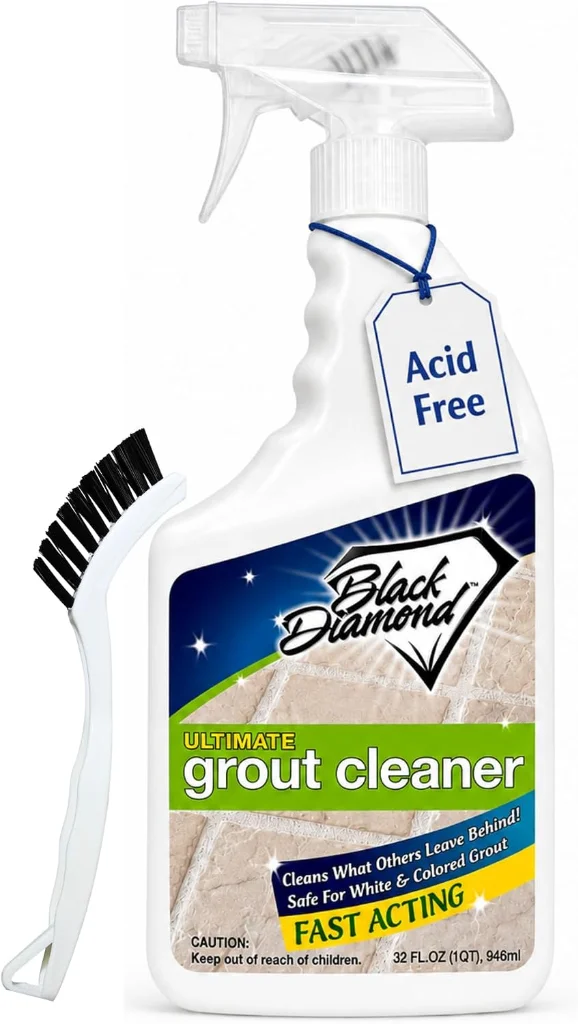
- 100% Acid-Free Chemistry: Safe for white and colored cementitious grout. Dissolves grease, soap scum, and grime without reacting with calcium carbonate or weakening cement binders.
- Rapid Capillary Penetration: Emulsifies deep grease deposits within 3 minutes of dwell time. Lets you rinse with gentle 800 PSI pressure rather than gouging joints.
- Non-Etching on Glazed Surfaces: Safe on porcelain, ceramic, granite, and polished quartz tiles where harsh acid cleaners cause permanent chemical hazing.
- Prepares Grout for Resealing: Leaves zero surfactant residue or sticky film. Lets penetrating fluoropolymer sealers anchor directly to cured silicate pores.
How to Clean Outdoor Patio Tile with Pressure Washer: Step-by-Step Field Guide
Whether you're tackling exterior patio tile, pool surround pavers, or using an enclosed extractor indoors, follow this step-by-step contractor protocol to protect your floors:
- Do the Screwdriver Scratch Test: Check your grout joints before spraying a drop of water. Run a flathead screwdriver or stiff scraper gently along a few lines. If the mortar is soft, crumbly, or cracked, stop right there. Pressurized water will blow out loose chunks and flood the slab. Repair failing joints and let fresh grout cure for 72 hours before washing.
- Apply Alkaline Pre-Treatment and Let It Dwell: Lay down an acid-free alkaline tile cleaner (pH 9.0 to 11.0) using a pump sprayer. Give it 8 to 10 minutes to emulsify oily dirt. For heavily soiled outdoor patios or cleft slate, agitate with a stiff nylon brush. Keep the floor wet. Never let alkaline chemicals dry on the tile.
- Dial Your Pressure Down to 800–1,000 PSI: Check your gauge before opening the trigger. What's the best psi for cleaning tile floors? Keep it strictly between 800 and 1,000 PSI. Drop your unloader setting or swap in larger #4.0 or #5.0 nozzles to bypass excess pressure. Don't blast it.
- Make Smooth 45-Degree Overlapping Passes: Hook up your enclosed spinner wand. Walk the tool in smooth, overlapping passes at a 45-degree angle to the grout grid. Running diagonally stops the rotor nozzles from tracking parallel down joint lines. That prevents edge chipping and leaves a crisp, uniform finish.
- Wait 24 to 48 Hours for Complete Drying: Cement grout drinks water like a dry sponge. Don't rush to seal it. Trapping moisture under fresh sealer causes foggy white efflorescence and flaking. Let the floor dry for 24 to 48 hours until core moisture drops below 3%.
- Reseal with an Impregnating Fluoropolymer: Grab an applicator bottle fitted with a roller wheel. Lay a penetrating fluoropolymer or silane-siloxane sealer directly along each dry grout line. The chemistry wicks deep into capillary pores. It repels oil, grease, and dirty mop water without leaving a tacky film that peels off.