
Surface Cleaner Size Calculator: Match Deck Diameter to Your GPM
Buying an oversized surface cleaner is the most common reason concrete driveways end up with permanent, etched tiger stripes. If your pressure washer does not supply enough water flow (GPM), the internal spray bar drags and spins too slowly to clean evenly. This free calculator uses your machine's true flow rate and pressure to find your maximum safe deck size, verify spray tip speeds, and prevent striping before you buy or rent.
Why Water Flow (GPM) Dictates Surface Cleaner Size
A rotary surface cleaner has no motor or electric engine. It spins entirely on the hydraulic force of water blasting out of its angled spray tips. If your pressure washer only pushes 2.5 GPM, it lacks the fluid volume needed to whip a heavy 18-inch or 20-inch bar around. The bar slows to a crawl, dragging across the concrete and leaving ugly spiral streaks. If you plan to run commercial 16-inch to 20-inch cleaners, read why water volume is essential in our 4 GPM Pressure Washer Guide. To see real-world performance tests of top attachments, check our breakdown of the 7 Best Pressure Washer Surface Cleaners.
The "4 Inches Per GPM" Rule Explained Simply
To guarantee smooth, stripe-free concrete cleaning, professional contractors follow a proven golden rule: multiply your machine's GPM by 4 to find your maximum safe deck diameter in inches (Diameter = GPM × 4). A standard 2.5 GPM homeowner unit safely powers a 10-inch deck, while a 4.0 GPM commercial washer easily spins a 16-inch disc. Enter your pressure washer flow below to see your optimal match and check your risk on the live speedometer gauge.
Surface Cleaner Size & Tiger Stripe Risk Calculator
Your selected 20" surface cleaner requires at least 5.0 GPM to spin effectively. With your 2.5 GPM machine, the spray bar will spin too slowly and drag, etching permanent circular tiger stripes into the concrete.
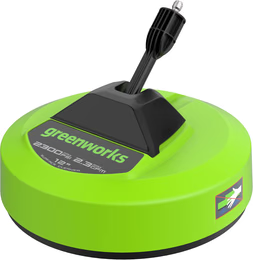
Greenworks 12" Surface Cleaner
The ideal matched diameter for machines producing up to 3.0 GPM. Spins freely without lagging or leaving etched overlap ridges.
Surface Cleaner Sizing & Nozzle Specification Chart
Matching your pressure washer to the correct surface cleaner deck size ensures the internal spray bar maintains high rotational speed (1,500 to 2,500 RPM) while delivering enough cleaning impact to wash away grime on the first pass. The table below outlines the recommended deck sizes, factory nozzle specs, and realistic production speeds across standard machine flow rates:
| Machine Flow (GPM) | Ideal Deck Size | Maximum Safe Size | Dual Nozzle Size (Per Tip) | Minimum PSI Required | Cleaning Speed (Sq Ft / Hr) |
|---|---|---|---|---|---|
| 2.0 – 2.5 GPM | 10 Inches | 12 Inches | 25015 (1.5 orifice) | 2,000 – 2,800 PSI | 400 – 600 sq. ft./hr |
| 3.0 – 3.5 GPM | 12 Inches | 14 Inches | 25020 (2.0 orifice) | 2,500 – 3,200 PSI | 800 – 1,200 sq. ft./hr |
| 4.0 GPM | 16 Inches | 18 Inches | 25020 (2.0 orifice) | 3,000 – 4,000 PSI | 1,500 – 2,200 sq. ft./hr |
| 5.5 GPM | 20 Inches | 22 Inches | 25030 (3.0 orifice) | 3,000 – 4,000 PSI | 2,500 – 3,200 sq. ft./hr |
| 8.0+ GPM | 24 Inches | 28 – 30 Inches | 25040 (4.0 orifice) | 3,000 – 3,500 PSI | 3,500 – 5,000 sq. ft./hr |
💡 Why Bigger Is Not Always Faster
It is tempting to think a 20-inch cleaner will finish your driveway twice as fast as a 12-inch cleaner. But if you connect a 20-inch deck to a 2.5 GPM machine, the bar spins so sluggishly that you have to walk in extreme slow motion to avoid striping. A properly matched 12-inch cleaner running at full RPM cleans significantly faster and leaves a flawless, uniform finish.
What Causes Tiger Stripes (and How to Prevent Them)
"Tiger stripes" (also known as zebra striping or swirl marks) are unsightly light-and-dark bands etched across concrete flatwork. They happen when water does not clean the surface evenly across the entire circular sweep of the spray nozzles. Here are the four primary causes and how to eliminate them:
- Walking Too Fast for Your Flow Rate: Even with a perfectly sized attachment, moving faster than 1 to 2 feet per second outpaces the spinning bar. As you walk forward, the nozzles spend more time along the outer edges of the circle than in the middle, leaving unwashed streaks. Always maintain a steady walking cadence and overlap each path by 50%.
- Partially Clogged Spray Nozzles: A rotary surface cleaner relies on equal thrust from both nozzles to stay balanced. If a tiny piece of sand, rust, or mineral scale lodges in one nozzle, that tip loses flow. The bar immediately loses rotational speed, starts vibrating violently, and cuts helical grooves into the concrete.
- Undersized GPM (The Rotational Drag Problem): Pressure (PSI) cuts dirt loose, but water flow (GPM) is what spins the rotor arm. If you push a large deck with low GPM, the water volume simply cannot overcome the mechanical friction of the central swivel and air resistance inside the housing.
- Skipping Chemical Pre-Treatment: Blasting baked-in organic algae with pure mechanical water pressure requires slow, overlapping passes that increase striping risks. Applying a light pre-treatment mix of sodium hypochlorite (SH) bleach loosens the organic bond in 10 minutes. Use our free Chemical Dilution Calculator to dial in safe pre-treat ratios.
How to Size & Replace Surface Cleaner Spray Bar Nozzles
Many homeowners and contractors do not realize that surface cleaner nozzles wear out over time or come from the factory equipped with tips meant for higher-GPM machines. Sizing replacement spray tips correctly is critical for maintaining maximum pressure without putting your pump into bypass:
Decoding Nozzle Part Numbers: Surface cleaner tips use standard 5-digit laser-etched codes (such as 25020 or 15020):
- The First Two Digits (Spray Angle):
25represents a 25-degree fan pattern. This is the universal standard for surface cleaners because it balances cleaning width with downward cutting impact. - The Last Three Digits (Orifice Size):
020represents a 2.0 orifice rating, which flows approximately 2.0 GPM at 4,000 PSI.
⚠️ The Two-Nozzle Division Rule
Because surface cleaners have two spray nozzles on the spinning bar, you must divide your pressure washer's total GPM by 2. If you have a 4.0 GPM machine, you need two 25020 nozzles (2.0 + 2.0 = 4.0 GPM). If you mistakenly install two 4.0 nozzles, your machine's pressure will drop from 3,500 PSI down to roughly 1,200 PSI. Conversely, installing tips that are too small will choke your pump and trigger the unloader valve into bypass.
Surface Material Tolerances: When NOT to Use a Surface Cleaner
While rotary surface cleaners are unmatched on cured concrete, using them on inappropriate surfaces can cause thousands of dollars in permanent property damage:
- Fresh Concrete (Under 1 Year Old): Newly poured concrete takes up to 12 months to cure to full compressive strength. The top microscopic layer (called the "cream") is soft. Spinning high-pressure tips will strip the cream away, permanently exposing coarse aggregate and sand. Clean fresh concrete only with low pressure (<1,200 PSI) and a wide fan tip.
- Paver Patios & Natural Flagstone: Rotary surface cleaners will instantly blast polymeric joint sand out from between pavers, causing pavers to shift and sink. Use a low-pressure wand rinse or prepare to re-sweep joint sand after washing.
- Exposed Aggregate & Stamped Concrete: Check decorative stamped concrete for intact acrylic sealer before cleaning. High rotary pressure can chip peeling sealer and create cloudy white blemishes.
- Hose & Pressure Diagnostic: If your surface cleaner feels sluggish even with the right GPM, your hose length might be dropping line pressure. Check our Hose Friction Loss Calculator to ensure your line delivers full power. If you are calculating chemical costs and time for an upcoming project, try our Pressure Washing Estimate Calculator.

Surface Cleaner Sizing & Tiger Striping FAQs
What causes tiger striping on concrete when using a surface cleaner?
Tiger striping is caused by an imbalance between your walking speed and the rotational speed (RPM) of the surface cleaner's spray bar. When an undersized pressure washer (low GPM) is paired with an oversized deck, the bar spins too slowly to overlap its circular cleaning paths, leaving uncleaned lines etched into the concrete. Other common causes include walking faster than 1–2 feet per second, partially clogged nozzles, or failing to maintain a 50% overlap between passes.
How do I size replacement nozzles for my rotary surface cleaner?
Surface cleaner nozzles are sized by dividing your pressure washer's total GPM by the number of spray nozzles (usually two). For example, a 4.0 GPM pressure washer with a 2-nozzle bar requires two size 2.0 nozzles (4.0 ÷ 2 = 2.0). In standard nozzle codes like 25020, the first two digits represent the 25-degree spray fan angle and the last three digits indicate the 2.0 orifice rating. Never install nozzles rated for your machine's full GPM on both sides, or your operating pressure will collapse.
Can I use a 20-inch surface cleaner with a 2.5 or 3.0 GPM pressure washer?
No. A 20-inch surface cleaner requires a minimum of 5.0 GPM to generate sufficient rotational thrust and tip speed. Running a 20-inch cleaner on a 2.5 or 3.0 GPM unit causes the spray bar to rotate at sluggish speeds, forcing you to walk at a crawl and practically guaranteeing circular tiger stripes and surface cleaner chatter.
Why is my surface cleaner floating or lifting off the concrete?
A surface cleaner hovers or lifts uncontrollably when its spray nozzles are angled too steeply toward the ground or when the nozzle orifices are too small for the pressure washer, generating excessive vertical lift rather than horizontal rotational spin. Verify that your nozzles are angled slightly backward to propel the bar in a circle and that the nozzle orifice size matches your pump's flow rating.
How can I fix or remove tiger stripes that are already etched into concrete?
If the striping is organic (unevenly cleaned algae and grime), apply a post-treatment spray of 2% to 3% sodium hypochlorite (SH) bleach using our Chemical Dilution Calculator. The chemical will dwell for 15 minutes and dissolve the shaded lines without needing further high pressure. If the cream layer of the concrete was physically etched by excessive PSI, the damage is structural; allowing natural weathering or applying a penetrating concrete stain is the best remedy.