
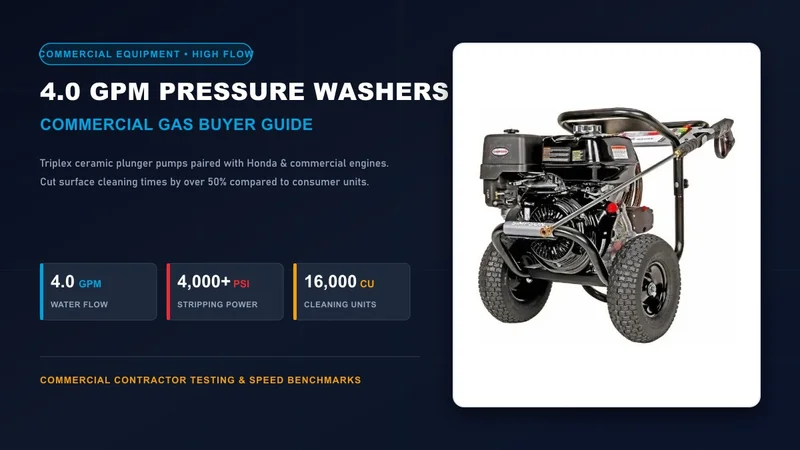
In exterior cleaning, water pressure (PSI) strips dirt, but water volume (GPM) carries it away. If you want to clean large concrete driveways, strip multi-story commercial siding, or run a 16-inch rotary surface cleaner without leaving tiger stripes, 4.0 Gallons Per Minute (GPM) is the professional gold standard. A 4.0 GPM machine cleans roughly three times faster than a standard 1.5 GPM residential electric washer, cutting a four-hour driveway marathon into a 45-minute breeze.
Quick Verdict: Top 4.0 GPM Contenders
- The Contractor Benchmark: SIMPSON PowerShot PS4240 — Powered by the legendary Honda GX390 commercial engine and an industrial AAA triplex ceramic plunger pump. Built for daily commercial duty.
- Best Value for Raw Power: Westinghouse WPX4400 — Massive 420cc 4-stroke engine delivering 4.2 GPM and 4,400 PSI on a heavy-duty steel tube cart.
- Commercial Fleet Workhorse: Champion Power Equipment 4200 PSI — Reliable 389cc OHV engine with integrated low-oil sensor and commercial brass triplex pump.
Mechanical Engineer's Note: The 13-Horsepower Physics Behind 4 GPM
Do not fall for retail marketing claims from budget online brands advertising "4 GPM electric pressure washers" that plug into a standard 120V wall socket. In fluid power mechanics, pressure and water volume require raw horsepower:
Pumping 4.0 GPM at 4,000 PSI requires 9.33 Hydraulic Horsepower. After factoring in mechanical friction and pump transmission losses, driving that pump requires a 13 HP gas engine (roughly 390cc to 420cc). A standard 120V 15A wall outlet caps out at 1.8 HP total.
True 4 GPM pressure washers are almost exclusively gas-powered commercial units or stationary industrial 240V or 480V high-voltage systems. If an electric washer claims 4 GPM on a standard 15-amp plug, it is measuring open-flow garden hose trickle with zero pressure nozzle attached.
Why 4.0 GPM Changes Everything for Flatwork & Washing Speed
1. Three Times Faster Surface Cleaning
Surface cleaners spin two angled nozzles beneath a hover dome. The standard rule of thumb is 4 inches of deck diameter per 1.0 GPM of machine flow. A small 2.0 GPM machine can only spin an 8-inch cleaner. A 4.0 GPM pressure washer easily spins a commercial 16-inch or 18-inch surface cleaner, letting you walk at a steady, comfortable pace while clearing a huge path in a single pass. To estimate project duration, test your numbers in our free Project Estimator Calculator.
2. Long-Distance Chemical Siphoning & Soft Washing
Downstream chemical injectors rely on the venturi effect. At 4.0 GPM, fluid velocity through your hose is high enough to pull soap through 150 to 200 feet of high-pressure hose without losing chemical draw. You can leave your pressure washer in your truck or driveway and carry just the spray gun around the entire house.
3. Heavy-Duty Triplex Ceramic Plunger Pumps
Virtually all genuine 4 GPM machines use commercial ceramic plunger triplex pumps with forged brass heads, rather than residential wobble plates. Ceramic plungers resist heat buildup and abrasive grit wear, giving you a 500-to-1,000-hour service life compared to the 60-to-100-hour lifespan of entry-level consumer pumps.
Top 4 Gallons Per Minute Pressure Washers
Here is an honest engineering breakdown of the leading 4 GPM machines available today:
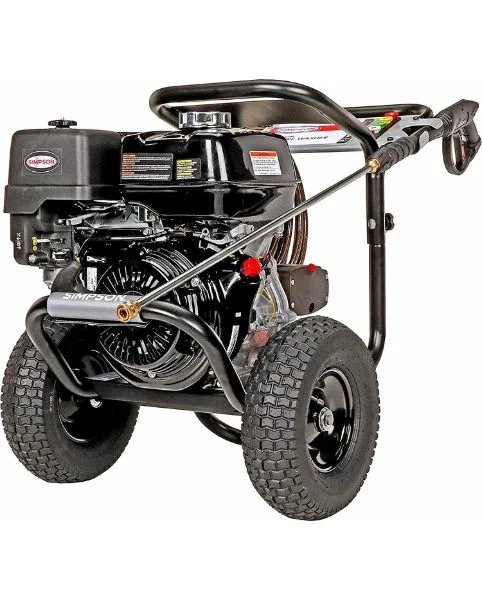
- Commercial Honda GX390 Engine: 389cc overhead valve commercial motor with cast iron cylinder sleeve and low-oil shutdown.
- AAA Industrial Triplex Plunger Pump: Forged brass manifold with ceramic-coated pistons and PowerBoost technology.
- Heavy-Gauge Welded Steel Frame: 13-inch pneumatic tires roll smoothly over construction site mud, lawn turf, and curbs.
- Monster 50ft Steel-Braided Hose: Non-marring high-pressure hose resists kinking and abrasion.
Hands-On Garage Assessment:
The Simpson PS4240 is the machine you see on the back of painting contractor trucks and detailing trailers everywhere. The pairing of a Honda GX390 commercial engine with an industrial triplex pump is the gold standard for reliability. It starts on the first or second pull, idles smoothly, and delivers steady, unrelenting water flow hour after hour.
At 4,200 PSI and 4.0 GPM, this machine has serious kickback. When pulling the trigger, you need two hands firmly planted on the wand. When paired with a 16-inch surface cleaner like those in our best surface cleaners guide, it strips black algae and oil stains off concrete without missing a beat.
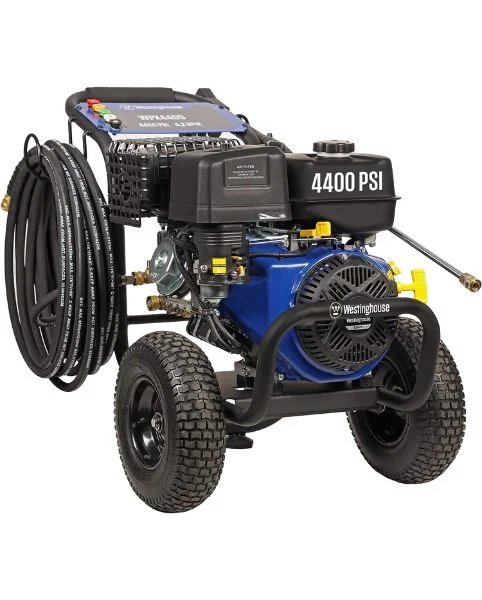
- 420cc 4-Stroke Westinghouse OHV Engine: Massive displacement creates raw torque to push a true 4.2 GPM.
- Commercial Triplex Pump: Adjustable unloader valve allows you to dial down working pressure for delicate painted surfaces.
- Heavy-Duty Steel Cart: Integrated 1-gallon onboard soap reservoir and flat-free tires.
- Complete Nozzle Kit: Includes 5 quick-connect tips (0°, 15°, 25°, 40°, and soap).
Hands-On Garage Assessment:
The Westinghouse WPX4400 is an absolute powerhouse. That 420cc engine produces 4.2 GPM, which gives you over 18,000 Cleaning Units (CU = PSI × GPM). If you are cleaning long farm fences, heavy construction machinery, or multiple driveways in a single day, this machine delivers commercial speed at a competitive consumer price.
Because it generates 4,400 PSI peak pressure, you must exercise caution: never use the 0-degree red tip or 15-degree yellow tip on wood decks or car paint. For concrete cleaning, its adjustable unloader lets you dial the pressure back to a safe 3,000 PSI while keeping the full 4.2 GPM water flow.
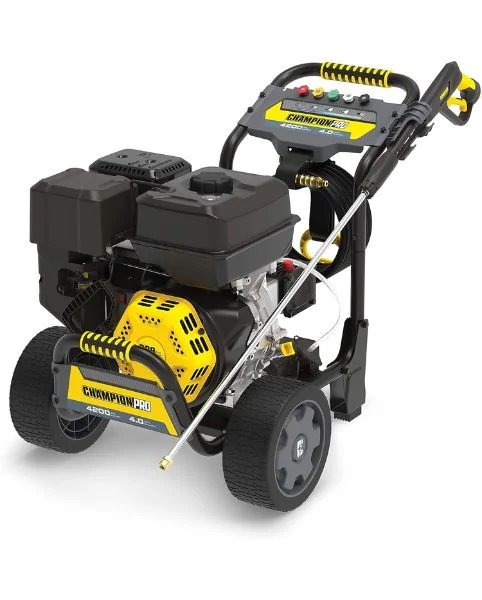
- 389cc Champion OHV Engine: Reliable commercial-grade motor with easy-pull recoil and low-oil shutoff sensor.
- Annovi Reverberi (AR) Brass Triplex Pump: Italian pump engineering renowned for long seal life and easily available rebuild kits.
- 50ft Commercial Rubber Hose: High-pressure braided hose that will not scuff or leave black streaks on concrete.
- Ergonomic Hand Cart Frame: Wide stance and 13-inch tires make rolling through grass and dirt easy.
Hands-On Garage Assessment:
Champion's 4200 PSI unit pairs their reliable 389cc engine with a genuine Annovi Reverberi (AR) triplex pump. AR pumps are well known in the pressure washing industry because replacement water seal packings and check valve kits are readily available at any equipment supply store. If you maintain your pump oil properly, this machine will provide years of heavy service.
Water Supply Requirements: Can Your Home Spigot Support 4 GPM?
Before purchasing any 4.0 GPM pressure washer, you must check your home's water supply. If you connect a 4.0 GPM pump to an outdoor spigot that only delivers 3.0 GPM, the pump will starve for water within seconds.
When an axial or triplex pump is starved, localized vacuum pockets form inside the brass manifold, causing pump cavitation. Vapor bubbles collapse against the ceramic pistons with explosive force, pitting the metal and chewing through high-pressure water seals within hours.
How to Test Your Garden Spigot in 60 Seconds (The Bucket Test)
- Grab a standard 5-gallon plastic utility bucket.
- Connect your regular garden hose to the outdoor spigot you plan to use.
- Turn the spigot valve fully open and time exactly how many seconds it takes to fill the bucket to the 5-gallon mark.
- Calculate your flow rate: (300 / seconds to fill) = Your Spigot GPM.
- If your bucket fills in 60 seconds, your flow rate is 5.0 GPM (safe for a 4.0 GPM machine). If it takes longer than 70 seconds (less than 4.3 GPM), your spigot cannot safely feed a 4.0 GPM pump directly without a buffer supply tank.
Always feed 4 GPM pumps through a 3/4-inch internal diameter garden hose rather than a standard 5/8-inch or 1/2-inch hose to minimize fluid friction on the intake side. For fitting specifications and quick connects, refer to our Pressure Washer Fittings Guide.
Final Engineering Verdict
If you clean large flat concrete areas, commercial buildings, or heavy equipment, upgrading to a genuine 4.0 GPM gas machine is the best investment you can make. The SIMPSON PowerShot PS4240 with its Honda GX390 engine remains our top recommendation for long-term commercial reliability. If maximum pressure per dollar is your priority, the Westinghouse WPX4400 provides unmatched raw power.