
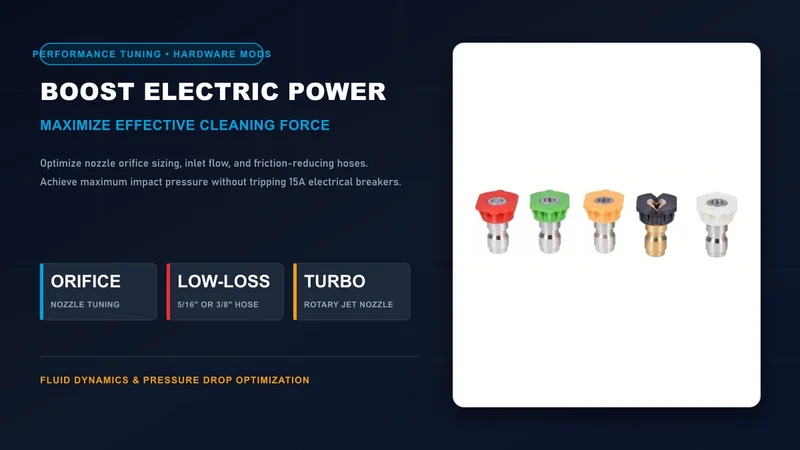
Let's be direct: you can't magically double motor horsepower on a 120-volt plug. But you can easily claw back 200 to 300 PSI of wasted force by killing hydraulic drag and fixing nozzle mismatches. Standard household outlets cap out at 15 amps (1,800 watts max). That's a hard physics wall. Yet factory machines bleed massive working pressure through skinny 1/4-inch plastic lines, choked foam jets, and cheap guns. We can reclaim that lost punch right now.
If you've ever asked, "Why does my electric pressure washer feel weak?", you aren't crazy. Pull the trigger on a stock Ryobi, Sun Joe, or Greenworks. It feels like an aggressive garden hose. You see terrible advice online about stretching unloader springs. Don't do that. You'll burn the motor. You can't cheat the circuit breaker. But you can stop choking pump flow.
In North America, your wall circuit tops out at 1,800 Watts (120 Volts × 15 Amps). Under steady motor load, the breaker wants to see 12 Amps (1,440 Watts). Factor in normal electric motor efficiency (75% to 80%). That leaves your pump with roughly 1.6 to 1.9 mechanical shaft horsepower:
The Hydraulic Horsepower Equation & The 15-Amp Ceiling
In fluid mechanics, water power follows one clean formula:
With 1.88 shaft horsepower at the pump, hydraulic output caps around 2,415 Cleaning Units. At 1.2 GPM, maximum working pressure is 2,012 PSI. Push that flow to 1.8 GPM, and pressure drops to 1,341 PSI. You can choose high pressure or high flow. You can't have both on a 15-amp circuit.
Retail box ratings are pure marketing fiction. A claim like "3,000 PSI at 2.0 GPM" on 120 volts requires 3.5 hydraulic HP. That pulls over 3,250 watts. It'll trip a breaker in two seconds. Manufacturers cheat by rating static spike pressure at zero flow. Or they stick a pinpoint needle nozzle on the lance that chokes flow to a trickle while cooking motor windings.
120V / 15A Electrical Power Curve: Marketing Fiction vs. True Physics
1,800W NEMA 5-15 LIMITPressure vs. Flow envelope for residential electric pressure washers. You cannot cross the blue physics boundary without tripping a 15-amp breaker. The green region shows where you can recover 250+ PSI of parasitic line drag.
Hydraulic Optimization Matrix: Stock Bottlenecks vs. Engineered Upgrades
Forget motor tweaks if you want to know how to get more pressure out of electric washer setups. The secret is cutting fluid drag and focusing stream impact. Factory stock parts strangle pump flow. Here's what's holding your machine back, along with the workbench fixes that free up real cleaning punch:
| Component / Mod | Stock Factory Bottleneck | Optimized Engineering Spec | Real-World Hydraulic Gain | Motor / Amp Draw Impact |
|---|---|---|---|---|
| Discharge Hose | 1/4" ID Narrow PVC (Drops 180–240 PSI over 50 ft) | 3/8" ID Smooth-Bore Rubber / UberFlex | +180 to +220 PSI recovered at spray tip | Reduces pump head load; drops current by ~0.8A |
| Foam Cannon Jet | Generic 1.25mm Orifice (Sluggish venturi at <1.5 GPM) | Calibrated 1.1mm (0.043") Orifice Jet | +40% vacuum suction; thick clinging foam | Zero motor strain; operates within normal duty cycle |
| Spray Nozzle Tip | Standard 25°/40° Fan (Impact dispersed over wide area) | Ceramic Rotary Turbo Nozzle (0° spinning core) | 200% greater point impact force across 25° swath | Maintains identical pump flow and 13.5A motor load |
| Spray Gun & Couplers | 36" Plastic Lance with molded internal barb restrictions | Short Detailing Stubby Gun + 3/8" Stainless Swivel | Eliminates 35 PSI fitting drop; stops hose kinking | Neutral electrical load; stops operator wrist fatigue |
| Electrical Feed | 16 AWG / 14 AWG Extension Cord (Drops voltage to 104V) | Direct NEMA 5-15 Wall Plug or 10 AWG Heavy Cord | Restores 15% pump RPM lost to inductive motor slip | Stops breaker nuisance tripping and motor overheating |
1. Mod #1: Recover 180 to 220 PSI by Upgrading to a 3/8" Smooth-Bore Hose
I hook digital test gauges to consumer electric washers in my shop every week. The friction drop through stock hoses is wild. Customers ask me all the time: does a bigger hose increase pressure? Here's the shop answer. A bigger hose won't make the pump generate more pressure. But it stops the hose line from stealing what's already there.
Water leaves the pump head at 2,000 PSI. But factory units ship with tiny 1/4-inch plastic lines with rough inner walls. Force water through 50 feet of that stiff tubing, and fluid drag burns up 180 to 240 PSI as wasted heat. Your spray gun only gets 1,760 PSI. You're starving your own nozzle. Swap the hose first.
Fluid friction scales with the 5th power of inner pipe diameter. Step up from a 1/4" to a 3/8" bore. Water speed drops from 9.8 feet per second down to 4.3. Wall drag plunges from roughly 210 PSI down to just 18 to 25 PSI over 50 feet. That puts 180+ PSI of hydraulic thrust back onto your driveway. Best part? It doesn't draw a single extra watt from your wall.
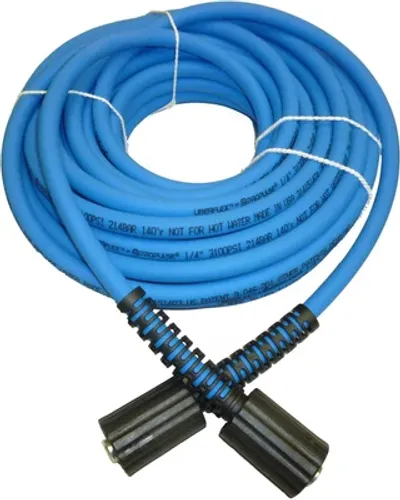
- Eliminates Parasitic Line Drag: The slick polymer liner slashes boundary friction, returning up to 220 PSI of working pressure across 50 feet.
- Zero Coil Memory: Synthetic yarn braiding unrolls dead flat. No fighting coiled spring loops across your driveway.
- Textured Polyurethane Jacket: Takes a beating on concrete pavers without scuffing automotive clear coats.
- Standard M22 Brass Fittings: Molded strain-relief boots prevent sharp bends and kinking right at the pump outlet.
2. Mod #2: Downsize Your Foam Cannon Orifice to 1.1mm for 40% More Suction
Want to know how to make foam cannon thicker on an electric washer? Stop buying boutique soaps. Your foam cannon just has the wrong brass jet inside. Nearly every cheap foam cannon ships with a 1.25mm orifice jet. Those jets are made for gas rigs pushing 3.0 to 4.0 GPM.
Foam cannons rely on the Venturi effect. High-speed water shoots across a narrow chamber, creating vacuum suction that pulls soap up the pickup tube. But an electric washer pushes only 1.2 GPM. Through a wide 1.25mm hole, that water moves too slowly to generate real vacuum. Siphon draw stalls out. You get runny soap that dribbles right off your car.
The fix takes two minutes and costs ten bucks. Swap that factory jet for a 1.1mm (0.043-inch) orifice jet. That small 0.15mm drop shrinks throat area by 22.5%. Fluid velocity surges across the suction chamber. Vacuum pull jumps by over 40%. Instantly, your small electric rig shoots thick shaving-cream foam that clings to clear coat for ten minutes flat.
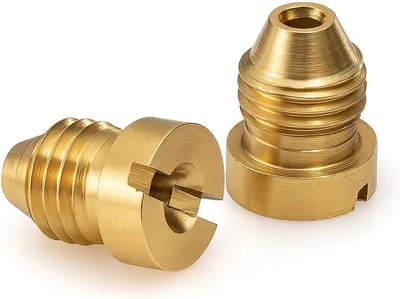
- Tuned for Low-GPM Electric Pumps: Built for 1.0 to 1.8 GPM units where factory 1.25mm jets fail to pull enough siphon suction.
- 22.5% Venturi Throat Reduction: Speeds up water through the induction throat to yank heavy soap concentrate up the tube.
- Solid Machined Brass: Precision CNC threads and a clean screwdriver slot make for a leak-free two-minute install.
- Universal Fit: Drops straight into Tool Daily, MATCC, Fasmov, McKillans, and generic Amazon foam cannon bodies.
3. Mod #3: Fit a Rotary Turbo Nozzle for 200% Stripping Force
Tackling moldy concrete, greasy pavers, or peeling deck paint? Leave the green 25-degree and white 40-degree fan tips in the holder. A fan tip spreads 1,800 PSI over a wide pattern. Impact pressure at the surface drops to just 90 to 120 PSI. It feels weak because cleaning energy is diluted.
Grab a rotary turbo nozzle instead. Inside, a ceramic 0-degree pinpoint jet spins inside a circular race at over 3,000 RPM. It carves a tight 25-degree cone:
- Zero-Degree Strike Force: Water hits the concrete as a solid pinpoint stream. You get 100% of the pump's hydraulic impact right at the contact point.
- No Zebra Striping: The spinning cone sweeps across the surface at high speed. You get deep cleaning without the gouges and lines of a stationary red tip.
- Double the Stripping Speed: On brick and concrete, an 1,800 PSI electric unit with a turbo nozzle matches a 2,800 PSI gas rig running a fan tip. It draws zero extra watts.
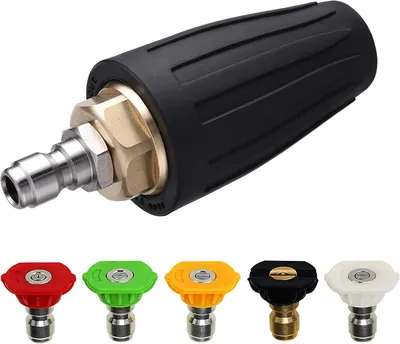
- Concentrated Mechanical Stripping: Turns pump pressure into a rotating 0° pencil jet that cuts driveway cleaning time in half.
- Ceramic Rotor & Brass Housing: Heavy ceramic core resists wear and internal water cavitation up to 4,000 PSI.
- Standard 1/4" Quick-Connect: Snaps directly into any common spray lance or stubby gun in one second.
- Matched #2.5 to #3.0 Orifice: Sized to hold full pressure on electric units without triggering unloader bypass.
4. Mod #4: Stainless Steel Quick-Connects & Short Detailing Gun
One of the best upgrades for Ryobi electric pressure washer rigs and Sun Joe units is trashing the floppy three-foot plastic wand. Those factory wands hurt performance in two big ways:
- Internal Fitting Choke: Factory wand stems choke down to 0.18-inch internal passages. Shoving 1.5 GPM through rough plastic edges creates severe turbulence. That robs you of 25 to 35 PSI before water even hits the tip.
- Hose Kinking: Threaded plastic collars can't rotate. As you walk around a car or patio, the hose winds up like a spring. It twists into tight loops, kinks hard, and chokes pump flow.
Upgrade to a full-flow stainless steel M22 quick-connect kit with an integrated 360-degree swivel. Couple that with a compact stubby gun. You get full water flow, no wrist strain, and zero hose kinks.
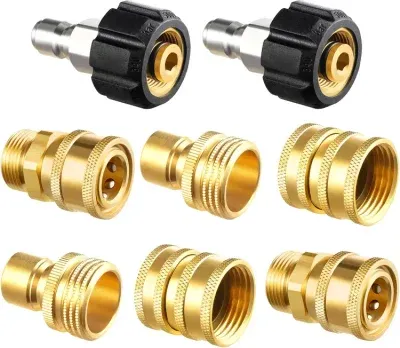
- Full-Port Flow Path: Wide internal stainless passages eliminate up to 35 PSI of fitting friction at the gun inlet.
- 304 Stainless Steel: Resists thread galling, rust, and harsh soaps up to 5,000 PSI without leaking.
- One-Second Click-In: Ditch threaded screw collars for commercial snap-lock couplers on your pump, hose, and gun.
- Dual Viton O-Rings: Tough 90A seals stop coupler leaks and maintain steady line pressure all day.
Dial In Your Rig With Our Engineering Calculators
Run your machine specs through our free shop calculators before buying hardware. Dial in your line friction drop over any hose run. Size your nozzle orifice to match pump output without tripping breakers:
Engineer's Bill of Materials (BOM): The Power Recovery Kit
Here's the complete hardware list to transform a stock electric pressure washer into a low-drag, high-output rig:
| Part Name | Thread / Orifice Spec | Engineering Purpose | Verified Amazon Link |
|---|---|---|---|
| ProPulse UberFlex Hose (50 ft) | 1/4" - 3/8" ID / M22-14mm Ends | Recovers 180–220 PSI of parasitic pipe friction; eliminates coil memory loops | VIEW ON AMAZON |
| 1.1mm Foam Cannon Orifice Jet | 1.1mm (0.043") / 1/4" NPT Male | Drops venturi area by 22.5%, accelerating velocity to pull 40% thicker foam | VIEW ON AMAZON |
| Commercial Rotary Turbo Nozzle | #2.5 - #3.0 Orifice / 1/4" QC Plug | Spins a 0° pinpoint jet at 3,000 RPM, doubling scouring impact on concrete | VIEW ON AMAZON |
| M22 Quick-Connect Kit | M22-14mm to 3/8" & 1/4" QC | Full-flow stainless construction removes 35 PSI fitting drop and stops hose twist | VIEW ON AMAZON |
Dangerous "Mods" That Destroy Electric Pressure Washers
Don't fall for internet hacks. Tinkering with an electric washer the wrong way will kill it fast. Here are three costly mistakes I see DIYers drag into my shop:
- Cranking Down the Unloader Valve Nut: The unloader valve is a safety bypass. It's not a throttle screw. Cranking that nut down forces the motor to fight trapped pressure. Current spikes past 18 amps, tripping breakers and frying windings. Worse, when you release the trigger, pressure spikes can pass 4,000 PSI. That will crack an aluminum pump head instantly.
- Forcing Tiny #1.5 or #1.8 Nozzles: Cramming an undersized nozzle onto the wand backfires every time. Positive displacement pumps must move water. If the tip is too small, excess water bypasses back into the pump manifold while you spray. That recirculating loop rapidly heats past 140°F. Your rubber packings melt in ten minutes.
- Using Cheap 16-Gauge Extension Cords: Electric motors hate voltage drop. Run a thin 50-foot or 100-foot lamp cord, and voltage drops from 120V down to 104V. To keep turning, the motor draws more amps. The motor overheats, trips internal thermal fuses, and burns out. Plug right into a wall outlet, or use a heavy 10-gauge or 12-gauge cord under 50 feet.
The Garage Verdict: Realistic Power Gains
You don't need a loud 4,000 PSI gas rig to wash vehicles, clean siding, or strip patio flagstone. Stop waiting for an electrical miracle on a 15-amp breaker. Instead, stop tossing away 250+ PSI to line friction. Swap the stock hose for a 3/8" smooth-bore line. Drop a 1.1mm orifice jet into your foam cannon. Snap on a rotary turbo nozzle for concrete. Keep your electrical feed heavy. Your washer will feel punchier, strip grime faster, and run reliably for years.