A pressure washer is only as good as its weakest connection. If your hose collar sprays water across your boots, or your 3,000 PSI machine suddenly feels weak at the wand, you are usually fighting a fitting mismatch or hose line loss. At 3,000 to 4,000 PSI, water does not act like a gentle garden hose; it acts like a high-speed hydraulic jet. A tiny 1-millimeter gap will chew through a rubber O-ring in seconds. And forcing water through a skinny 1/4-inch hose steals hundreds of pounds of pressure before water ever touches the driveway.
In this guide, we break down high-pressure plumbing from pump to nozzle tip. You will learn why Teflon tape on M22 threads never stops leaks, why skinny hoses kill pump power, why wrapping a blown hose in duct tape is a hospital emergency waiting to happen, and how to convert your entire setup to commercial 3/8-inch quick-connects in fifteen minutes.
Key Engineering Takeaways for High-Pressure Plumbing
- M22 Threads Do Not Seal Fluid: The screw threads only clamp the brass pieces together. The real seal happens inside on a smooth cylindrical brass stem with a rubber O-ring.
- The 14mm vs. 15mm Trap: Plugging a 14mm hose onto a 15mm pump stem leaves an unsealed 1.0mm gap. At 2,000+ PSI, your O-ring squishes through that gap like playdough and tears apart.
- The Fifth-Power Hose Drag: Water friction drops with the fifth power of the hose bore. Moving from a 1/4" to a 3/8" hose cuts line friction by over 80%.
- The 4:1 Safety Factor Rule: High-pressure hoses must hold four times their working pressure before bursting. A 4,000 PSI hose requires a 16,000 PSI burst limit to protect you from skin-piercing water jets.
- Nozzles Set Your Real Pressure: Turning an engine knob will not give you more pressure. Working pressure depends on pump water volume forced through the tiny spray tip hole.
1. Thread & Coupler Engineering Taxonomy (M22, NPT, QC & GHT)
The single most common mistake I see on wash jobs is assuming that all screw-on fittings work like household plumbing. People grab white Teflon tape, wrap it twenty times around an M22 hose collar, wrench it down with pliers, and wonder why water still shoots out all over their boots.
Here is why: pressure washer fittings use three completely different mechanical seals:
- Radial Barrel Seal (M22 Metric): The threads are straight metric spirals ($M22 \times 1.5\text{mm}$). They hold zero water pressure. The seal happens entirely when a smooth brass stem plunges into an internal bore. A rubber O-ring sits in a groove on that stem and expands against the inner wall. Putting Teflon tape on the outside threads does nothing to stop water leaking around the inner stem.
- Tapered Thread Wedge (NPT Pipe Thread): National Pipe Taper threads have a slight cone shape (1° 47' taper). As you tighten male and female fittings, the metal threads crush together to make a seal. Liquid thread sealant or Teflon tape is mandatory here to fill tiny gaps in the metal spirals.
- End-Face Compression (GHT Garden Hose): Garden hose threads ($3/4\text{" GHT}$) are coarse straight threads. They seal simply by squishing a soft rubber washer flat against the bottom rim of the female brass fitting.
Deep Dive: M22-14mm vs. M22-15mm Compatibility Matrix
Wondering whether your specific machine uses a 14mm or 15mm stem? Review our brand-by-brand breakdown covering Sun Joe, Simpson, Ryobi, Kärcher, and Greenworks:
READ M22-14mm VS 15mm GUIDE →Master Dimensional Specification Table
Every fitting on your pressure washer follows one of five standardized plumbing specifications. Use this lookup table before ordering aftermarket hoses, guns, or foam cannons:
| Coupler Standard | Thread / Socket Spec | Internal Stem / Plug OD | Sealing Interface | Typical Equipment Location |
|---|---|---|---|---|
| M22-14mm (Standard) | M22 × 1.5mm Metric Straight | 14.0 mm Smooth Cylindrical Stem | Radial O-Ring (Buna-N / Viton) | Gas units (Simpson, Honda, CRX), commercial electrics (Active 2.0/2.3) |
| M22-15mm (Specialty) | M22 × 1.5mm Metric Straight | 15.0 mm Smooth Cylindrical Stem | Radial O-Ring (Buna-N / Viton) | Residential electrics (Sun Joe SPX, AR Blue Clean, Ryobi electric) |
| 3/8" Quick-Connect (QC) | ISO 7241-B Ball-Lock Plug | 14.8 mm Plug Tip / 8.9mm Locking Groove | Internal Socket O-Ring + PTFE Backup | Commercial hose ends, unloader outlets, high-pressure ball valves |
| 1/4" Quick-Connect (QC) | 1/4" Industrial Interchange | 11.7 mm Plug Tip / 7.1mm Locking Groove | Internal Socket O-Ring | Wand spray nozzles, foam cannons, turbo nozzles, undercarriage brooms |
| 3/8" & 1/4" NPT | National Pipe Taper (60° Thread) | Tapered threaded shaft (18 TPI) | Metal-to-metal flank crushing + PTFE | Pump head manifolds, unloader blocks, pressure gauge stems |
| 3/4" GHT | Garden Hose Thread (11.5 TPI Straight) | 1.0625" (27mm) Outer Thread Diameter | End-face flat rubber compression washer | Pump water inlet swivel, garden hose spigots, supply filters |
Interactive Fittings & Coupler Finder (30+ Models)
Instantly verify exact pump outlet thread size, gun inlet fittings, and required quick-connect adapters for your specific pressure washer model.
2. Darcy-Weisbach Hydraulic Line Loss: 1/4" vs. 5/16" vs. 3/8" Hose Bore
Ever connect 100 feet of extension hose to your pressure washer and feel like the spray lost its punch? You didn't lose water flow. Water cannot be compressed; every gallon leaving the pump plungers has to come out the spray nozzle. What you lost is working pressure (PSI), eaten up by water scraping against the inside walls of the hose.
In fluid mechanics, we calculate this line drag using the Darcy-Weisbach equation:
Now look at what happens when you change hose diameter. Because fluid velocity ($v$) depends on cross-sectional area, pressure drop scales inversely with the fifth power of the hose inside diameter:
Think of it like drinking a thick milkshake. Sipping through a thin coffee stirrer takes massive lung effort because of wall friction. Drinking through a wide boba straw feels effortless. When you step up from a skinny 1/4-inch ($0.250\text{"}$) hose to a 3/8-inch ($0.375\text{"}$) commercial hose, friction loss drops by over 80%. If you run a 4 GPM washer through 100 feet of 1/4-inch line, you waste over 450 PSI just turning engine power into warm hose rubber before water reaches your nozzle.
High-Pressure Hose Friction Loss Benchmark Matrix (PSI Lost)
The table below shows real-world hydraulic pressure lost strictly to internal fluid shear across smooth thermoplastic and rubber hoses at 68°F (20°C):
| Flow Rate (GPM) | Hose Inner Diameter (ID) | Fluid Velocity (ft/sec) | PSI Lost @ 50 Ft | PSI Lost @ 100 Ft | PSI Lost @ 150 Ft |
|---|---|---|---|---|---|
| 1.5 GPM (Electric Rig) | 1/4" (0.250") | 9.8 ft/s | 35 PSI | 70 PSI | 105 PSI |
| 1.5 GPM (Electric Rig) | 5/16" (0.312") | 6.3 ft/s | 12 PSI | 24 PSI | 36 PSI |
| 1.5 GPM (Electric Rig) | 3/8" (0.375") | 4.4 ft/s | 5 PSI | 10 PSI | 15 PSI |
| 2.5 GPM (Mid-Tier Gas) | 1/4" (0.250") | 16.3 ft/s | 92 PSI | 184 PSI | 276 PSI |
| 2.5 GPM (Mid-Tier Gas) | 5/16" (0.312") | 10.4 ft/s | 31 PSI | 62 PSI | 93 PSI |
| 2.5 GPM (Mid-Tier Gas) | 3/8" (0.375") | 7.3 ft/s | 13 PSI | 26 PSI | 39 PSI |
| 4.0 GPM (Commercial Direct/Belt) | 1/4" (0.250") | 26.1 ft/s | 228 PSI | 456 PSI | 684 PSI |
| 4.0 GPM (Commercial Direct/Belt) | 5/16" (0.312") | 16.7 ft/s | 76 PSI | 152 PSI | 228 PSI |
| 4.0 GPM (Commercial Standard) | 3/8" (0.375") | 11.6 ft/s | 31 PSI | 62 PSI | 93 PSI |
Calculate Your Exact Hose Line Loss Online
Entering custom hose runs, non-standard diameters, or hot-water temperatures? Use our interactive engineering calculator to compute exact pressure drop in seconds:
LAUNCH HOSE FRICTION LOSS CALCULATOR →3. Hose Construction & Materials: PVC vs. Polyurethane vs. Steel Braid
A pressure washer hose is not just a thick garden hose. It is a miniature composite pressure vessel built in three bonded layers:
- The Inner Core: The smooth tube carrying the water. Cheap hoses use rigid PVC that curls into stubborn loops you can't straighten out on chilly mornings. Quality hoses use a flexible thermoplastic elastomer that stays supple even in near-freezing weather.
- The Reinforcement Braid: The structural skeleton that keeps the hose from blowing up like a balloon under pressure. Entry-level hoses use knitted polyester or nylon cords. Commercial hoses wrap the core in one or two braided sleeves of high-tensile carbon steel wire.
- The Outer Jacket: The wear skin that drags over asphalt, concrete, and driveway curbs. Polyurethane jackets slide smoothly without leaving black skid marks on fresh concrete. Heavy commercial rubber jackets handle friction better and won't melt if they briefly brush against a hot engine muffler.
Hose Material Matrix: PVC vs. Polyurethane vs. Steel Wire Braid
| Hose Construction | Weight (per 50 ft) | Flexibility & Handling | Working Pressure | Durability & Heat Limits |
|---|---|---|---|---|
| Rigid PVC Plastic (Stock OEM) | 2.8 lbs (Light) | Stiff; permanent coil memory below 60°F; kinks easily | 2,000–2,500 PSI | Poor. Melts instantly on hot mufflers; cracks in cold weather. |
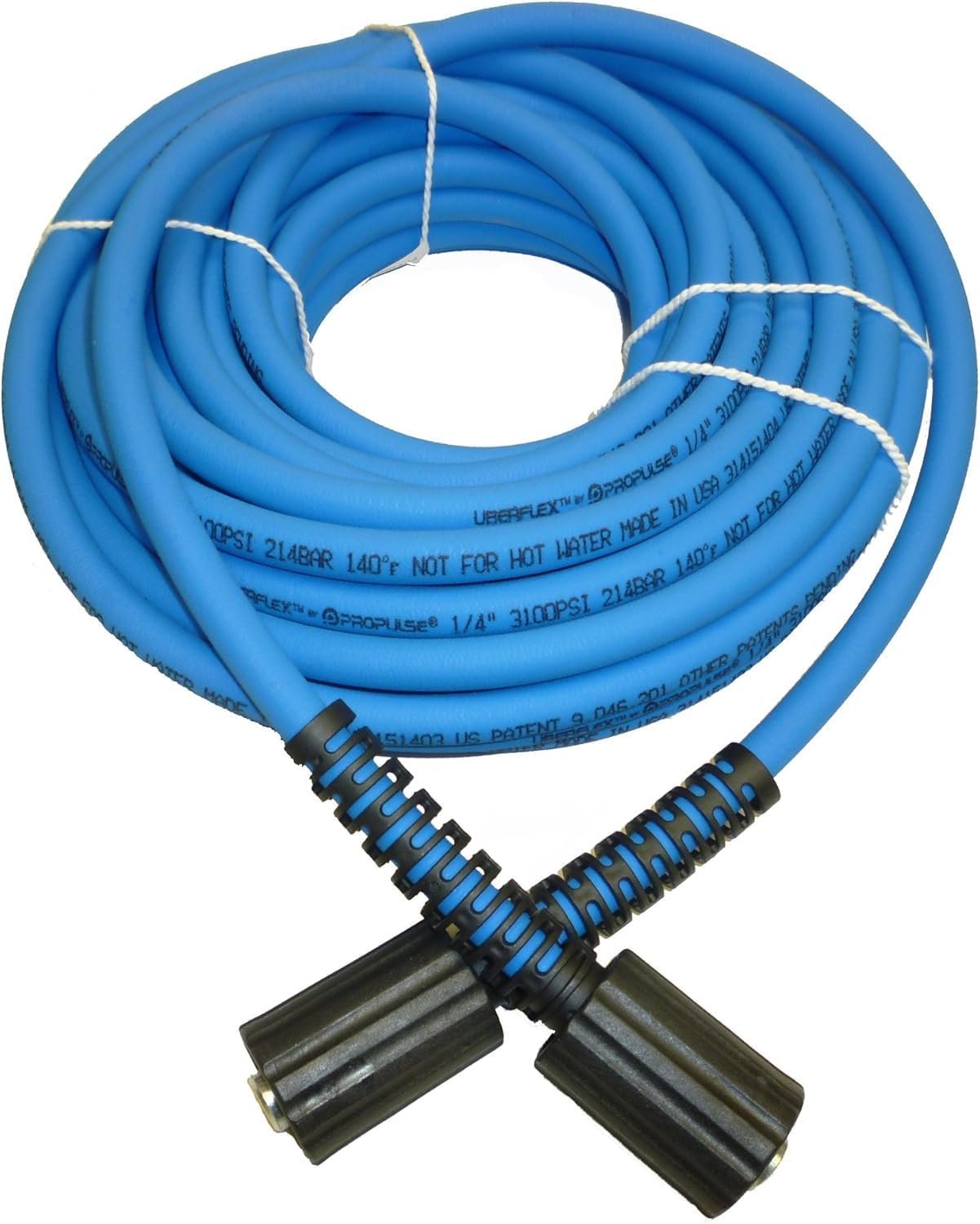
| Thermoplastic Polyurethane (UberFlex) | 3.6 lbs (Lightweight) | Exceptional; zero coil memory; bends tightly without kinking | 3,100–3,700 PSI | High abrasion resistance; non-marking cover. Melts if touching hot exhaust. |
| Single Steel Wire Braid (1-Wire) | 9.5 lbs (Heavy) | Moderate; firmer feel requiring a wider 4" to 5" bend radius | 4,000–4,500 PSI | Industrial grade. Resists dragging over raw concrete, gravel, and curbs. |
| Double Steel Wire Braid (2-Wire) | 14.2 lbs (Very Heavy) | Rigid; industrial commercial use; stiff to handle all day | 6,000–8,000 PSI | Maximum burst security. Handles continuous hot water up to 250°F. |
In-Depth Hardware Teardown: ProPulse UberFlex Review
Looking for a lightweight hose that won't fight you every time you coil it? Read our hands-on review of the ProPulse UberFlex, testing actual bend radius, burst limits, and reel compatibility:
READ UBERFLEX HOSE TEARDOWN →Safety Warning: High-Pressure Pinholes & Injection Injuries
When a pressure washer hose springs a leak, people often try to wrap it in duct tape, silicone tape, or radiator clamps. Never do this. Water escaping through a tiny pinhole at 3,000 PSI cuts like an industrial scalpel. Human skin breaks open at only 100 PSI.
A high-pressure jet shoots straight through work gloves and drives dirty wash water, sand, and oil deep into your hand. At first, the puncture looks harmless—just a tiny red mark that feels like a bee sting. But within a few hours, the trapped fluid triggers severe internal swelling and aggressive bacterial infections that can cost you fingers or a hand. If a hose blows, do not patch it with tape. Cut out the damaged section and install a rated steel hydraulic mender, or replace the hose completely.
Step-by-Step SOP: Safe Pressure Washer Hose Repair
Learn how to inspect blown steel braids, cut damaged jackets cleanly, and install field-attachable hydraulic repair fittings safely at home:
READ HOSE REPAIR SOP →4. Nozzle Orifice Math & The 5-Color Spray Tips
Most pressure washer owners pick spray tips based on color alone: yellow for concrete, white for cars, red if you want to gouge something. But spray nozzles are not decorative caps. They are precision-machined restriction holes that control how your machine runs.
Your pump is a positive displacement unit. With every turn of the motor, its ceramic or steel pistons push a fixed volume of water forward. That water has to get out somewhere. If the nozzle hole is tiny, the pump has to squeeze water through a tight choke point, sending system pressure through the roof. If the hole is too wide, water dumps out effortlessly with hardly any pressure behind it. You don't adjust pressure by tweaking the throttle on your engine; you set working pressure by choosing the right nozzle orifice size.
Here is the formula engineers use to match nozzle size to pump flow:
How to Read the 5-Digit Stamp on Any Spray Tip
Look closely at the metal collar of any quick-connect nozzle tip. You will see a 5-digit number stamped into the stainless steel, such as 25035 or 40040. Here is what those numbers mean:
- First Two Digits (Fan Width): The spray spread in degrees. A
25creates a 25-degree flat fan. A40spreads water out at 40 degrees for gentle rinsing. A00is a dead-straight pencil jet with zero fan. - Last Three Digits (Hole Size): The flow rating divided by ten. A
035is an orifice size #3.5 (a 0.043-inch drilled hole). A040is an orifice size #4.0 (a 0.048-inch hole).
| Nozzle Color | Fan Angle | Cleaning Impact | Best Uses | Surface Warnings |
|---|---|---|---|---|
| Red | 0° (Pinpoint) | Maximum concentrated cutting force; works like a hydraulic chisel | Unpainted steel, rusted iron, baked-on tar spots on concrete | Etches cured concrete, cuts into wood decking, and shatters window glass instantly. |
| Yellow | 15° (Chisel) | Strong strip force across a narrow 4" to 6" blade | Peeling flaking paint, thick mud on equipment tracks, heavy grease | Will gouge soft cedar decking and knock mortar out of brick joints if held too close. |
| Green | 25° (Wash) | Balanced balance of washing impact and fan coverage | Concrete driveways, stone patios, composite decking, brick walkways | The ideal go-to cleaning tip for 80% of outdoor flatwork. |
| White | 40° (Rinse) | Gentle water spread across an 8" to 12" wide fan | Car paint, vinyl siding, patio furniture, window screens | Gentle pressure that won't lift car clear-coat or crack plastic trim. |
| Black | 65° (Soap) | Wide, ultra-low pressure flood pattern (#30 to #40 orifice) | Applying soaps, detergents, and degreasers through a chemical injector | Drops system pressure below 250 PSI so your pump's soap injector can siphon detergent. |
Master Nozzle Size Lookup Chart (PSI & GPM Lookup)
Want to find the exact nozzle size for your washer without doing the math by hand? Check our master orifice chart covering 1.0 to 5.0 GPM across 1,000 to 4,000 PSI:
VIEW NOZZLE SIZE CHART →5. Universal Quick-Connect Conversion: Five Parts for a Pro Setup
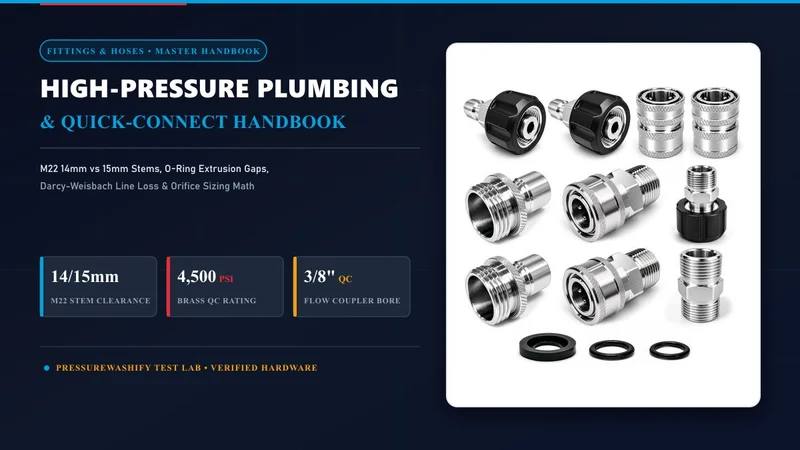
Fumbling with threaded M22 collars every time you wash your car or clean the patio is slow, and it is all too easy to cross-thread soft brass collars with cold hands. Upgrading your pump, hose, and gun to commercial 3/8-inch and 1/4-inch brass quick connects lets you snap your supply hose, gun, wand, and foam cannon together in under ten seconds.
These five field-tested plumbing components eliminate collar stripping, prevent high-pressure O-ring blowouts, and protect your pump head from sediment contamination:
| Component | Engineering Spec | Function & Advantage | Recommended Part |
|---|---|---|---|
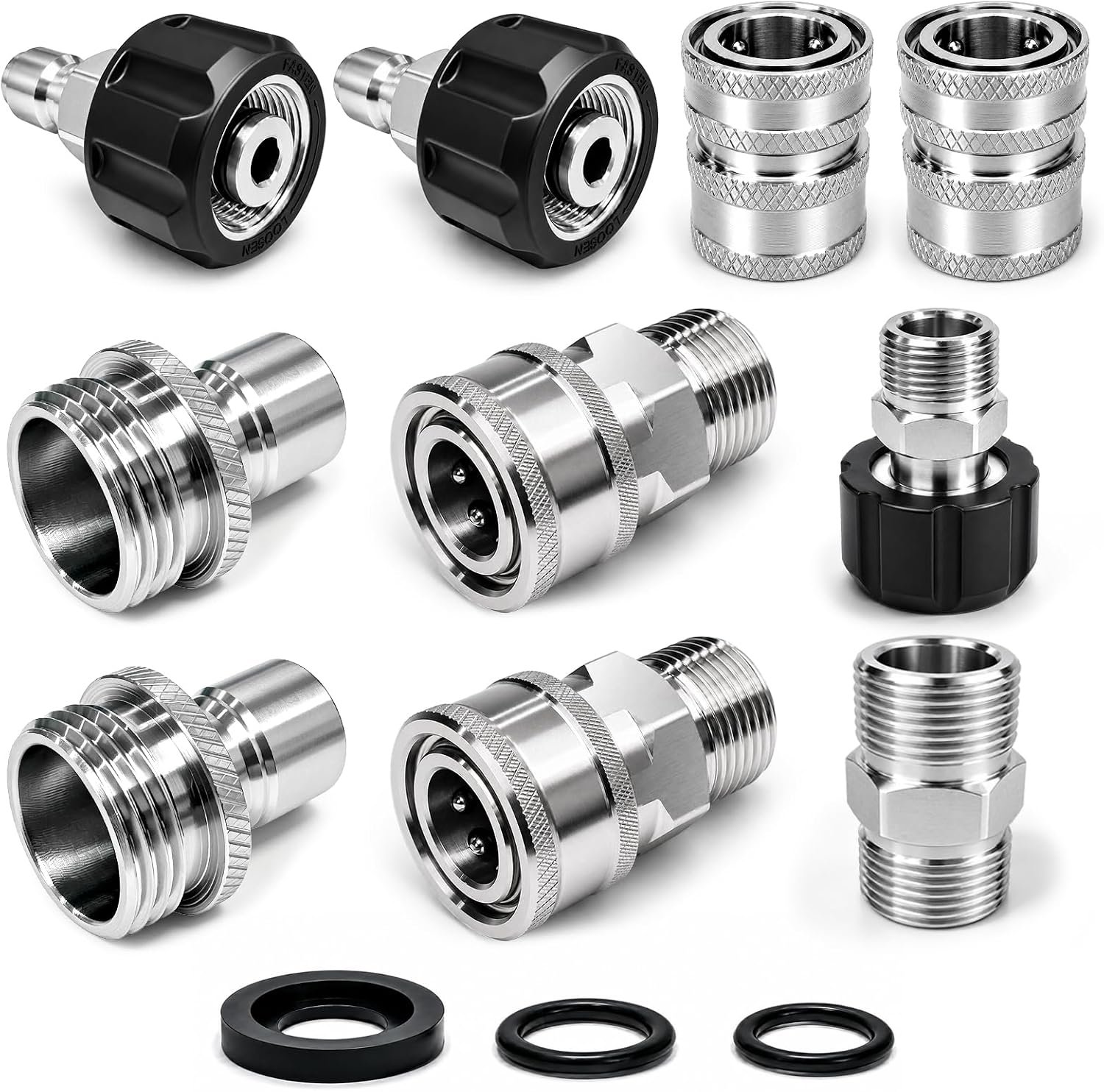
| M22 to 3/8" Quick Connect Kit (10-Pack) | M22-14mm Brass Couplers & 3/8" Stainless Steel Plugs | Converts pump discharge and hose connections from threaded screw collars to commercial ball-lock quick connects; eliminates stripped threads and wrench fatigue. | |
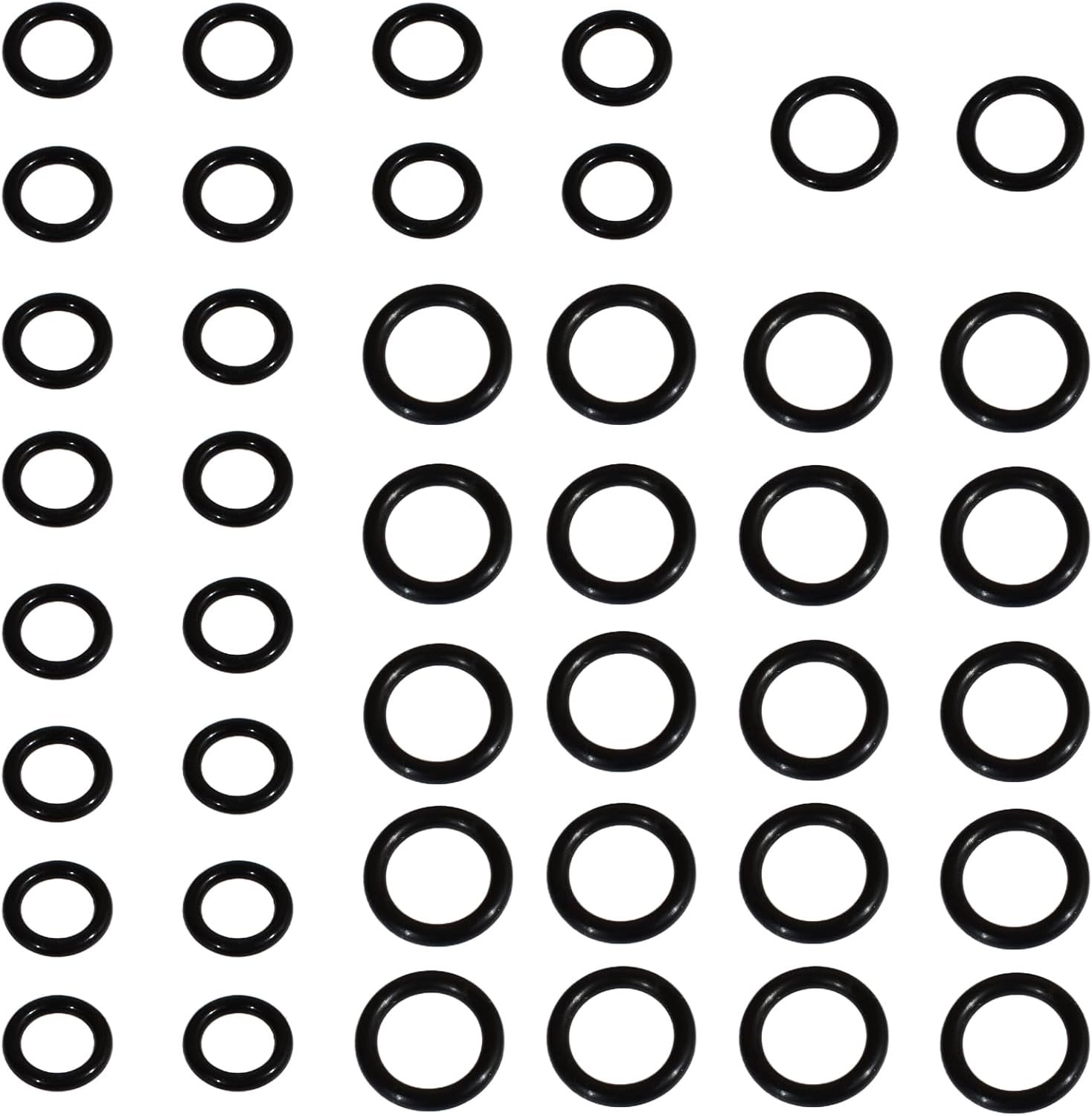
| Viton FKM High-Temp O-Rings (42-Pack) | Fluorocarbon Elastomer (FKM 75 Durometer) for 1/4", 3/8" & M22 | Withstands intense chemical exposure and hot water up to 300°F; far superior extrusion resistance compared to cheap standard nitrile Buna-N rubber rings. | |
| ProPulse UberFlex 50ft Hose | 1/4" ID, 3,100 PSI Thermoplastic Kink-Resistant Line | Patented polymer blend provides unmatched flexibility and zero coil memory; glides smoothly around vehicle tires and lawn edges without snarling. | |
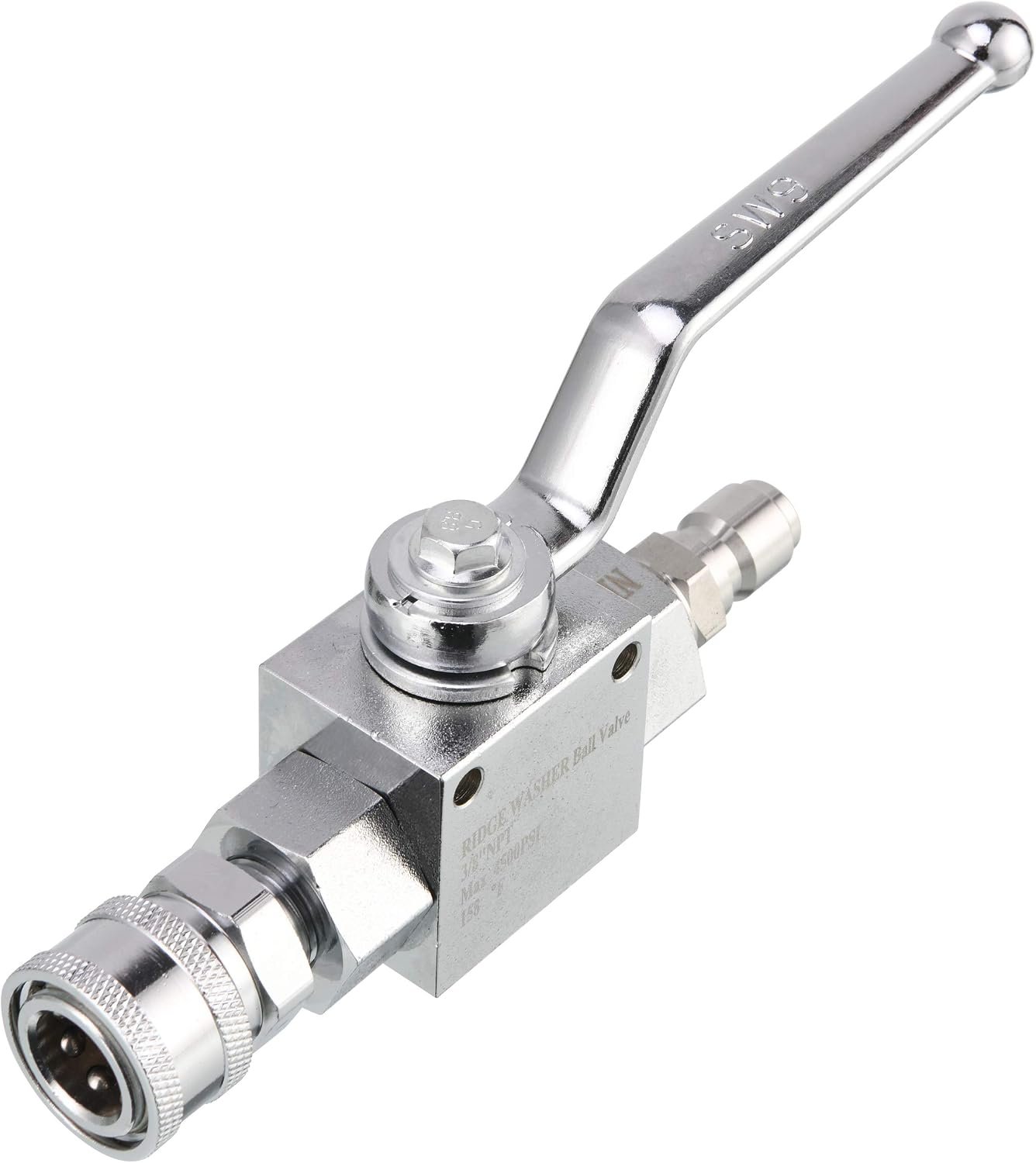
| High-Pressure Ball Valve Kit | 3/8" QC Heavy-Duty Brass Valve Rated to 4,500 PSI | Allows instant water shutoff at the end of the hose line; switch between spray guns, foam cannons, and surface cleaners without walking back to the machine. | |
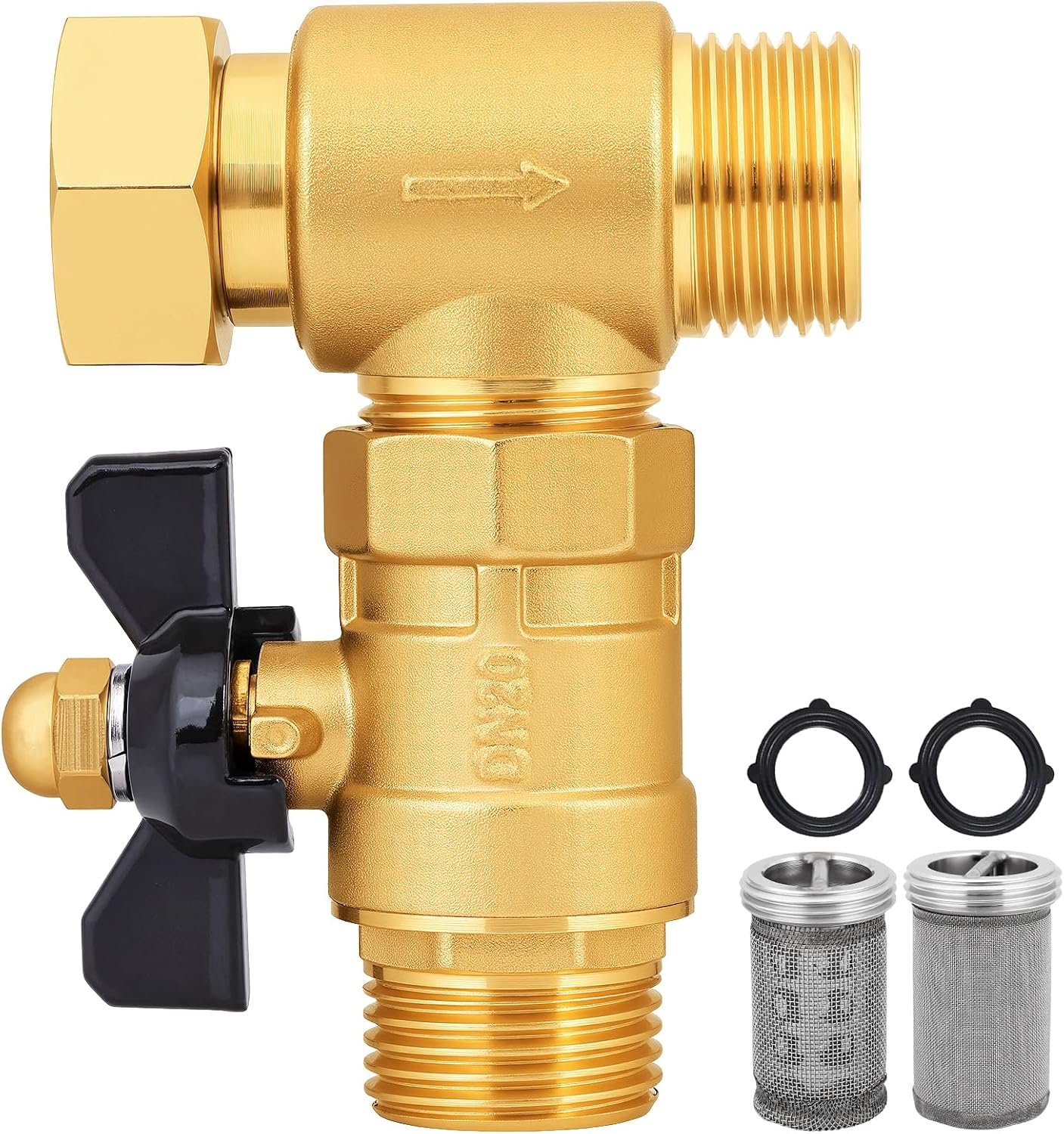
| Brass Inline Garden Hose Filter | 3/4" GHT with Integrated Drain Valve, 40 & 100 Mesh Screens | Captures rust flakes, well silt, and sand grains before they enter the pump manifold; prevents scoring on ceramic plungers and stuck check valves. |