
When an electric pressure washer hums instead of spinning, the motor is mechanically stuck or electrically starved. In almost every case, the culprit is trapped water pressure, dried mineral crust locking the pump plungers, a bad start capacitor, or voltage drop across a thin extension cord.
When you hear that low, vibrating 60 Hz hum, your motor is screaming for relief. Holding the power switch down pumps 18 to 25 amps through fine copper wire designed for only 13 amps. Within seconds, all that trapped electrical energy turns into intense heat inside the motor windings. If you keep holding the switch, you can burn off the wire's protective coating or blow the motor's internal thermal fuse.
Don't throw the pressure washer out. The motor itself is almost always intact. It simply doesn't have the starting muscle to overcome trapped water or a seized pump. Here is how to diagnose the stall in 20 seconds and fix it right on your workbench.
The 20-Second Diagnostic Triage Protocol
- Symptom A — Hums with hose attached, but starts instantly when you squeeze the trigger: Trapped water pressure. Water locked at 1,800 PSI acts like a solid wall against the pump pistons. Squeezing the spray gun trigger drops that pressure so the motor can spin.
- Symptom B — Shaft refuses to spin by hand with the rear plastic fan shroud removed: Seized pump plungers. Dried mineral scale from tap water has glued the pump pistons to their rubber seals.
- Symptom C — Motor shaft turns smoothly by hand, but hums and stays still under power: Blown start capacitor. The motor is free to turn, but the capacitor isn't giving it the electrical kick needed to pick a direction and spin.
- Symptom D — Hums on an extension cord, but runs normally plugged directly into a wall outlet: Voltage drop. A long or skinny extension cord starves the motor of electrical power right when it needs maximum torque to get moving.
Why the Motor Hums and Stalls
To understand why the motor hums, look at how standard household single-phase motors work. Unlike three-phase industrial motors, a household 120-volt motor cannot start spinning on its own from a dead stop.
The main motor winding creates an alternating magnetic field that flips back and forth 60 times a second. It pulls the motor's rotor in both directions with equal force. At standstill, the rotor is trapped in an electrical tug-of-war. It vibrates back and forth in place—creating the buzzing hum you hear—without being able to pick a direction to rotate.
To solve this, manufacturers add a second helper winding wired to a start/run capacitor (usually a cylindrical CBB60 capacitor rated between 25 and 45 microfarads). The capacitor delays the electrical pulse going to that helper winding by a quarter-cycle (a 90-degree phase shift):
That timing shift turns stationary vibration into a rotating magnetic field that pulls the motor rotor up to full operating speed (typically 3,450 RPM).
When the capacitor wears out or overheats, its internal layers break down. Without that electrical timing kick, the rotating field vanishes. The motor loses all starting torque, electrical current shoots up to four to six times normal running levels, and the motor just sits there humming in place.
Technical Schematic — Rotating Field vs Locked Rotor Stall
The diagram below shows how the motor uses a capacitor to create starting spin, and what causes it to lock up and stall:
Diagnostic Guide for Humming Motors
Before buying replacement parts, use this troubleshooting guide to pinpoint whether your electrical supply, capacitor, or pump mechanism is causing the stall:
| Failure Root Cause | What Is Happening | Diagnostic Field Test | Tolerance Threshold | Permanent Shop Repair |
|---|---|---|---|---|
| Start/Run Capacitor Failure | The capacitor loses its charge-holding ability, failing to give the motor the electrical kick needed to start spinning. | Discharge terminals with an insulated tool; measure capacitance with digital multimeter in μF mode. | Reading drops > 5% below rating stamped on the case (e.g., < 33.2 μF on a 35 μF capacitor). | Replace with an identical CBB60 capacitor matching the microfarad rating and rated for ≥ 450VAC. |
| Trapped Water Pressure | Trapped high-pressure water pushes against the pump plungers; because water cannot compress, the motor hits a hydraulic wall. | Turn switch OFF and squeeze spray gun trigger. Look for a pressurized burst of water before starting. | Any trapped pressure holding the pump plungers back at startup. | Squeeze gun trigger before turning power switch ON; service unloader valve if pressure traps continuously. |
| Plunger & Wobble Plate Mineral Seizure | Hard water minerals dry up during storage, sticking the stainless steel plungers tight against dry rubber seals. | Remove rear fan cover; turn motor drive shaft clockwise using a flathead screwdriver or socket. | Rotor shaft cannot be turned 360 degrees smoothly by hand without binding. | Inject pump conditioner or lubricant into garden hose inlet; rock shaft until it turns freely. |
| Extension Cord Voltage Drop | Long or thin extension cords cause voltage to plunge under heavy startup demand, starving the motor of spinning torque. | Plug machine directly into a wall outlet without any extension cord to test. | Line voltage at the machine drops below 108V AC during a starting attempt. | Ditch 16 AWG extension cords; plug directly into a 15A/20A wall outlet, or use a heavy-duty 12 AWG cord ≤ 50 ft. |
| Seized Unloader Valve Shuttle | Corrosion or grit jams the unloader valve shut, forcing the pump to push against full pressure right at startup. | Inspect unloader valve pin movement when pulling and releasing the spray trigger. | Unloader pin is seized solid and refuses to slide. | Disassemble unloader valve cartridge, clean lime scale with white vinegar, and apply silicone grease. |
The 4 Mechanical Fixes
Fix 1. Squeeze the Trigger to Bleed Trapped Pressure
This is the most common reason electric pressure washers hum on startup, especially units equipped with a Total Stop System (TSS). When you finish washing and release the spray trigger, the high-pressure hose remains charged with water at full working pressure (1,500 to 2,000 PSI).
Water cannot be compressed. When you turn the machine off and then try to switch it back on while holding trapped pressure, water forces the three pump plungers back against the wobble plate. On its very first turn, the electric motor must produce immense torque just to push those plungers into a solid column of pressurized water.
Because an electric induction motor produces its lowest starting power right at zero RPM, it cannot push through that hydraulic wall. The motor stalls immediately and hums in place.
- Turn the pressure washer electrical power switch to OFF.
- Turn on your outdoor garden hose spigot so water feeds into the pump.
- Point the spray gun in a safe direction and squeeze the trigger.
- Hold the trigger down until all trapped air and pressurized water escape, leaving a smooth, low-pressure garden hose stream flowing out the nozzle.
- Keep the trigger squeezed while you flip the pressure washer power switch to ON.
With line pressure relieved, the pump plungers face zero backpressure. The motor spins up to full speed smoothly without stalling. If your pressure washer starts and stops randomly during operation or surges at idle, inspect our guide on why electric pressure washers surge on and off.
Fix 2. Free the Seized Wobble Plate and Plungers
If the motor hums even with the trigger squeezed and water flowing freely, the pump mechanism itself is stuck mechanically. This happens frequently after winter storage or several months of sitting idle in a garage.
Tap water contains dissolved minerals like calcium and magnesium. When leftover water evaporates inside the aluminum pump head during storage, these minerals leave behind a hard, crusty scale around the stainless steel plungers and dry rubber seals. That mineral crust locks the plungers in place like cement.
The Manual Rotation Procedure:
- Unplug the pressure washer cord from the wall outlet completely. Disconnect the garden hose and high-pressure hose.
- Locate the plastic cooling fan shroud at the rear of the electric motor housing. Remove the 3 or 4 Phillips retaining screws and pull the shroud off.
- Look at the center of the cooling fan hub. You will see the exposed steel motor rotor shaft, usually stamped with a flathead screwdriver slot or an 8mm/10mm hex socket.
- Insert a flathead screwdriver or socket wrench into the shaft end. Gently rotate the shaft clockwise.
- If the shaft feels locked solid, do not hammer it or force it. Inject pump conditioner or lubricant directly into the garden hose inlet fitting. Let it soak into the plunger bores for 15 minutes to break down the mineral crust.
- Gently rock the screwdriver back and forth until you feel the mineral scale crack free. Rotate the shaft 3 to 4 full revolutions by hand. It should now spin with moderate, smooth resistance against the internal plunger return springs.
- Reinstall the plastic fan shroud, reconnect your water supply, purge the air, and power the machine on.
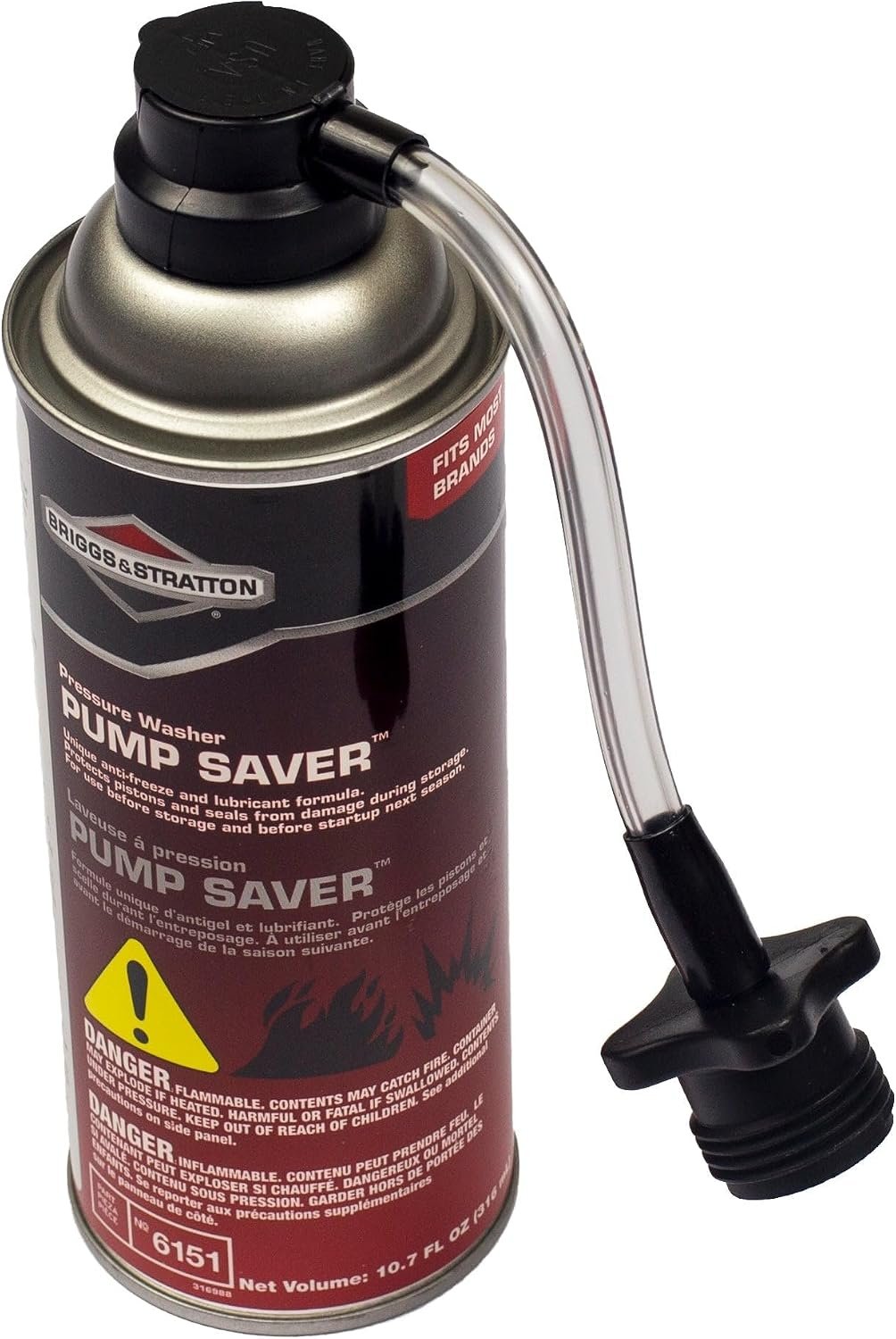
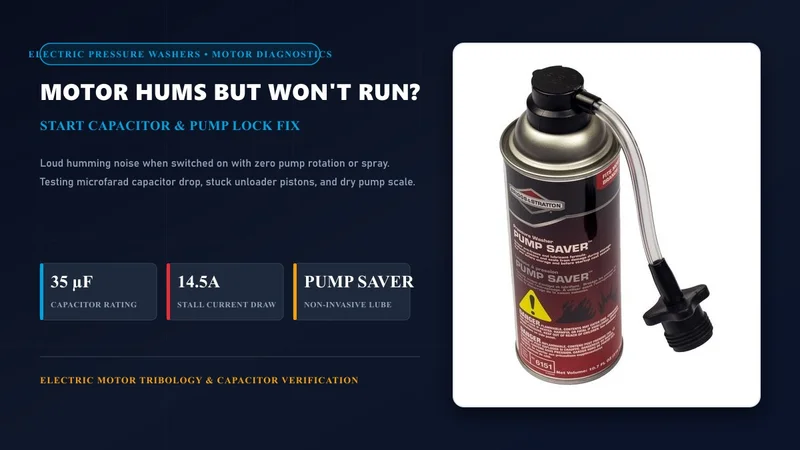
When an electric pressure washer sits unused over the winter or between projects, leftover water dries out and leaves hard mineral crust on the three internal pump plungers. The rubber packings stick solid, and when you flip the switch, the motor hums because it cannot overcome that bone-dry friction.
Briggs & Stratton Pump Saver dissolves that stubborn mineral scale and coats the axial wobble plate and plungers in heavy synthetic lubricant. It threads directly onto your standard 3/4" garden hose brass inlet for a 10-second treatment that frees stuck pistons, coats the dry seals, and stops the motor from stalling on startup.
Fix 3. Test and Replace the Motor Capacitor
If your motor shaft spins smoothly by hand with the fan shroud removed, but the motor immediately hums and vibrates when power is applied, the start/run capacitor is blown. This is the single most common electrical failure on induction machines like the Active 2.0, AR Blue Clean 600 series, Kärcher K-series induction units, and commercial detailing pumps.
The capacitor is housed inside an electrical junction box mounted on the motor frame, or behind a plastic side cover. It looks like a cylindrical plastic or aluminum can with two or four spade wire leads.
Safety Warning: Capacitors store high voltage electrical charges even after the machine is unplugged. Always discharge the capacitor before touching its terminals.
- Unplug the pressure washer completely. Remove the screws securing the motor electrical box cover.
- Discharge the capacitor: take an insulated screwdriver with a thick rubber handle (or a 20k-ohm resistor) and bridge the terminal spades for 5 seconds to drain any stored electrical charge safely.
- Inspect the capacitor body. If you see bulging plastic, oil weeping from the seams, scorch marks, or a popped rubber pressure plug, the capacitor has burned out and is ruined.
- To verify with a digital multimeter: set your meter to the Capacitance (μF) setting. Disconnect the spade wires from the capacitor terminals.
- Touch the meter probes across the terminals. A healthy capacitor must measure within ±5% of the rating printed on its casing (for example, a 35 μF capacitor must read between 33.2 μF and 36.8 μF).
- If the meter reads "0.0", "OL" (open loop), or anything below tolerance, replace it. Order an exact match: look for the CBB60 code, microfarad rating (e.g., 30 μF, 35 μF, or 40 μF), and voltage rating (≥ 450V AC). A replacement costs roughly $10 to $15 and drops in with two spade clips.
Fix 4. Remove Extension Cords and Check Outlet Voltage
Electric pressure washers push standard 120V household outlets to their limit. While spraying, a typical motor pulls 12 to 14.5 continuous amps. But during the first half-second of startup, the motor demands an inrush burst of 35 to 50 amps to break static inertia and get spinning.
If you run your pressure washer on a thin 16-gauge cord or a 100-foot extension cord, that skinny wire acts like an electrical bottleneck. Under that heavy startup surge, line voltage drops dramatically. An outlet providing 120 volts at the wall can plunge down to 100 volts or less by the time it reaches the motor plug.
Electric motors lose starting muscle fast when voltage dips. A 20-volt drop slashes the motor's starting torque by nearly 30%. With only two-thirds of its normal power, the motor simply cannot push the pump plungers past the grip of cold rubber seals. It sits there buzzing until the circuit breaker trips.
To learn how proper electrical sizing impacts pressure washer output, see our breakdown on how to make an electric pressure washer more powerful.
The Fix:
- Unplug the extension cord completely. Plug the factory power cord directly into a 15-amp or 20-amp GFCI wall outlet.
- If you must use an extension cord, never use 16 AWG. Use a heavy-duty 12 AWG cord under 50 feet, or a 10 AWG cord if running up to 100 feet.
- Ensure no other high-draw appliances (refrigerators, air compressors, or shop vacs) share the same circuit branch.
Verify Your Nozzle Orifice Size
Using an undersized spray nozzle tip spikes internal hydraulic backpressure above your unloader valve's bypass limit. This traps excess head pressure and stalls the motor during trigger cycling. Calculate your exact nozzle orifice rating based on your machine's rated GPM and working PSI.
OPEN NOZZLE SIZE CALCULATOR →Shop Rule for Humming Motors
Never flip the power switch repeatedly when an electric motor hums. Each 3-second hum pumps locked-rotor current into copper windings that have zero cooling airflow from the stationary fan. Always pull the trigger to bleed water pressure first. If it still hums, pull the rear shroud and spin the shaft by hand. You will diagnose 95% of motor stalls in under two minutes without buying unnecessary parts.