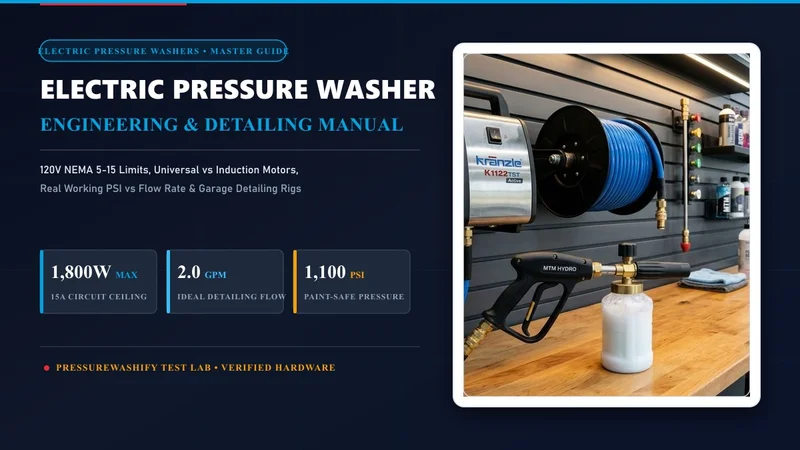
Every electric pressure washer plugged into a standard North American wall outlet runs into the exact same physical wall: 1,800 watts. It doesn't matter what the glossy packaging at the big-box store promises. No patent, no fancy branding, and no marketing slogan can change how an ordinary 120-volt, 15-amp circuit breaker behaves in your home. When a manufacturer slaps "3,000 PSI and 2.0 GPM" on a $150 electric pressure washer box, they are claiming something that requires more than double the power a household outlet can supply.
I wrote this handbook to cut through retail marketing and explain electric pressure washers through straightforward fluid power mechanics. Below, you'll learn the real math behind working pressure versus water flow, how brushed universal and brushless induction motors differ inside, how to tune a garage detailing setup for thick foam without stripping car paint, and how to track down phantom pressure switch pulsing.
The 1,800-Watt Wall Outlet Ceiling: Advertised PSI vs. Reality
Electric pressure washers run on standard residential electricity. In North America, that means the standard 3-prong wall outlet in your garage or exterior wall (technically called a NEMA 5-15 receptacle). It supplies 120 volts on a standard 15-amp circuit breaker. The gross electrical power available before you trip that breaker is simple arithmetic:
Power (Watts) = Volts × Amps = 120V × 15A = 1,800 Watts Gross
Now, you cannot convert 100% of those 1,800 electrical watts directly into spraying water. Real-world machinery loses energy at two distinct stages:
First, electric motors are not perfectly efficient. Small universal and induction motors lose 15% to 25% of their electrical power as heat in their copper windings (which is why motors run hot to the touch). Second, the mechanical pump loses another 25% to 30% through friction, piston seals, internal valves opening and closing, and turbulence as water squeezes through tight internal channels.
Think of it like a car: the engine might make 200 horsepower at the crankshaft, but after the transmission, axles, and tires absorb friction, only about 160 horsepower actually reaches the road. Multiply those electrical and hydraulic losses together (roughly 0.80 motor efficiency × 0.72 pump efficiency), and an electric pressure washer operates at 58% to 62% overall efficiency. That leaves roughly 1,080 continuous watts of usable hydraulic power at the spray tip—equivalent to about 1.45 to 1.50 water horsepower (WHP).
Here is the core equation engineers use to measure hydraulic power in any fluid system:
Water Horsepower (HP) = (Working PSI × Flow Rate GPM) / 1,714
Where does the number 1,714 come from? It is simply the standard engineering conversion factor that turns fluid pressure in pounds per square inch (PSI) and volumetric flow rate in gallons per minute (GPM) into mechanical horsepower.
Because you only have about 1.45 horsepower of actual water power available from a 15-amp wall circuit, pressure (PSI) and water volume (GPM) sit on a strict teeter-totter. If one goes up, the other must come down:
- At 1.2 GPM (typical budget electric unit): Peak real working pressure cannot exceed 1,400 to 1,450 PSI.
- At 1.5 GPM (balanced residential washer): Peak real working pressure settles at 1,200 to 1,250 PSI.
- At 2.0 GPM (high-flow car detailing rig): Peak real working pressure drops to 1,050 to 1,120 PSI.
So how do brands get away with printing "3,000 PSI and 2.0 GPM" on an electric machine? Run the math: (3,000 × 2.0) / 1,714 = 3.5 WHP. Factoring in efficiency, that machine would pull over 4,400 watts from your wall—or roughly 37 amps. Your household 15-amp breaker would trip before the motor finished ramping up.
Brands create those inflated box numbers by combining two separate laboratory tests that never occur at the same time: they measure maximum pressure with the spray gun shut against a dead-end unloader valve (zero water moving), and they measure flow rate by running water through an open hose with no nozzle attached (zero pressure). It is like advertising that a car gets 100 miles per gallon while doing 150 miles per hour.
Engineering Deep-Dive: Maximizing Electric Washer Output
You cannot change residential breaker limits, but you can eliminate downstream hydraulic friction losses to squeeze maximum cleaning power from your motor. Read my full engineering teardown on nozzle orifice tuning and flow preservation.
READ: HOW TO MAKE AN ELECTRIC WASHER MORE POWERFUL →Brushed Universal vs. Brushless Induction Motors: Why Heat Kills Cheap Pumps
Inside an electric pressure washer, two components do all the heavy lifting: the electric motor and the high-pressure water pump. How those two parts handle friction and heat decides whether your machine lasts two summers or a full decade.
1. Brushed Universal Motors with 3-Piston Wobble Plates
Universal motors are the lightweight, scream-at-the-top-of-their-lungs motors you find inside household blenders, cheap vacuum cleaners, and hair dryers. In entry-level pressure washers (under $200), these motors spin miniature internal armatures at screaming speeds between 16,000 and 20,000 RPM.
To transfer electricity into that spinning core, little blocks of carbon (called brushes) press directly against spinning copper contacts (the commutator). That constant rubbing creates friction sparks, carbon dust, and intense heat—just like pencil lead wearing down against sandpaper.
Because 18,000 RPM is far too fast to pump water directly, the motor uses tiny plastic or metal reduction gears to spin a wobble-plate pump. Picture holding a dinner plate tilted at an angle on a spinning stick: as the plate spins, its tilted edge wobbles back and forth, pushing three spring-loaded stainless steel pistons to pump water.
Most budget wobble-plate heads are cast from cheap aluminum or composite plastic. They run hot, have a continuous duty cycle under 20 to 30 minutes, and generally last 75 to 100 total operating hours before the carbon brushes wear out or the internal water seals fail. For washing patio furniture twice a summer, that is totally fine. For washing two cars every weekend, it is on borrowed time.
2. Brushless Induction Motors with Swashplate or Triplex Pumps
Brushless induction motors are the heavy, quiet workhorses you find inside workshop table saws and commercial refrigeration compressors. Instead of using physical carbon brushes that rub and wear out, they use rotating magnetic fields to spin the rotor at a calm, synchronized 3,450 RPM (or 1,725 RPM on commercial 4-pole units).
Because nothing physically touches the spinning shaft, there are no sparks, no carbon dust, and virtually no internal motor wear.
Induction motors produce massive low-end torque, so they connect directly to five-piston swashplates or true crankshaft-driven triplex pumps without fragile gearboxes. Pump heads are machined from solid billet aluminum or forged brass, surrounded by heavy aluminum cooling fins that dump heat into the air. These machines are significantly heavier (often 35 to 60+ pounds), but they hum at a quiet conversational volume and regularly deliver 300 to 500+ operating hours.
| Engineering Parameter | Brushed Universal Rig | Brushless Induction Rig |
|---|---|---|
| Armature / Motor RPM | 16,000 – 20,000 RPM | 1,725 – 3,450 RPM |
| Pump Architecture | 3-Piston Axial Wobble Plate | 5-Piston Swashplate or Triplex |
| Manifold Metallurgy | Cast Aluminum or Composite | Anodized Aluminum or Forged Brass |
| Sound Pressure (dBA) | 85 – 94 dBA (High-Pitched Whine) | 68 – 76 dBA (Low Electric Hum) |
| Continuous Duty Cycle | 20 – 30 Minutes Continuous | 60 – 120+ Minutes Continuous |
| Service Life Expectancy | 75 – 100 Hours (Disposable) | 300 – 500+ Hours (Rebuildable) |
| Representative Models | Sun Joe SPX3000, Greenworks 2000 | Active 2.0, Kärcher K1700, Comet Static |
Explore In-Depth Equipment Teardowns
We tore down the market's most popular electric pressure washers to inspect motor metallurgy, unloader stability, and real discharge flow rates:
- Active 2.0 Review: Real GPM & PSI Test — A forensic look at the 5-piston swashplate pump delivering true 2.0 GPM.
- Active 2.0 vs. Kärcher K1700 Comparison — Detailing flow vs. budget compact reliability.
- Sun Joe SPX3000 vs. Greenworks Pro 2300 — Universal brushed motor vs. brushless motor face-off.
Garage Wall-Mount & Auto Detailing: Why Water Flow Beats Raw Pressure
Automotive detailing has completely transformed how people buy electric pressure washers. Driveway cleaning and vehicle washing have completely opposite hydraulic requirements.
When you are blasting black mold and mildew off concrete pavers, you need raw, concentrated pressure (PSI) to rip dirt out of porous masonry. But when washing a car, high pressure is your biggest enemy. Safe car detailing demands the exact reverse: high water volume (GPM) paired with moderate, paint-safe pressure (PSI).
1. Paint-Safe Pressure & Clear-Coat Delamination
Your vehicle's factory clear coat is a thin layer of protective polyurethane or acrylic resin, typically measuring just 35 to 50 microns thick. To put that in perspective: a single human hair is about 70 microns wide. Your car's entire protective topcoat is thinner than a strand of hair.
Spraying automotive bodywork with 2,500+ PSI at close range introduces severe hydraulic shear stress. If your paint has existing rock chips, micro-scratches, or weak edges along plastic bumper seams, that high-pressure water jet can wedge itself underneath the paint film and literally peel clear coat away from the color base coat (a disaster called delamination).
The sweet spot for car washing is 1,000 to 1,200 working PSI at 1.8 to 2.2 GPM. That pressure safely strips away road film, bugs, and brake dust without lifting paint edges. At the same time, the higher water flow creates a liquid cushion that washes abrasive road grit off the bodywork before your wash mitt even touches the surface.
2. Tuning Water Flow with Nozzle Orifices
Every pressure washer ships from the factory with stock spray tips sized around its peak advertised pressure (usually tiny #2.5 or #3.0 orifice nozzles).
What does nozzle orifice mean? Think of putting your thumb over the end of a garden hose. If you pinch the opening down to a tiny slit (small orifice), water shoots out in a stinging, narrow jet, but very little water actually escapes. If you relax your thumb (larger orifice), the stinging pressure drops, but a heavy flood of water rushes out.
By swapping your pressure washer's stock spray tip for an oversized #3.5, #4.0, or #4.5 nozzle tip, you relieve backpressure at the pump. The harsh 1,800 PSI drops down to a gentle, car-safe 1,100 PSI, while the water volume opens up to the maximum flow rate your pump can deliver.
3. The Foam Cannon Secret: Why You Need the 1.1mm Jet Swap
Ever buy an aftermarket foam cannon, plug it into your electric pressure washer, and get runny, watery soap dribbles instead of thick shaving-cream foam? Here is the fluid physics behind that problem:
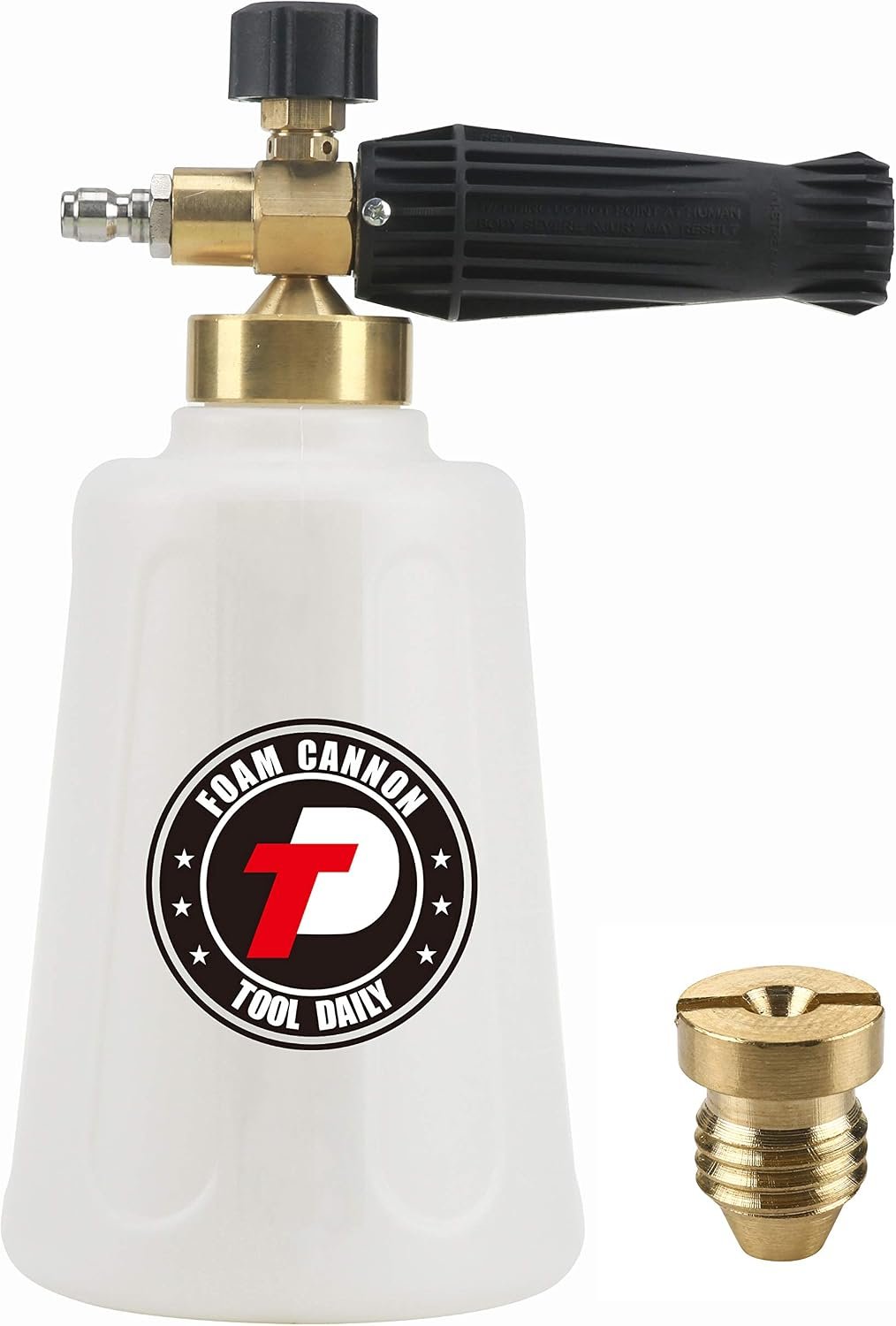
Foam cannons work on the Venturi effect: high-pressure water shoots through a tiny internal brass nozzle (a jet). As the water speeds through that restriction, it creates a localized vacuum that sucks concentrated soap up from the bottle, mixes it with air, and blasts it through an internal stainless steel mesh agitator into thick foam.
Almost every foam cannon comes pre-installed with a 1.25mm internal jet designed for commercial gas pressure washers flowing 3.5 to 4.0 GPM. But electric pressure washers only push 1.2 to 2.0 GPM. At that lower flow rate, water moves too slowly through a 1.25mm jet to create a strong suction vacuum. Soap draws sluggishly, producing runny foam that slides off your car in seconds.
The solution costs about $5: swap that internal factory jet for a 1.1mm orifice jet. Narrowing the internal opening acts like pinching a straw—it forces lower-flow water to speed up through the Venturi chamber, creating strong suction and generating thick shaving-cream foam on any 120V electric unit.
Wall-Mounted Rigs & The M22 Fitting Problem
Mounting an electric pressure washer on a garage wall creates an ultra-fast detailing station, but connecting aftermarket stubby guns and hose reels exposes plumbing traps:
- 5 Best Wall Mounted Pressure Washers — Comparing Giraffe Tools, Active 2.0, and custom Comet garage setups.
- M22 14mm vs. 15mm Fittings Guide — Why proprietary 15mm stems on Sun Joe and AR Blue Clean leak when paired with standard 14mm detailing accessories.
Troubleshooting & Winterizing: Stopping Phantom Pulsing and Freeze Cracks
Unlike gas pressure washers that rumble away continuously whether you spray or not, electric machines use automated switches to start and stop on command. When an electric washer acts up, the problem almost always boils down to tiny pressure leaks, power delivery issues, or winter freeze damage.
1. Why Your Pressure Washer Pulses On and Off (The Phantom Leak)
Most modern electric pressure washers feature a Total Stop System (TSS). Inside the pump manifold, a mechanical microswitch is linked directly to the water pressure. When you let go of the spray gun trigger, trapped water pressure spikes and trips this switch, immediately cutting electrical power so the motor does not run needlessly.
If your machine sits on the driveway untouched and suddenly kicks on for a half-second every few minutes, you are dealing with what engineers call pressure hysteresis. In plain English: you have a tiny leak playing tricks on the pressure switch.
When the trigger is closed, the high-pressure hose between the pump and gun is under full pressure. If even five drops of water escape per minute somewhere in your line, that trapped pressure slowly bleeds off:
- A nicked or dry rubber O-ring inside a 3/8" brass quick-connect fitting.
- A loose M22 screw-thread hose connection.
- A slow drip past the spray gun trigger seat.
- A worn check-valve poppet inside the pump's unloader valve.
The moment line pressure bleeds down below the microswitch trigger threshold, the switch snaps closed, thinking you just pulled the trigger. The motor fires up for a split-second pulse to rebuild pressure, shuts off, and the cycle repeats indefinitely.
The Fix: Check your O-rings first. Nine times out of ten, replacing a compressed or dry rubber O-ring inside your quick-connect couplers stops phantom pulsing immediately.
2. Why Skinny Extension Cords Strangle Electric Motors
When an electric motor starts spinning under a heavy pump load, it requires a momentary surge of power—often drawing 30 to 45 startup amps for a fraction of a second to get moving.
If you plug your 14-amp pressure washer into a thin, 50-foot orange extension cord (the kind labeled 16 AWG wire), electrical resistance strangles that power delivery. Trying to pull heavy startup amps through thin wire causes severe voltage drop. Your nominal 120V household electricity can sag down below 104 volts by the time it reaches the motor.
When voltage sags, an electric motor compensates by pulling even higher current. The motor struggles to spin, hums loudly, overheats rapidly, and either trips your household breaker or burns out its internal thermal fuse.
The Rule: Always plug your electric washer directly into a dedicated wall outlet whenever possible. If you must use an extension cord, use a heavy-duty 10 AWG or 12 AWG outdoor contractor cord, and keep the length under 25 to 50 feet.
3. Winter Freezing: Why Shaking Water Out Won't Save Your Pump
Leaving an electric pressure washer in an unheated garage or shed over winter ruins more machines than hundreds of hours of actual pressure washing. Water has a unique physical property: when liquid water freezes into solid ice, it expands by roughly 9% in volume.
If that water is trapped inside a rigid aluminum pump manifold with nowhere to go, that 9% expansion generates over 25,000 PSI of outward force (hoop stress). That is more than enough force to crack cast aluminum pump heads like eggshells, snap ceramic pistons, and crush internal plastic check-valve cages.
Here is the trap that catches most homeowners: you cannot drain a pump simply by tipping the unit upside down or shaking it. Surface tension (capillary action) holds standing water trapped inside the narrow check-valve seats and internal channels.
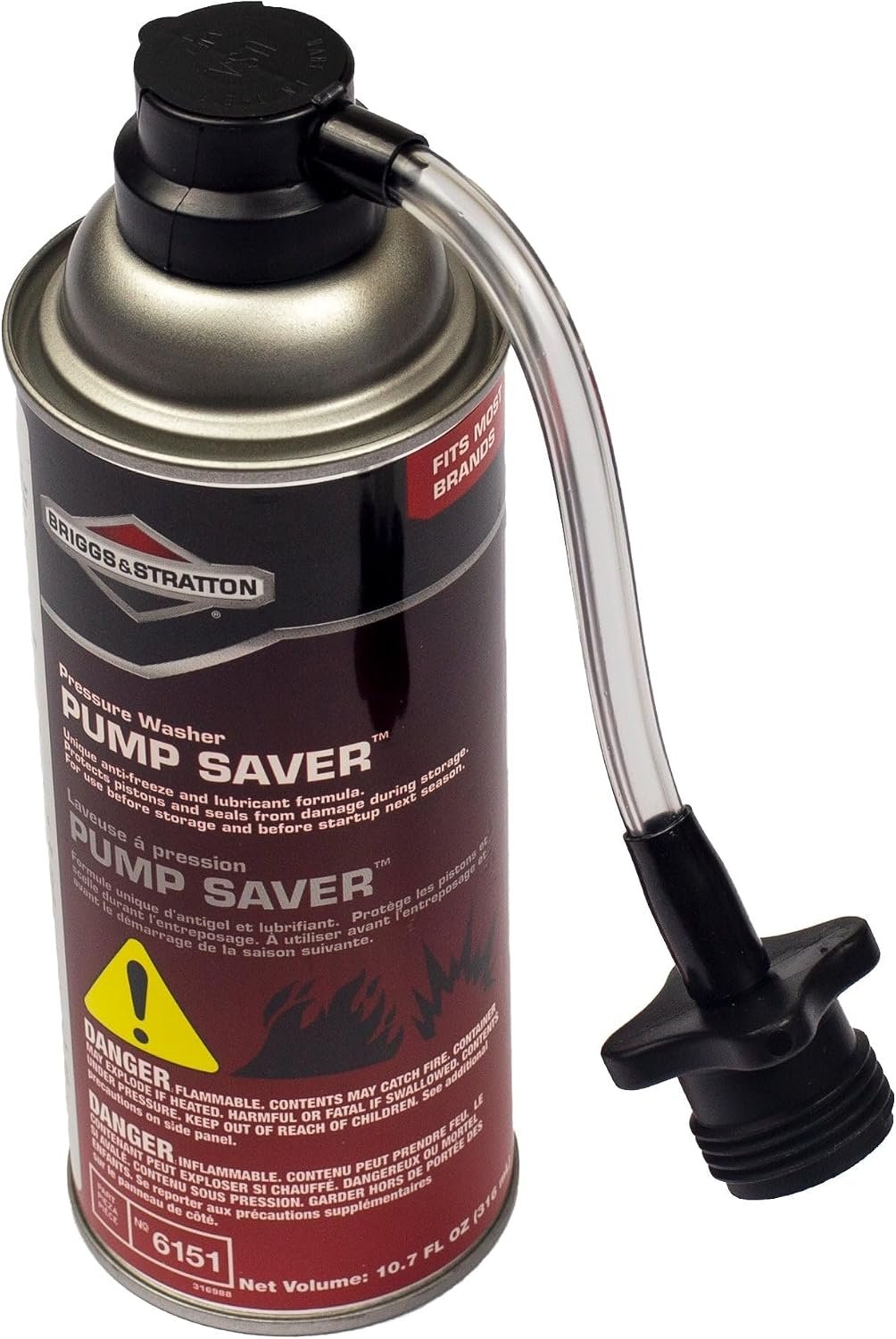
The only reliable way to winterize is to screw a bottle of pump protector (non-toxic propylene glycol with anti-corrosion lubricants) onto the garden hose inlet. Pull the trigger or push the aerosol can until lubricant squirts out the high-pressure discharge port. That forces every drop of standing water out and coats your rubber valve seals in protective lubricant so they stay soft until spring.
Step-by-Step Maintenance Protocols
Follow our dedicated diagnostic and seasonal maintenance walk-throughs:
- Electric Washer Cycling On & Off: 5 Mechanical Fixes — A step-by-step diagnostic tree for unloader micro-leaks and TSS faults.
- How to Winterize an Electric Pressure Washer — Complete 3-step winterizing protocol using pump saver antifreeze.
Tool Bridges & Complete Electric Detailing Upgrade BOM
Building a high-output garage detailing rig doesn't require thousands of dollars in commercial equipment. It requires matching components so fluid flows smoothly from spigot to tip without bottlenecking water volume.
Free Engineering Calculators & Compatibility Hub
Test your specific pump output, calculate nozzle orifice diameters, and check fitting compatibility across 30+ pressure washer brands with our free web tools:
Engineer's Detailing Upgrade Bill of Materials
These five vetted components eliminate factory bottlenecks, upgrade water flow to car-safe levels, and protect pump seals through winter storage:
| Component | Engineering Spec | Function & Advantage | Recommended Part |
|---|---|---|---|
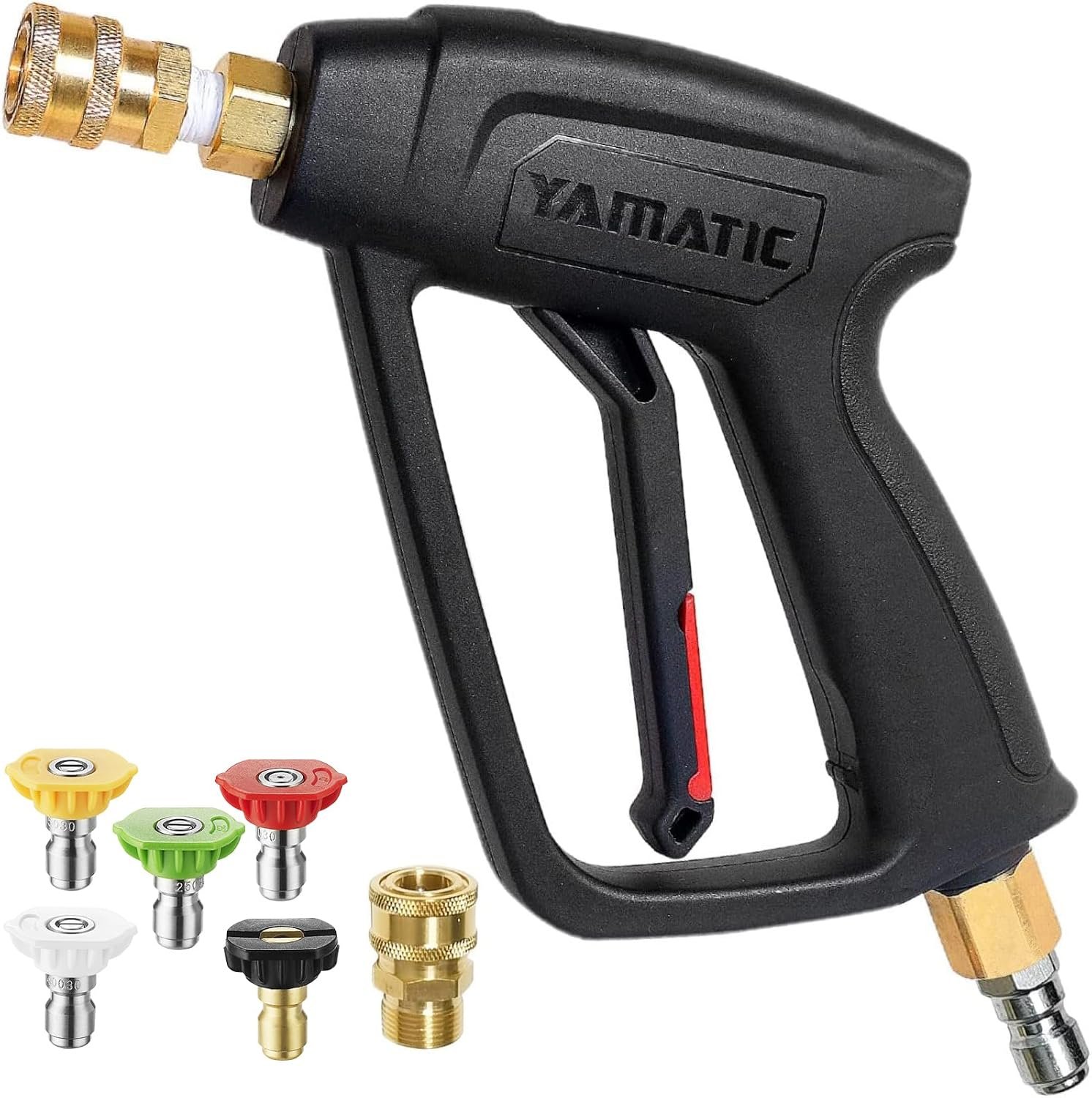
| YAMATIC Short Gun | Integrated 3/8" Live Swivel, 1/4" QC Outlet, 4,000 PSI | Replaces the clumsy 3-foot factory wand with a compact stubby gun. The live brass swivel lets the hose spin freely as you walk around a car so it never kinks or coils into knots. | |
| Tool Daily Foam Cannon | 1.1mm Venturi Jet Installed, 1/4" QC Plug, 1L Reservoir | Comes with the critical 1.1mm orifice jet already installed, forcing lower-flow electric washers (1.2–2.0 GPM) to whip up rich, shaving-cream foam that clings to paint. | |
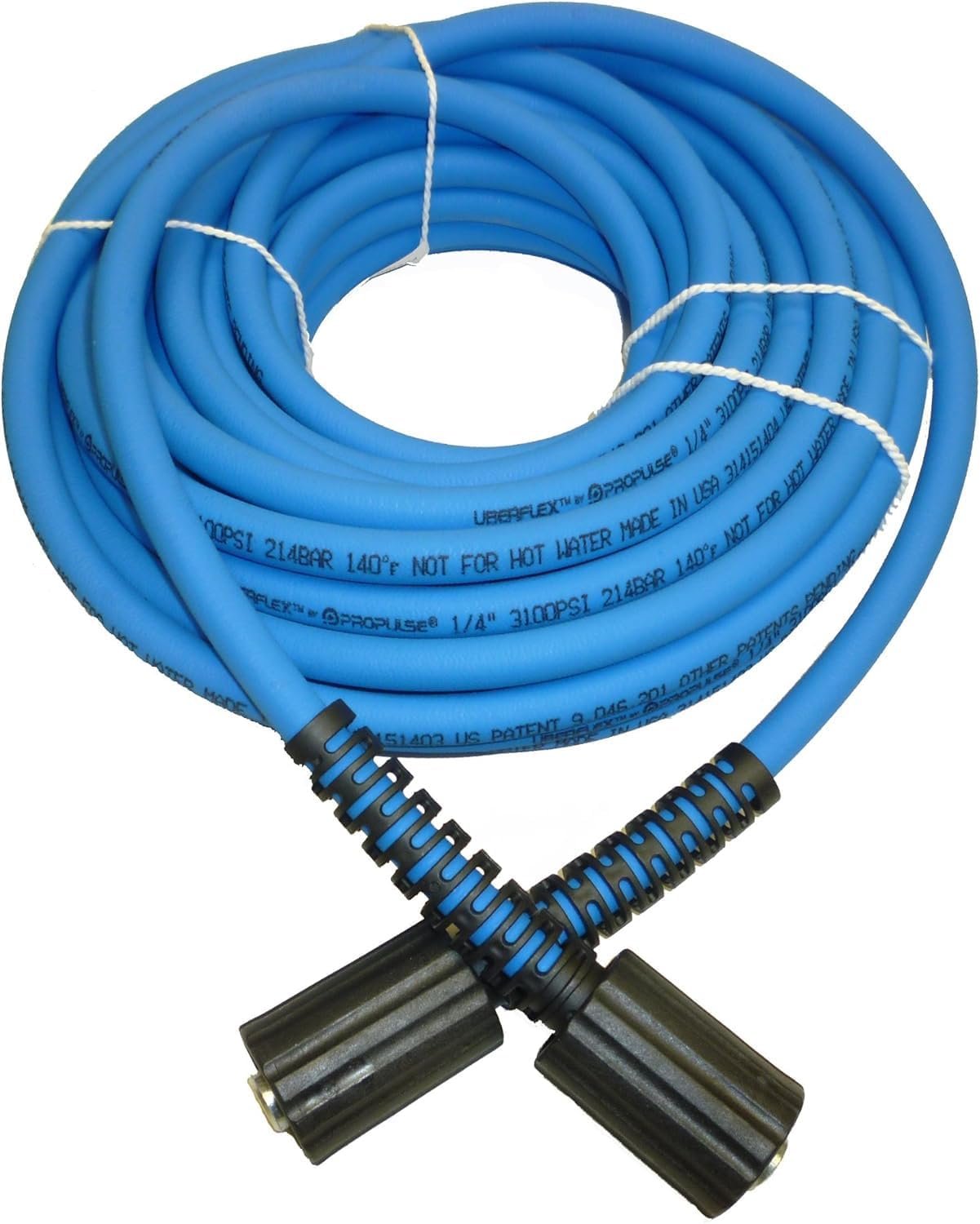
| UBERFLEX™ Hose (50ft) | 1/4" ID, 3,100 PSI, Wire Braid, (2) M22-14mm Brass Ends | Ditches the stiff plastic hose that comes in the box for an ultra-flexible textured line. Lays flat on the driveway without springing into coils or dragging across painted car corners. | |
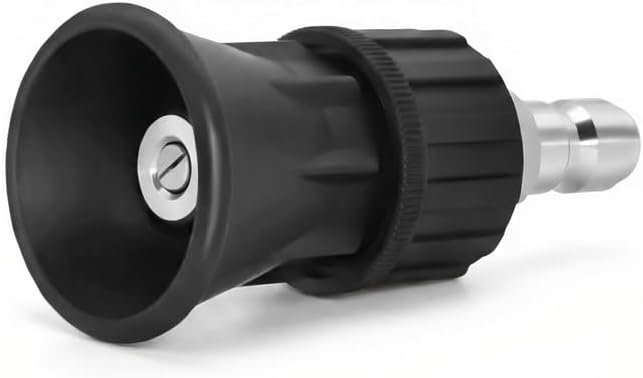
| 40° Nozzle Guard (#4.0) | #4.0 Orifice, 40° Wide Fan, Soft Rubber Shroud | Expands the nozzle orifice to #4.0, dropping harsh 1,800 PSI pressure to a car-safe 1,050 PSI while maximizing water flow. The rubber shroud protects paint if the tip accidentally bumps a wheel. | |
| B&S Pump Saver | 100% Propylene Glycol + Anti-Corrosion Lubricants | A $12 insurance policy against winter freeze damage. Pushes trapped standing water out of internal pump cavities and coats rubber seals so they don't dry out and crack before spring. |