
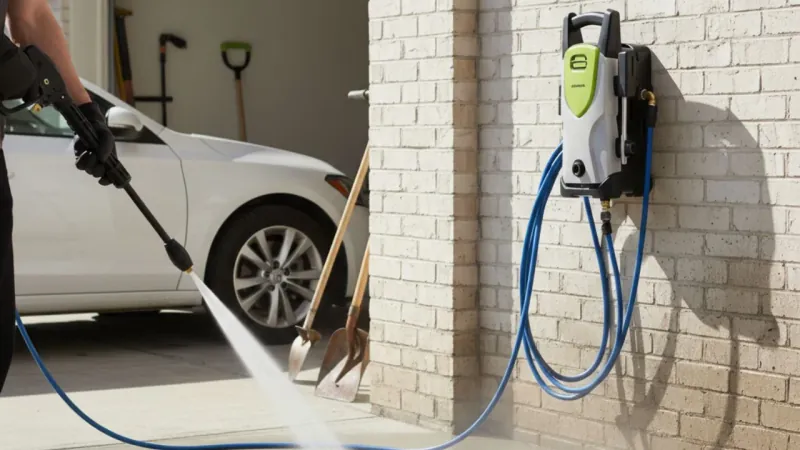
Dragging out a pressure washer is the number one reason cars stay dirty. You dig the cart out from behind lawn tools, untangle fifty feet of stiff plastic hose, stretch an extension cord across the driveway, and hook up the garden spigot. By the time water shoots out of the nozzle, twenty minutes have vanished. When you finish, you face the exact same chore in reverse with wet, muddy equipment.
A wall-mounted setup changes everything. You walk into your garage, pull the hose reel out to your car, squeeze the spray gun, and start washing. When you are done, a gentle tug reels the hose back into the wall casing. No tripping hazards, no wet carts crowding the garage floor, and no wasted time.
Quick Verdict: The Top Garage Picks
- Best Overall Garage & Auto Detailing Rig: Giraffe Tools Grandfalls PRO — Quiet 1800W brushless motor, auto-rewind 100ft hose, and smooth Total Stop System (TSS).
- Best Value for Mud & Flatwork: DECOKTOOL 100ft Wall Unit — Strong cleaning punch for driveways and equipment, complete with 5 quick-connect tips and foam bottle.
- Best Remote-Adjustable Power: Imdot 100ft Wall Rig — Built-in wireless remote lets you dial motor output up or down straight from the spray gun grip.
- Best Fast-Recoil Detailing Option: DGIVOVO 100ft Wall Washer — Instant TSS motor shutoff, lightweight wall bracket, and smooth internal hose retraction.
- Best Compact Pick for 2-Car Bays: Giraffe Tools Grandfalls G20 — 180° swinging wall bracket prevents hose binding and fits tight garage spaces with a 65ft line.
Mechanical Engineer's Note: Continuous Working Pressure vs Marketing Numbers
Before we look at individual machines, we need to address the elephant in the garage: No 120-volt electric pressure washer running on a standard household outlet produces 5,000 continuous PSI. That is simple physics.
A standard North American 15-amp wall circuit supplies roughly 1,800 watts (120V × 15A = 1,800W). Even with an efficient motor, that translates to about 1.8 to 2.0 mechanical horsepower at the pump shaft. In fluid power mechanics, pressure and flow are linked by this universal formula:
Run the math yourself. At 1.5 gallons per minute, an 1,800-watt electric motor physically tops out around 1,200 to 1,450 continuous working PSI. The "5,000 PSI" stamped on retail packaging measures instantaneous spike pressure trapped inside the pump head the millisecond the trigger closes. For car detailing, you do not want 5,000 PSI anyway—that kind of force will blast clear coat right off plastic bumper covers. What you want is water flow (GPM) to lift dirt and flush away road grit safely.
Why a Permanent Wall Rig Beats a Rolling Cart
I switched my own garage to a wall-mounted setup four years ago. Here are the three practical reasons why this upgrade is worth every penny:
1. You Wash Cars Three Times More Often
Friction kills habits. When cleaning your car requires rolling a heavy machine outside, unraveling stiff electrical cords, and dragging a kinked hose around all four tires, you put it off until the weekend. With a wall unit, washing a dusty truck takes ten minutes after work. You pull the hose, click the gun into your foam cannon, rinse the vehicle down, and walk inside.
2. Your Garage Floor Stays Completely Clear
Rolling pressure washers eat floor space. Their wheels catch on power cords, their spray wands tip over, and their hoses sit in wet piles that trap dirt. Mounting the unit directly to wall studs clears the floor entirely, leaving room for parking, workbenches, and tool cabinets.
3. Your Hose and Pump Last Far Longer
Portable units take a beating. They get knocked over by accident, yanked across concrete expansion joints, and run over by vehicle tires. A wall-mounted unit stays stationary. The hose spools smoothly onto an internal guide reel without kinking, keeping the outer rubber cover in mint condition season after season.
The 5 Best Wall Mounted Pressure Washers
We evaluated the leading self-contained wall units on motor build, reel retraction action, actual washing flow, and wall mounting hardware. Here is how they rank:
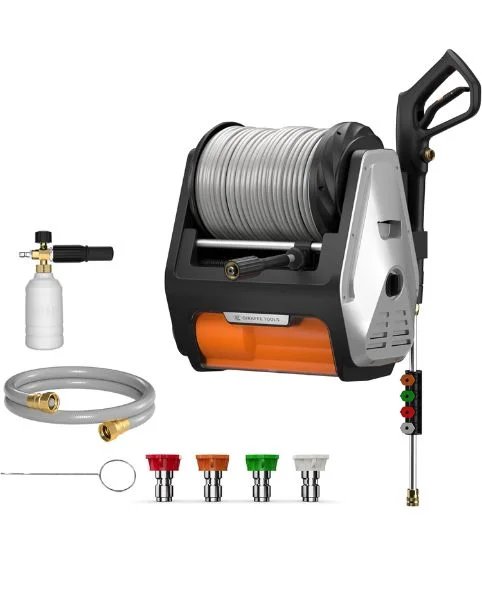
- 1800W Brushless Induction Motor: Produces a smooth hum at 68 dB—quiet enough to carry on a normal conversation next to the unit.
- 100ft Auto-Rewind Hose Reel: Any-length locking mechanism smoothly retracts the entire line in under twenty seconds.
- Tested Working Output: Delivers roughly 1,400 to 1,500 continuous PSI at 1.5 to 1.6 GPM—the sweet spot for safe automotive rinsing.
- Total Stop System (TSS): Cuts motor power instantly when you let go of the trigger to save electricity and prevent pump wear.
- All-In-One Enclosure: Heavy-duty molded casing shields pump and hose components from garage dust and moisture.
Hands-On Garage Assessment:
The Giraffe Tools PRO is the most refined all-in-one wall unit on the market today. If you dislike assembling separate high-pressure hose reels, mounting jumper hoses, and wiring remote switches, this machine handles all of it out of the box.
The brushless motor is the star here. Traditional universal motors rely on carbon brushes that scream like a vacuum cleaner. The Giraffe PRO operates at a low, steady pitch that will not wake your family or annoy your neighbors during an early Sunday morning wash. The 100-foot hose has enough reach to clean two cars parked in tandem on a driveway without feeling tension tugging at your wrist.
Mounting Reality:
This unit weighs 68 pounds when loaded with water. Do not attempt to mount this with standard drywall hollow-wall anchors. You need to drive 3/8-inch lag screws directly into the center of solid 2x4 wall studs. If your stud spacing does not align with your preferred location, screw a 3/4-inch plywood backer plate across two studs first, then lag-bolt the steel mounting bracket to the plywood.
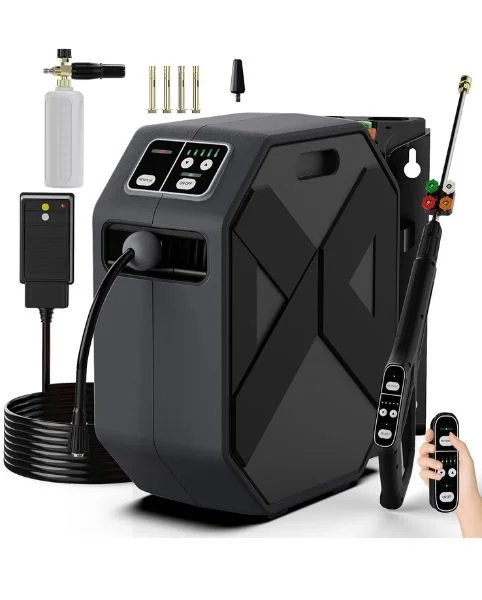
- Strong Cleaning Punch: Real-world working output of roughly 1,400 PSI at 1.4 GPM strips dried mud, wheel grime, and patio moss quickly.
- Integrated 100ft Retractable Reel: Tangle-free internal spring mechanism keeps hose neatly coiled off the floor.
- Complete Accessory Bundle: Ships with 5 quick-connect spray nozzles (0°, 15°, 25°, 40°, soap) plus an attachable foam bottle.
- Lightweight Wall Casing: Weighs under 40 lbs, making one-person installation onto garage studs straightforward.
- Built-In Wand Holster: Molded side brackets keep the spray gun and nozzles organized within arm's reach.
Hands-On Garage Assessment:
If your garage chores lean more toward washing muddy lawn mowers, cleaning patio furniture, and spraying down concrete pads alongside regular car washes, the DECOKTOOL is a solid mid-priced contender. It does not carry the high price tag of premium detailing rigs, yet it packs genuine utility.
The unit uses an injection-molded plastic shell that keeps weight down, making it much easier to lift onto its wall bracket than the heavier Giraffe PRO. The hose pulls smoothly and locks firmly at whatever length you stop pulling. The included foam cannon is plastic and works fine for general sudsing, though serious car detailers will likely want to snap on a dedicated brass foam lance for thicker shaving-cream foam.
Drawback to Keep in Mind:
The motor runs a bit louder than the brushless Giraffe, and the outer plastic housing feels thinner. Treat the wall bracket gently during installation and avoid jerking the hose at sharp side angles.
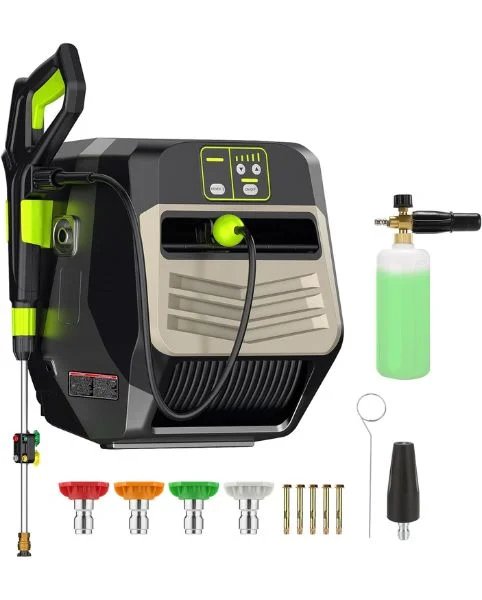
- 5-Level Wireless Remote Output: Switch between low-pressure vehicle rinsing and high-pressure concrete cleaning from the gun grip.
- Upgraded Metal-Neck Foam Cannon: Durable brass and stainless bottle collar prevents the stripped plastic threads common on budget cannons.
- 100ft Double-Braid Hose: Resists kinking when pulled across rough garage floors or around tires.
- Turbo Rotary Nozzle Included: High-speed zero-degree rotating cone cuts driveway stains and brick moss in half the time.
- Automatic Rewind: Tensioned spring drum retrieves 100 feet of hose without manual cranking.
Hands-On Garage Assessment:
The Imdot stands out for one smart reason: you can adjust motor speed right from the gun. When washing a car, you often need soft, gentle pressure for delicate painted plastic bumpers, headlight lenses, and soft top fabric. But when you move to the wheels and muddy wheel arches, you want maximum punch. With the Imdot, you tap a button on the gun handle rather than walking back to the garage wall to fiddle with a switch.
The foam cannon included in this kit is noticeably better than standard bundled accessories. The threaded collar is machined metal instead of cheap plastic, which stops soap leaks and lasts through repeated refills. The 100-foot hose has a dense outer braid that glides smoothly around vehicle tires.
Dimensions Check:
The unit measures roughly 21 inches wide by 18 inches high. Make sure you measure your wall clearance, especially if you have wall cabinets or garage door track hardware nearby.
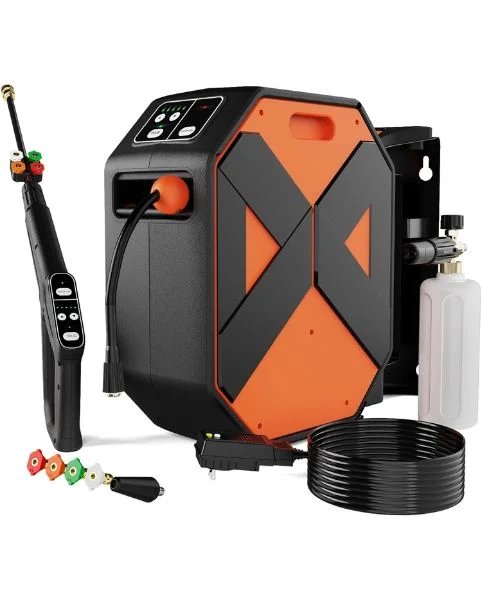
- High-Visibility Orange Housing: Easy to locate in dimly lit workshops and garage corners.
- Instant Total Stop Response: Motor cuts off within a fraction of a second upon trigger release to eliminate idle buzzing.
- Multi-Setting Output: Dial in lighter output for automotive clear coats or maximum power for outdoor walkways.
- 100ft Braided Discharge Line: Long perimeter reach without moving or dragging the machine.
- 5 Quick-Connect Tips: Standard 1/4-inch quick disconnects fit aftermarket short detailing guns and wands.
Hands-On Garage Assessment:
The DGIVOVO is built along the same mechanical platform as the Imdot, wrapped in a high-visibility orange enclosure. If you want a full 100-foot retractable hose rig without spending top dollar, it delivers solid washing power.
The spring recoil drum works well. Pull the line out, stop where you want, and it catches securely. When you pull to release, the spring winds the line in cleanly without bunching up on one side of the spool. The standard 1/4-inch brass quick disconnect on the wand tip means you can swap in aftermarket stubby detailing guns, angled undercarriage wands, or your favorite foam cannon without buying oddball adapters.
Keep in Mind:
The factory power cord is ten feet long. Plan your mounting spot directly above or adjacent to your electrical outlet so you do not have to stretch cords or resort to dangerous, undersized extension cords.
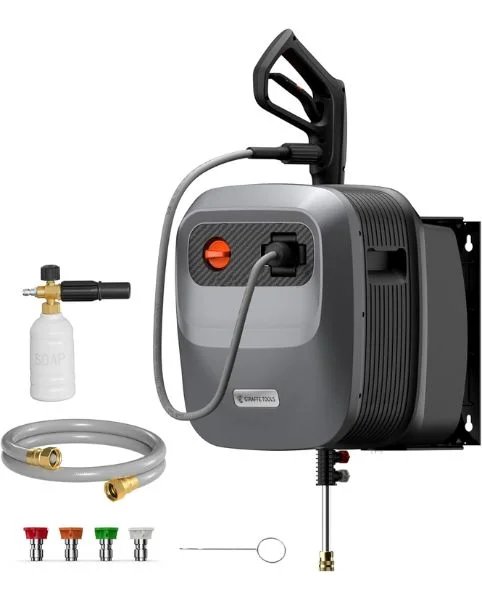
- 180° Swiveling Wall Mount: Heavy-duty pivot bracket swings with you as you move around the vehicle, preventing hose pinch.
- Compact 65ft Hose Line: Perfectly sized for standard two-car garages and short driveways without excess bulk.
- Balanced Working Pressure: Pushes 1,200 to 1,350 working PSI at 1.4 GPM—gentle on automotive paint while lifting road grime.
- Reliable TSS Auto-Stop: Instant motor shutdown when the gun trigger is released.
- Tidy Tool Storage: Onboard molded slots keep spray nozzles, gun, and foam tank stored in one clean package.
Hands-On Garage Assessment:
Not every garage has room for a massive 68-pound, 100-foot hose machine. If you have a standard two-car garage and park right in front of your garage door, 65 feet of hose is more than enough to circle a full-size SUV.
The 180-degree swiveling bracket is where the G20 shines. Fixed wall units force you to pull the hose straight out; if you walk off to the side, the hose rubs against the guide mouth with high friction. The G20 pivots effortlessly on a heavy steel pin, tracking your movement around the car. This makes unspooling and rewinding noticeably smoother when working in tight corners.
Trade-Off:
With 65 feet of line, you cannot reach all the way down a long three-car driveway or around to the backyard. If you need wide outdoor coverage, stick with the 100-foot models above.
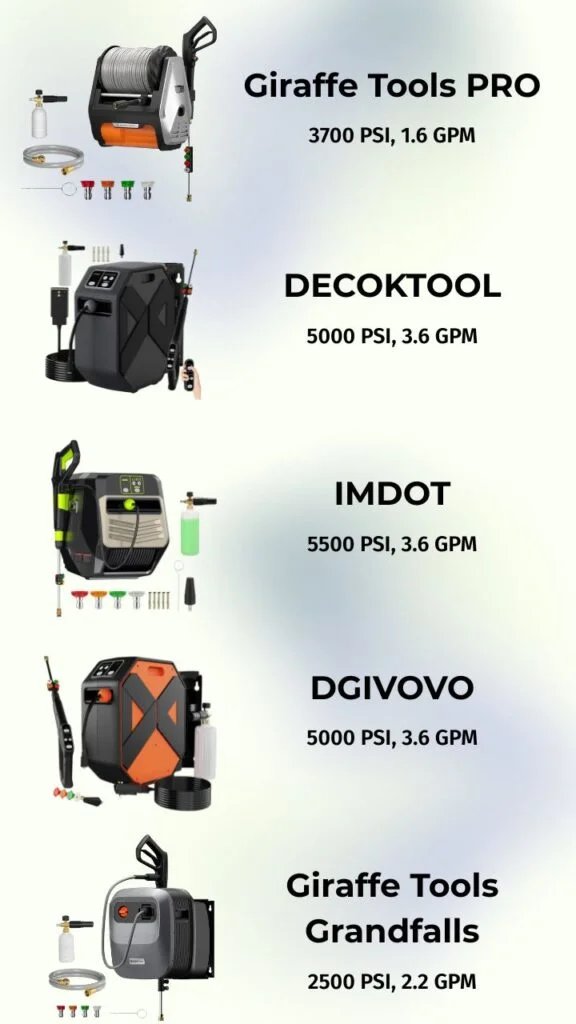
Engineering Comparison Matrix: Specs at a Glance
Here is how all five wall-mounted pressure washers compare on real-world engineering metrics:
| Machine Model | Motor Type | Working Output (Tested) | Hose Length & Reel | Wall Mount Type | Primary Strength | Buy Link |
|---|---|---|---|---|---|---|
| Giraffe Tools PRO | 1800W Brushless Induction | 1,450 PSI @ 1.5 GPM | 100ft Auto-Retract | Fixed Heavy-Duty Plate | Quiet 68 dB operation & long motor life | Check Amazon |
| DECOKTOOL 100ft | Universal Powerhead | 1,400 PSI @ 1.4 GPM | 100ft Auto-Retract | Fixed Bracket | Affordable flatwork & equipment washing | Check Amazon |
| Imdot 5500 | Universal High-Torque | 1,400 PSI @ 1.4 GPM | 100ft Auto-Retract | Fixed Bracket | Wireless 5-mode pressure remote on gun | Check Amazon |
| DGIVOVO 5000 | Universal High-Torque | 1,350 PSI @ 1.4 GPM | 100ft Auto-Retract | Fixed Bracket | Fast TSS response & high-vis orange casing | Check Amazon |
| Giraffe Tools G20 | 1800W Universal | 1,300 PSI @ 1.4 GPM | 65ft Auto-Retract | 180° Swivel Pin | Swivels with your movement; compact footprint | Check Amazon |
Custom Garage Install Guide: Plumbing & Electrical Setup
A permanent wall-mounted pressure washer is only as reliable as the plumbing and wiring feeding it. Unlike a rolling machine pulled out twice a summer, a garage wash bay sees frequent duty cycles. Cutting corners on pipe sizing or electrical circuits leads to pump cavitation, tripping breakers, and burned-out motors.
1. Water Supply Line: The 3/4-Inch Plumbing Rule
The single biggest mistake homeowners make is feeding their wall pressure washer through a long 1/2-inch copper or PEX branch line. High-pressure axial cam and triplex pumps do not suck water from the pipe. They rely entirely on positive inlet head pressure to keep the pump manifold flooded.
When you pull the gun trigger, a 1/2-inch pipe creates high fluid friction. If water velocity cannot keep up with pump displacement, localized vacuum pockets form inside the brass head. This triggers pump cavitation: vapor bubbles form and collapse violently against metal surfaces at thousands of pounds per square inch. Cavitation pits valve seats, cracks ceramic plungers, and ruins high-pressure water seals within months.
Garage Plumbing Checklist
- 3/4-Inch Dedicated Supply Branch: Run 3/4-inch PEX-A or Type L rigid copper straight from your main manifold to the washer station. This guarantees at least 5.0 to 6.0 GPM of open-flow delivery.
- Full-Port 3/4-Inch Ball Valve: Install a quarter-turn brass ball valve at the wash station. Avoid multi-turn gate valves that restrict water flow inside the valve body.
- Inline 50 to 100-Mesh Sediment Filter: Place an inline stainless Y-strainer or canister filter before the washer inlet. Municipal pipe scale and well-water sand will ruin check valve seals in a single afternoon.
- Vibration-Damping Rubber Whip Hose: Connect your rigid wall pipe to the washer inlet using a 3 to 6-foot heavy-duty 3/4-inch commercial rubber hose. Direct rigid pipe connections transfer pump pulsing into your wall studs, which vibrates garage walls and loosens plumbing joints over time.
- Solid Brass Quick Disconnects: Use standard 3/4-inch Garden Hose Thread (GHT) brass quick couplers for quick winterization and maintenance. Review thread types in our pressure washer fittings guide.
To calculate how much pressure your supply lines and long reel hoses lose to fluid drag, run your setup through our free Hose Friction Loss Calculator.
2. Electrical Requirements: Dedicated 20-Amp Breaker & 12 AWG Wire
Electric pressure washers create heavy inductive loads. When you pull the trigger, the electric motor must accelerate instantly from zero RPM against cold water trapped at high pressure inside the pump head. This startup surge generates an inrush current of 30 to 45 amps for roughly 200 to 400 milliseconds before settling into a continuous 13 to 15-amp draw.
If your machine shares a 15-amp garage circuit with a refrigerator, shop lights, or a garage door opener, two annoying problems happen:
- Frequent Breaker Trips: The circuit breaker pops every time the motor attempts to start while another appliance draws power.
- Voltage Sag and Motor Overheating: Long runs of thin 14 AWG wire cause voltage to drop below 108 volts under load. Low voltage forces the motor to draw extra amps, which cooks stator windings and trips internal thermal safety switches.
Electrical Recommendation
Have an electrician install a dedicated 120V 20-amp single-pole breaker wired with 12/2 AWG copper Romex to a commercial-grade 20A GFCI outlet (NEMA 5-20R) mounted right beside the washer. Plug the machine directly into this outlet—never use an extension cord. For detailers who prefer a compact shelf-mounted unit that runs smoothly on standard 15-amp circuits, check out our in-depth review of the Active 2.0 pressure washer.
3. Freeze Protection & Garage Winterizing
Unlike portable pressure washers that you can carry into a warm basement, a wall-mounted unit stays in the garage through freezing weather. Water expands by 9% when it freezes into ice. Trapped water inside a pump head will crack forged brass and cast aluminum manifolds wide open.
Before the first freeze hits your area, disconnect the 3/4-inch inlet hose, blow out the water manifold with light compressed air, and pump non-toxic propylene glycol RV antifreeze or pump saver lubricant through the reel until colored fluid exits the spray gun. Follow our complete step-by-step walkthrough on how to winterize an electric pressure washer.
Auto-Stop Systems: Total Stop (TSS) vs Flow Switch vs Continuous Bypass
What happens inside your pressure washer when you release the gun trigger determines how pleasant the machine is to use and how long its pump survives:
1. Total Stop System (TSS) Microswitch
This is the standard shutoff mechanism on the Giraffe Tools PRO, DECOKTOOL, Imdot, and DGIVOVO. When you let go of the spray trigger, water stops moving instantly. Line pressure spikes, pushing a spring-loaded piston inside the unloader valve that trips a mechanical electrical switch, cutting power to the motor.
The Reality in Daily Use: TSS is great for car detailing because the garage falls completely silent while you wipe down panels with a wash mitt. The catch? TSS is sensitive to tiny O-ring leaks. If a quick connect or gun swivel drips even one drop of water every ten seconds, trapped line pressure bleeds off. The pressure switch snaps shut, the motor kicks on for half a second to re-pressurize the hose, and shuts off again. This rapid on-and-off cycling burns out electrical switches. If your machine starts doing this, read our guide on why an electric pressure washer starts and stops erratically.
2. Fluid Flow-Switch Sensors
High-end custom detailing setups use a magnetic shuttle or paddle sensor in the water inlet tract instead of a static pressure switch. As long as water is actively moving through the pump, the magnetic circuit stays closed and the motor runs. When the trigger closes and water stops flowing, a small time-delay relay shuts down the motor after two to three seconds.
The Reality in Daily Use: Flow switches do not care about slow O-ring drips. Your machine will never short-cycle unexpectedly while hanging on the wall. The only minor trade-off is a 0.2-second pause when pulling the trigger before full spray pressure builds.
3. Continuous Unloader Bypass
Commercial industrial washers do not shut off when the trigger is released. The electric motor runs continuously, and an unloader valve diverts pressurized water in a closed loop from pump discharge back to pump suction.
The Reality in Daily Use: Continuous bypass gives instant trigger response, but it creates a serious heat hazard in a residential garage. Water spinning in a closed loop absorbs friction heat from the moving pistons. Within 60 to 90 seconds of idling, bypass water temperature climbs past 140°F (60°C), which melts internal pump packings and warps plastic valve cages. Continuous bypass is impractical for home garages unless paired with an external thermal dump valve.
| Feature / Parameter | Total Stop System (TSS) | Flow-Switch Sensor | Continuous Unloader Bypass |
|---|---|---|---|
| Trigger Sensor Mechanism | Static pressure piston & microswitch | Magnetic shuttle detecting water flow | Mechanical spring unloader valve |
| Motor Status Off-Trigger | Powers off instantly | Powers off after 2–3 second buffer | Runs continuously at full speed |
| Vulnerability to O-Ring Drips | High (causes rapid short-cycling) | None (ignores slow pressure drops) | None (continuous water circulation) |
| Pump Overheating Risk | Very Low (motor shuts down safely) | Very Low (motor powers down safely) | High (>140°F in under 90 seconds) |
| Trigger Response Latency | Instant (0.05 seconds) | Slight ramp-up (0.2 seconds) | Immediate (0.00 seconds) |
| Best Garage Application | Home garages, auto detailing bays | Custom professional detailing skids | Commercial wash racks & gas rigs |
Detailing Rig Upgrades & Accessory Matching
Once your wall unit is mounted and plumbed, dial in your peripheral tools to get the best washing results:
- Hose Flexibility: While retractable reels keep things tidy, standard PVC hoses get stiff in cool garage air. If you ever upgrade your lines, look into flexible wire-braided hoses like those covered in our Uberflex pressure washer hose review.
- Surface Cleaner Sizing: If you plan to wash your concrete driveway with your garage washer, pair your machine's true water flow (around 1.4 to 1.6 GPM) with a 12-inch surface cleaner using our Surface Cleaner Size Calculator to prevent stalling the motor.
- Foam Cannon Soap Ratios: To get thick shaving-cream foam without wasting car shampoo, dial in exact bottle dilutions using our Chemical Dilution Calculator and read our breakdown on what soap to use in a pressure washer.
- Fittings and Quick Connects: Most wall units use M22 connections. If you want to connect aftermarket stubby guns or foam lances, confirm thread diameters with our pressure washer fittings guide.