
If your pressure washer trips the GFCI the second you plug it in or flip the power switch, the issue almost always comes down to three things: trapped water pressure choking the motor, water leaking into the electrical switch, or a long extension cord starving the motor of voltage. A GFCI trips whenever it detects as little as 5 milliamps leaking toward ground, shutting off power in less than 25 milliseconds to protect you from a shock.
Hearing an immediate click from your outlet or power cord is annoying, but it rarely means your motor is burnt out. In most cases, the motor is completely fine—it is either fighting trapped water pressure, starving for power through an extension cord, or sensing moisture near the electrical terminals. You can track down the exact problem in a couple of minutes.
Triage — Which Component Just Tripped?
Before taking any covers off, look at what popped. The tripped device tells you what kind of problem you are dealing with:
- The Black Pod on the Power Cord Tripped: This is a true ground leak. Water has reached the power switch, the cord is pinched, or the motor capacitor has an internal short.
- The Wall Outlet GFCI Tripped: The outlet itself is sensing a leak. This often happens if the outdoor outlet is damp, or if an extension cord plug is sitting on wet ground.
- The Main Breaker in Your Home Panel Tripped: This is an overload, not a ground leak. The motor is pulling too much power—usually because of trapped pump pressure or a skinny extension cord.
1. How a GFCI Detects Ground Leaks
To fix an immediate trip, it helps to understand what the GFCI plug is actually doing. Every electric pressure washer sold in North America comes with a built-in Ground Fault Circuit Interrupter (GFCI) module molded directly into the power cord.
A GFCI has one simple job: it checks that the electrical current flowing into your machine matches the current coming back out. Inside the plug, both the hot wire and the neutral wire pass through a small magnetic sensing ring:
- Normal Operation: Electricity flows through the hot wire into the motor, and the exact same amount flows back through the neutral wire. The two currents balance out, and the sensor stays quiet.
- A Ground Leak: If water gets into the switch housing or a cracked wire touches the metal pump frame, electricity takes a shortcut into the ground wire or water puddles.
If as little as 4 to 6 milliamps (less power than an indicator LED uses) leaks away, the sensor detects the imbalance. It fires a mechanical spring that snaps the electrical contacts open in less than 25 milliseconds. That split-second cut-off prevents dangerous electric shocks when working around water.
Technical Schematic — GFCI Sensor and Fault Paths
This engineering schematic illustrates the 120V line path through the toroidal transformer, the differential secondary pickup loop, and how stray water ingress creates an alternate current path that trips the sensing coil:
Diagnostic Guide — When and Why It Trips
A pressure washer does not trip at random. Exactly when the click happens tells you what is going on. Use this quick guide to find the cause:
| When It Trips | What Is Happening | Quick Test | How to Fix It |
|---|---|---|---|
| The Instant You Plug It In (Switch OFF) | Water got inside the plug housing, or the power cord has a cut inside the outer insulation. | Check the plug prongs for moisture or dirt, and look along the cord for pinches or cuts. | Dry out the plug with compressed air. If the cord is cut, replace the cord assembly. |
| The Second You Turn Switch ON | Water is sitting on the power switch terminals, or the motor capacitor has blown and shorted to the metal frame. | Inspect the switch cavity for moisture. Test the capacitor with a multimeter for a short to ground. | Dry the switch cavity with a hair dryer on low. If the capacitor is bad, replace it ($10–$15 part). |
| Motor Hums for a Second, Then Trips | The motor is stalling because water pressure is trapped in the pump, or an extension cord is choking voltage. | Plug directly into a wall outlet. Squeeze the spray gun trigger while turning the power switch ON. | Ditch the extension cord and always hold the trigger open when starting the machine. |
| The Second You Squeeze the Trigger | Pump water seals are weeping water into the motor housing, or the pressure switch is wet inside. | Look for water dripping from the weep hole where the pump bolts to the motor. | Replace the leaking pump water seals, or replace the Total Stop pressure switch. |
| Runs for 3 to 10 Seconds, Then Trips Breaker | A clogged nozzle tip or stuck unloader valve is blocking water flow, deadheading the pump and overloading the motor. | Remove the spray tip from the wand and see if the machine runs freely without tripping. | Clean the nozzle tip opening with a fine wire pin. Clean and lubricate the unloader valve piston. |
2. Blown Motor Capacitors and Switch Moisture
Most electric pressure washers rely on a single-phase induction motor. To get spinning from a dead stop, these motors need a start/run capacitor (usually rated between 25 and 45 microfarads). The capacitor looks like a small cylinder with two wires, tucked inside the motor cover.
Every time you let go of the spray gun trigger, the pressure switch abruptly cuts power to the motor while it is running under high pressure. This sudden stop creates an electrical voltage spike back through the motor windings.
Over time, these spikes and heat break down the thin insulation inside the capacitor. When it fails, electricity jumps directly to the capacitor's metal shell. Because that shell is bolted to the machine's metal frame, electricity leaks straight into the ground wire—tripping your GFCI the instant you flip the power switch.
How to Test the Motor Capacitor
- Unplug the Machine: Always pull the plug from the wall before opening any covers.
- Discharge the Capacitor: Touch the terminals with an insulated screwdriver with a thick rubber handle (or a 20k-ohm resistor) for 5 seconds to drain any leftover charge safely.
- Unclip the Wires: Pull the wire spade connectors off the top of the capacitor.
- Check for Damage: If the plastic casing is bulged, cracked, or leaking oily residue, the capacitor is ruined and needs replacement.
- Test with a Multimeter: Set your meter to capacitance (μF). Place the probes on the two terminals. It should read within 5% of the number printed on the side (for example, between 33 and 37 μF for a 35 μF capacitor). Next, touch one probe to a terminal and the other to the metal mounting case. Any reading other than open circuit (OL / infinite) means electricity is leaking to the frame, which trips your GFCI.
3. Why Long Extension Cords Trip Breakers
A very common mistake is plugging a pressure washer into a 50-foot or 100-foot orange extension cord. You flip the switch, the breaker trips, and you assume the machine has an electrical short. In reality, the extension cord is simply choking the motor.
While running normally, an electric pressure washer draws about 13 to 14.5 amps. But for the first split-second when the motor starts from a dead stop, it demands 40 to 50 amps to get the pump spinning.
Running electricity through a long, skinny extension cord (like a standard 16-gauge cord) is like trying to drink a thick milkshake through a coffee straw. The thin copper wire creates resistance. When the motor tries to pull that big initial surge of power, voltage drops hard—often plummeting from 120 volts down to under 85 volts at the machine.
When voltage drops that low, the motor loses more than half its starting muscle. It cannot overcome the friction of the pump plungers and cold rubber seals. Instead of spinning up, the motor sits there humming and pulling maximum power for two or three seconds until your home breaker pops.
Shop Rule — Extend Water, Never Electricity
Water flows through a 50-foot or 100-foot high-pressure hose with virtually zero power loss (less than 35 PSI drop). By contrast, running electricity through a 50-foot extension cord drops voltage, builds heat, and starves your motor. Always plug your pressure washer directly into a wall outlet, and use a 50-foot high-pressure hose to reach around your driveway or car.
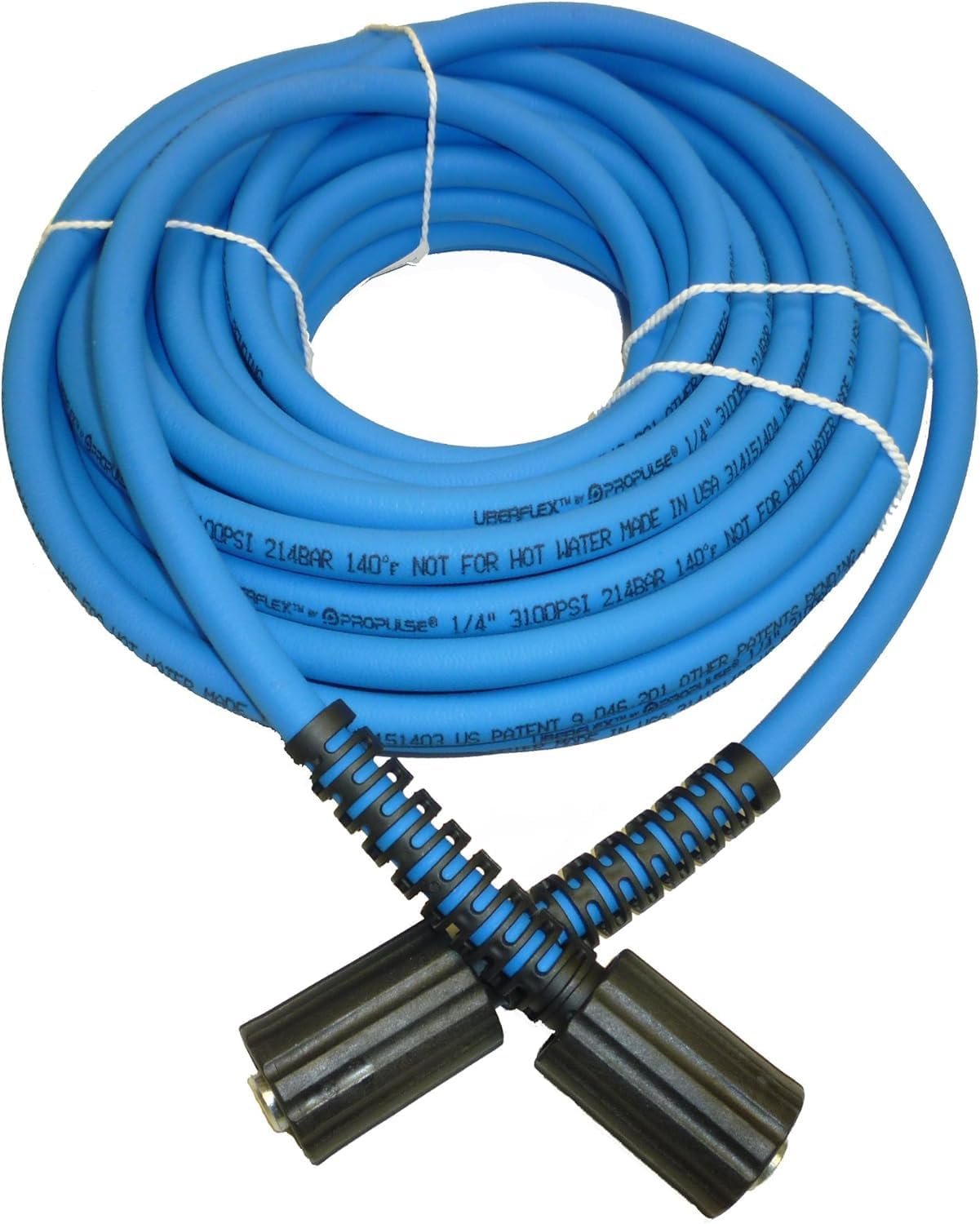
- Cures Extension Cord Tripping Forever: Follows the foundational engineering rule: extend the water hose, never the power cord. Keeps your pressure washer plugged directly into a wall outlet, eliminating inrush voltage drop completely.
- Patented Kink-Resistant Polyurethane: Textured thermoplastic elastomer cover over high-tensile polyester braid glides smoothly over asphalt, never binds into loops, and stays flexible down to 35°F.
- 3,100 PSI Working Pressure Rating: Easily handles full working flow and pressure for Sun Joe, Greenworks, Active, Ryobi, Simpson, and Kärcher electric machines without bulging or pressure drop.
- Standard M22-14mm Brass Ends: Includes standard M22-14mm brass spin collars, plus includes an M22-15mm adapter fitting for full compatibility with Sun Joe SPX series machines. Learn more in our full UberFlex Hose Review.
4. Step-by-Step Diagnostic Guide
Follow these four simple steps to find out why your pressure washer is tripping your circuit:
Step 1. Squeeze the Trigger to Bleed Pressure
If water pressure is trapped in the hose from your last use, the pump pistons sit jammed against solid water. The electric motor simply does not have enough starting torque to push against that backpressure from a dead stop. Always squeeze the spray gun trigger so water flows through the nozzle under garden hose pressure, and only then turn the power switch ON. Bleeding that trapped pressure cuts the starting load in half.
Step 2. Test the Outlet and Isolate the Circuit
Outdoor GFCI outlets take a beating from rain, morning dew, and lawn sprinklers. Dampness inside the exterior outlet box often trips the outlet before you even turn on an appliance. Test the outlet by plugging in a shop light or hair dryer. If it works fine, plug your pressure washer directly into that outlet without an extension cord. For more details on electrical sizing, check our guide on making an electric pressure washer more powerful.
Step 3. Check the Switch Box for Trapped Water
Unplug the machine and remove the plastic cover. Look closely at the master on/off switch. On many consumer washers, the clear rubber waterproof boot over the switch tears over time, letting overspray pool around the wire terminals. Blow warm air across the switch terminals with a hair dryer on low for 3 to 5 minutes to dry out any moisture, then test again.
Step 4. Check for Stiff Plungers and a Stuck Unloader
If the electrical circuit is bone-dry and the capacitor is good, your problem is mechanical. If the washer sat over winter, dried mineral scale can seize the pump pistons. Unplug the machine, take a flathead screwdriver, and gently turn the motor cooling fan blades through the rear vents. If the fan does not spin freely by hand, the pump is stuck. If it spins freely but trips after running for 3 seconds, see our guide on why electric pressure washers start and stop to clear a stuck unloader valve or a clogged spray nozzle.
Verify Electrical & Hydraulic Sizing with Our Free Calculators
Improper nozzle sizing causes severe unloader deadheading, while long high-pressure hose runs require careful diameter selection to prevent friction loss. Use our interactive fluid dynamic tools to verify your rig:
Frequently Asked Questions
Why does my pressure washer trip the GFCI the second I plug it in without turning it on?
Can an extension cord cause a pressure washer to trip a GFCI or circuit breaker?
Why does my pressure washer run for 3 to 10 seconds and then trip the breaker?
Is a GFCI trip always an electrical short, or can pump water leaks cause it?
How do I test if my electric pressure washer motor run capacitor is blown?