
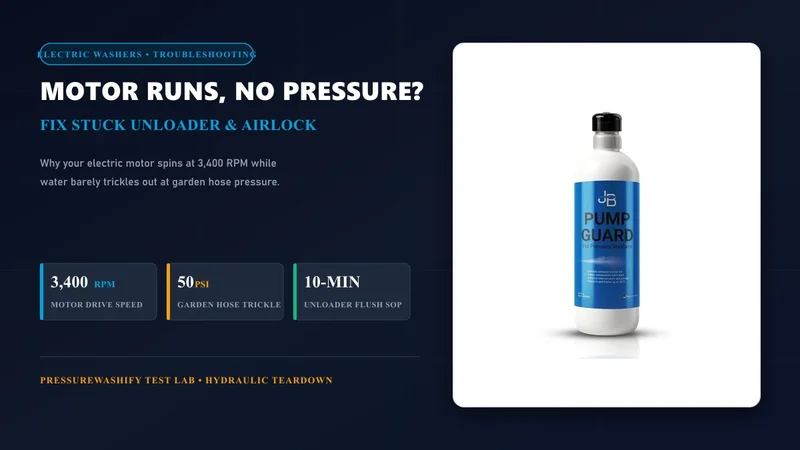
When an electric pressure washer motor hums and spins normally but water only dribbles out at garden hose pressure (40 to 60 PSI), 85% of cases come down to two culprits: a stuck unloader valve bypass piston or an airlock trapped inside the pump manifold. Because water is incompressible and air is compressible, trapped air cushions the pistons and prevents hydraulic pressure from building; meanwhile, a stuck unloader dumps all pressurized water right back into the pump inlet loop.
Few mechanical failures are more confusing than turning on your machine, hearing the electric motor spin at a brisk 3,400 RPM, and watching water lazily trickle out of your spray wand like a tired garden hose. Most owners assume the motor is dead or the pump is destroyed. But the fact that your motor is spinning cleanly proves your electrical circuit, start capacitor, and motor windings are doing fine.
The failure is purely hydraulic. You can diagnose and resolve the issue in ten minutes right in your driveway before replacing expensive components.
The 60-Second Triage — Isolating Air, Nozzles, and the Unloader
- Test 1 — Check your spray nozzle color. If you have the black brass nozzle installed, that is a low-pressure soap tip designed to limit pressure to under 100 PSI so the chemical injector draws soap. Pop in your green 25-degree tip and test again.
- Test 2 — Purge the pump with the motor turned OFF. Switch the machine power switch to OFF. Turn your garden spigot wide open. Pull and hold the spray gun trigger for 45 full seconds. You should see spurts of spitting air followed by a solid stream of garden hose water. Once solid, switch the motor back ON. If pressure returns immediately, you had an airlock.
- Test 3 — Tap the unloader housing gently. If bleeding air does not work, the unloader valve piston is likely seized in bypass mode. With the garden hose on and motor running, gently tap the unloader valve brass/aluminum body with the plastic handle of a screwdriver while pulling the trigger. The shock frequently unsticks the spring.
How an Electric Pressure Washer Pump Actually Builds Pressure
A common misconception is that the pump "makes" pressure. In fluid dynamics, a pump only produces flow (measured in Gallons Per Minute, or GPM). Pressure (Pounds per Square Inch, or PSI) is simply resistance to flow.
Inside an electric pressure washer, a high-speed universal or induction motor turns an angled swashplate (wobble plate). As this slanted plate spins, it pushes three spring-loaded stainless steel pistons back and forth sequentially. Each piston stroke pulls water in through an inlet check valve, compresses it, and forces it out through an outlet check valve into the high-pressure manifold.
When this pressurized water hits the tiny orifice of your spray nozzle (typically 0.040 inches or smaller), the restriction creates backpressure: PSI ∝ (GPM / Orifice)². If water can bypass that restriction or if air enters the chamber, pressure drops to near zero.
Technical Schematic — Normal High Pressure vs Stuck Bypass Loop
The 5 Primary Causes of Zero Pressure on an Electric Washer
If your motor hums or spins but you cannot blast grime, investigate these five physical failure points in order:
1. Stuck Unloader Valve Bypass Piston (Limescale & Debris)
This is the number one cause of zero pressure on electric pressure washers, responsible for over 70% of shop complaints. The unloader valve acts as a mechanical safety diverter. When you let go of the spray trigger, water pressure spikes, pushing a spring-loaded piston open to divert water into an internal bypass loop so the pump does not crack from hydraulic deadheading.
If your machine sat in a garage or shed for several months with mineral-rich tap water inside the pump head, calcium carbonate and lime crust form around the piston shaft and O-rings. The next time you start the washer, the unloader piston jams open. Even though the motor spins at full speed, all water recirculates harmlessly inside the manifold and never travels out to your lance.
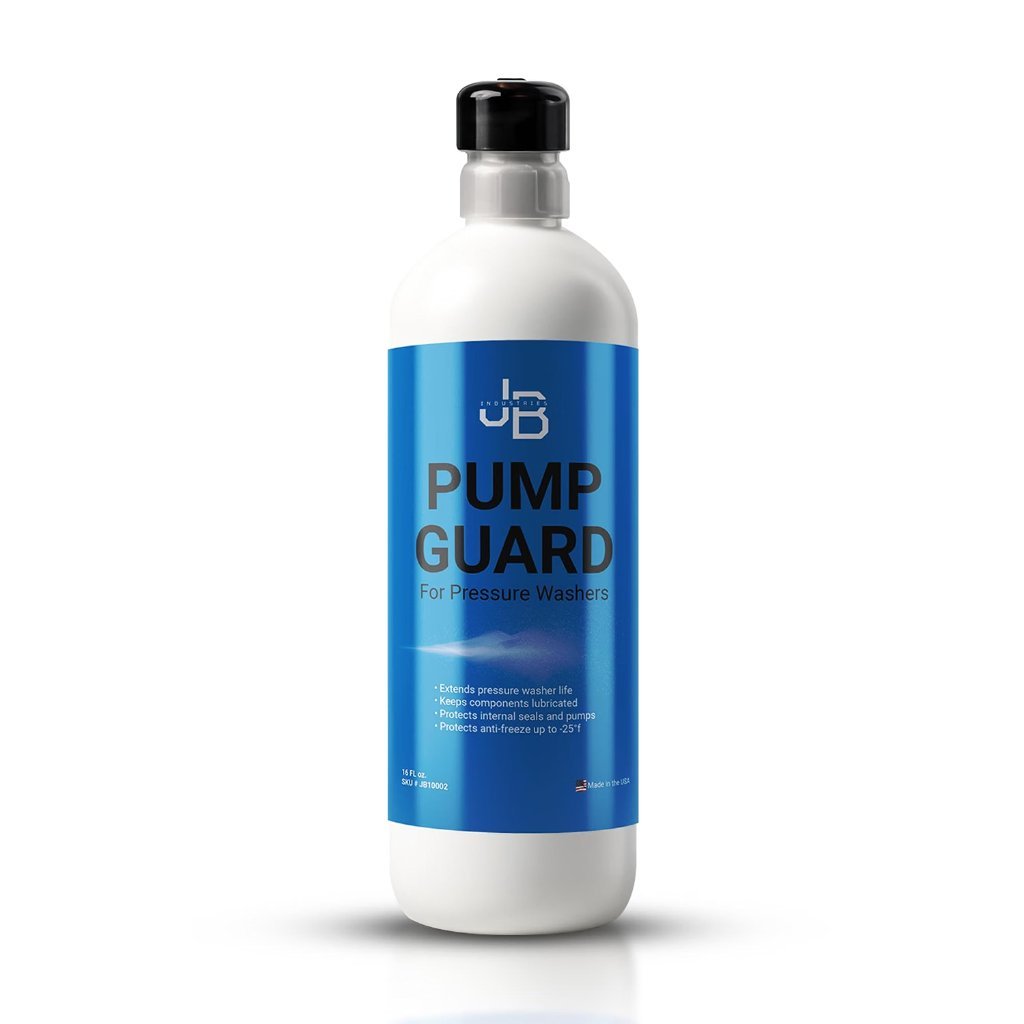
- Frees Sticking Unloader Pistons — Formulated with concentrated lubricants that dissolve hardened mineral scale and loosen frozen unloader springs without tearing down the pump.
- Conditions Internal Piston Packings — Protects Buna-N rubber water seals and synthetic V-packings from drying out, cracking, or sticking to stainless plunger walls during seasonal storage.
- Anti-Freeze Defense Down to -25°F — Prevents trapped winter water from freezing, expanding, and snapping aluminum wobble-plate cylinder heads.
- Universal Thread Fit — Screws directly onto standard 3/4" garden hose inlet threads for a quick 60-second recovery flush.
2. Manifold Air Cavitation (Trapped Air Lock)
If you turn your pressure washer motor on before connecting the water supply and purging air from the hose, the pump fills with ambient air. Water pumps are positive-displacement hydraulic devices engineered to move liquids, not gases.
Because air is highly compressible, the three small pump pistons simply compress and decompress the trapped air bubbles inside the manifold chambers. The check valves cannot seat properly, and water cannot enter the cylinders. The motor whines loudly, but almost zero fluid movement occurs. If your machine starts pulsing when you release the handle, read our complete guide on electric pressure washer pulsing on trigger release.
3. Jammed or Sediment-Fouled Pump Check Valves
Every axial wobble-plate pump features six check valves: three suction valves that let water into the piston chambers, and three discharge valves that push water toward the outlet. These valves rely on miniature plastic poppet cages, rubber O-rings, and fine stainless steel return springs.
If water entering your machine contains fine sand, well silt, or flakes of garden hose rust, debris lodges between the poppet face and its brass seat. If even one check valve is held partially open by grit, water sloshes backward into the suction chamber on every piston stroke rather than building head pressure. If your motor only hums and struggles to turn over at all, see our diagnosis on fixing an electric pressure washer motor that hums but won't run.
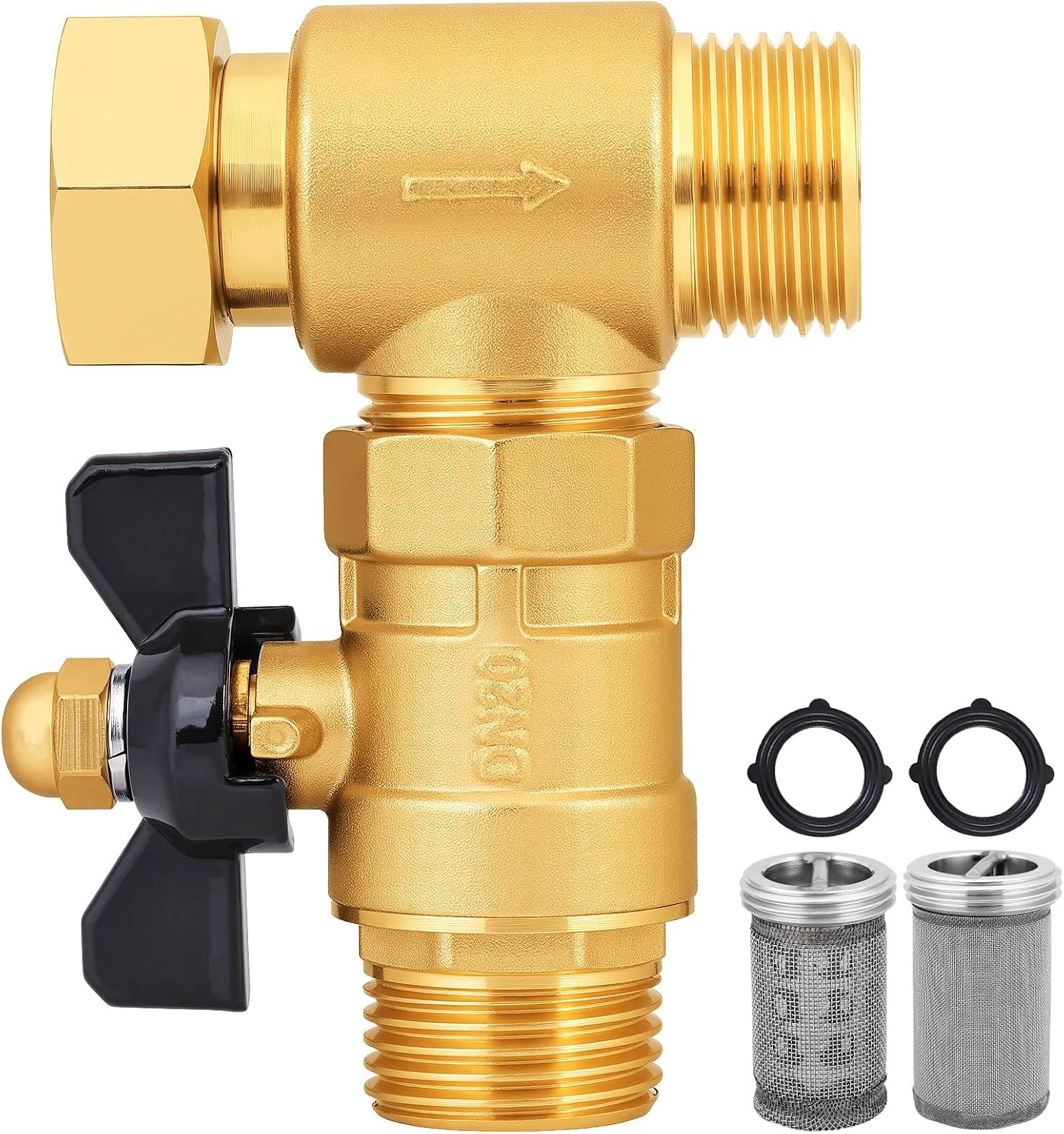
- Catches Silt Before the Pump — Dual-stage 40-mesh and 100-mesh stainless steel filter screens catch fine sand, iron rust, and pipe scale before they can foul delicate pump check valves.
- Heavy-Duty Solid Brass Body — Heavy-duty machined 3/4" GHT brass fittings eliminate cross-threading and withstand high garden hose supply pressures without cracking.
- Quick-Flush Purge Valve — Features a bottom purge ball valve allowing you to flush trapped sediment in five seconds without unscrewing the housing.
- Protects Pump Packings — Prevents abrasive grit from scoring ceramic and stainless pump plungers, extending high-pressure seal lifespan.
4. Stripped Motor Drive Pin or Wobble Plate Keyway
In residential electric pressure washers (such as Sun Joe SPX series, Ryobi, Kärcher K1700, and Greenworks), the motor armature shaft couples to the pump wobble plate through a steel shear pin, keyway, or reduction planetary gear set.
If the pump seized due to dry running or winter freeze damage, or if the unit suffered a severe hydraulic pressure spike, this pin acts as a mechanical fuse and shears off. When this happens, the electric motor spins completely freely with very little electrical resistance. You will hear the motor whirring at a higher pitch than normal, but the pump pistons never stroke. If this occurs, the pump head or drive gear requires physical replacement.
5. Installed Black Soap Nozzle or Blown Orifice
Never underestimate the simplest fix. Pressure is generated exclusively when water is squeezed through a restrictive nozzle orifice. Pressure washer quick-connect tips are color-coded:
- 0° Red — Pinpoint cutting jet (maximum pressure).
- 15° Yellow — High-pressure chisel spray.
- 25° Green — Universal general cleaning fan.
- 40° White — Gentle wide vehicle wash.
- 65° Black — Low-pressure wide soap nozzle.
The black soap nozzle has an orifice diameter over three times larger than high-pressure tips. If that nozzle is clicked into the wand, line pressure drops below 100 PSI by design so the chemical siphon valve opens. If no nozzle is installed in the wand collar at all, water flows with zero resistance.
Step-by-Step Recovery Guide — How to Restore Full Pressure
Follow this workshop sequence to unstick your pump and restore full operating pressure without paying for a shop repair:
- Shut Off Power and Connect Full Water Flow — Disconnect the electrical cord from the wall. Hook up a 5/8" or 3/4" garden hose to your outdoor spigot and turn the water on completely.
- Purge the Pump Manifold — Take any spray tips out of the wand collar. Squeeze the spray gun trigger and hold it open for 60 seconds. Wait until all coughing, sputtering, and air pockets stop, leaving a smooth, solid stream of water flowing out the end of the wand.
- Perform an Unloader Lubricant Flush — Turn off the water supply and disconnect the garden hose. Pour or inject 2 to 3 ounces of pump guard lubricant directly into the water inlet fitting. Turn the motor on for exactly 2 seconds to draw the lubricant into the internal valve chambers, then switch it off. Let it sit for 20 minutes to soften mineral scale.
- Snap the Unloader Piston Free — Reconnect your garden hose and turn water back on. Plug in the power cord. Squeeze the spray gun trigger and switch the motor ON. Rapidly pull and release the spray trigger 10 times in five-second bursts. The sudden hydraulic pressure shock waves will snap a sticking unloader piston back into its normal operating position.
- Install a Clean 25° Green Nozzle — Click your green 25-degree nozzle into the wand collar. Squeeze the trigger. The pump will immediately bite and discharge at full rated pressure.
Diagnostic Table — Zero Pressure Symptoms vs Root Causes
Use the matrix below to match the physical behavior of your electric washer with the exact repair step:
| Observed Symptom | Sound / Motor Pitch | Underlying Cause | Immediate Driveway Test | Mechanical Fix |
|---|---|---|---|---|
| Steady Water Trickle (50 PSI) | Normal humming pitch | Unloader piston stuck in bypass | Tap unloader body; rapidly cycle trigger 10 times | Flush with pump guard; descale internal unloader spring |
| Water Sputters and Pulses Weakly | Struggling, uneven pitch | Air cavitation inside pump manifold | Shut off motor, pull trigger for 60s under full water flow | Bleed all air bubbles through open wand before powering on |
| Wide Spray but Zero Impact Force | Normal smooth pitch | Black soap nozzle or missing tip | Inspect wand collar orifice color | Swap to green 25° nozzle; verify orifice size matches GPM |
| Water Pressure Cycles 0 to 500 PSI | Jerky pulsing rhythm | Sediment holding check valve open | Inspect inlet filter screen for sand or rust flakes | Clean inlet screen; install inline 50-mesh sediment filter |
| Motor Screams at High Pitch | High-pitched whining spin | Stripped shear pin or drive spline | Feel pump head; zero vibration or water movement | Replace motor drive pin, wobble plate, or pump assembly |
Nozzle Orifice & Operating Pressure Calculator
Did you know that installing an oversized nozzle orifice drops your working pressure by hundreds of PSI? Use our free calculator to calculate the exact orifice size required for your machine's GPM and motor capacity.
CALCULATE NOZZLE ORIFICE SIZEShop Rule — The 3 Golden Rules to Protect Electric Pump Pressure
To ensure your pump pistons never lose pressure or seize between uses, apply these three shop rules:
- Always Bleed Before You Power Up — Never flip the power switch until water has flowed continuously through the un-nozzled wand for 30 to 45 seconds. Running dry for even 10 seconds causes friction heat that scores plastic valve cages.
- Use an Inline Sediment Filter on Well Water — If your water comes from a well or older municipal galvanized pipes, install a 40/100 mesh inline filter at the spigot to keep micro-silt from jamming check valves.
- Store Wet with Pump Guard — Before putting your pressure washer away for more than two weeks, inject pump saver into the inlet. This prevents limescale from freezing the unloader piston during storage.