
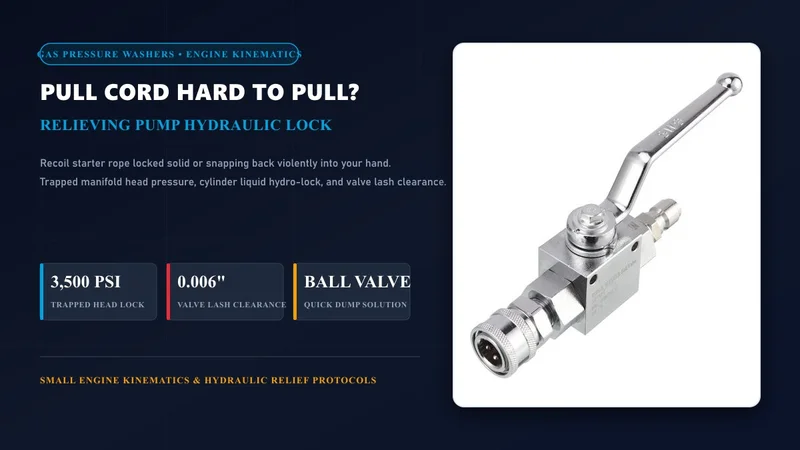
If your gas pressure washer pull cord feels stiff, locks solid, or violently snaps back and bruises your fingers, 85% of the time you are fighting trapped water pressure inside the pump. Water cannot compress. When water is trapped behind a closed spray gun, the pump pistons hit a solid wall of fluid, stopping the engine from turning and snatching the starter rope right out of your grip.
If you have ever felt that painful jolt where the recoil starter rips out of your hand, don't worry—your engine usually isn't ruined. While trapped water pressure causes most stuck pull cords, the remaining cases come down to two engine issues: loose overhead valve (OHV) clearance disabling the engine's compression release, or a flooded cylinder where liquid gas leaked past the carburetor into the engine. You can isolate the problem in under a minute.
The 60-Second Triage — Isolating Pump vs Engine vs Starter
- Test 1: Squeeze the spray gun trigger while pulling. If the rope suddenly pulls smoothly and the engine turns over freely, your engine is completely fine. You were simply fighting trapped water pressure in the pump.
- Test 2: Shut off the spigot, disconnect the garden hose, and pull. If the rope still kicks back hard every couple of pulls, the issue is not water. Move directly to the engine's OHV valve lash clearance.
- Test 3: Remove the spark plug and pull the cord. With the spark plug out, the engine has zero cylinder compression. If the rope still won't budge at all, you either have liquid fuel hydro-lock in the cylinder or a seized pump.
Root Cause 1 — Trapped Water Pressure in the Pump
To see why a pressure washer locks the starter cord, look at how the pump connects to the engine. On almost all consumer and commercial gas washers (like Simpson, DeWalt, Generac, and Ryobi), the pump bolts directly to the engine crankshaft. There is no clutch. When you pull the starter rope, you are turning the engine flywheel and pushing three pump pistons forward at the exact same time.
Water does not compress. Once you turn on your garden hose, water fills the pump. As soon as you pull the cord, the pump check valves close. If the spray gun trigger is released, that water has nowhere to go. Trying to push those pump pistons against a closed spray gun is like trying to push against solid rock.
Engineering Note — Why the Rope Snaps Back So Hard
Why does the rope snap back with enough force to sprain a wrist? It comes down to hydraulic force:
When water gets trapped at just 1,200 PSI against a closed spray gun, it pushes backward against the pump plungers with over 300 pounds of force. That backward force transfers straight through the pump shaft into the engine recoil pulley. The moment the pistons hit that trapped water, the crankshaft stops dead, and all that recoil energy whips the starter handle straight back into the housing.
Hydraulic Lock vs Relieved Flow State
The diagram below illustrates what happens inside the pump head during cranking when pressure is trapped versus when it is relieved to atmospheric pressure:
How to Relieve Head Pressure (The Trigger Squeeze vs The Ball Valve)
The universal zero-cost fix is simple: always squeeze the spray gun trigger with one hand while pulling the starter rope with the other. Squeezing the trigger opens the spray gun valve, giving the trapped water an open exit path through the nozzle. Pressure in the hose immediately drops to zero, the pump plungers push water freely, and the cord pulls smoothly without resistance.
However, anyone who runs a gas pressure washer alone knows how awkward this is. You are crouched next to the machine, one foot bracing the frame, your left arm stretched out holding a 3-foot spray wand, while your right arm tries to yank the recoil handle. If you let go of the trigger for just two seconds to get a better grip, head pressure builds right back up.
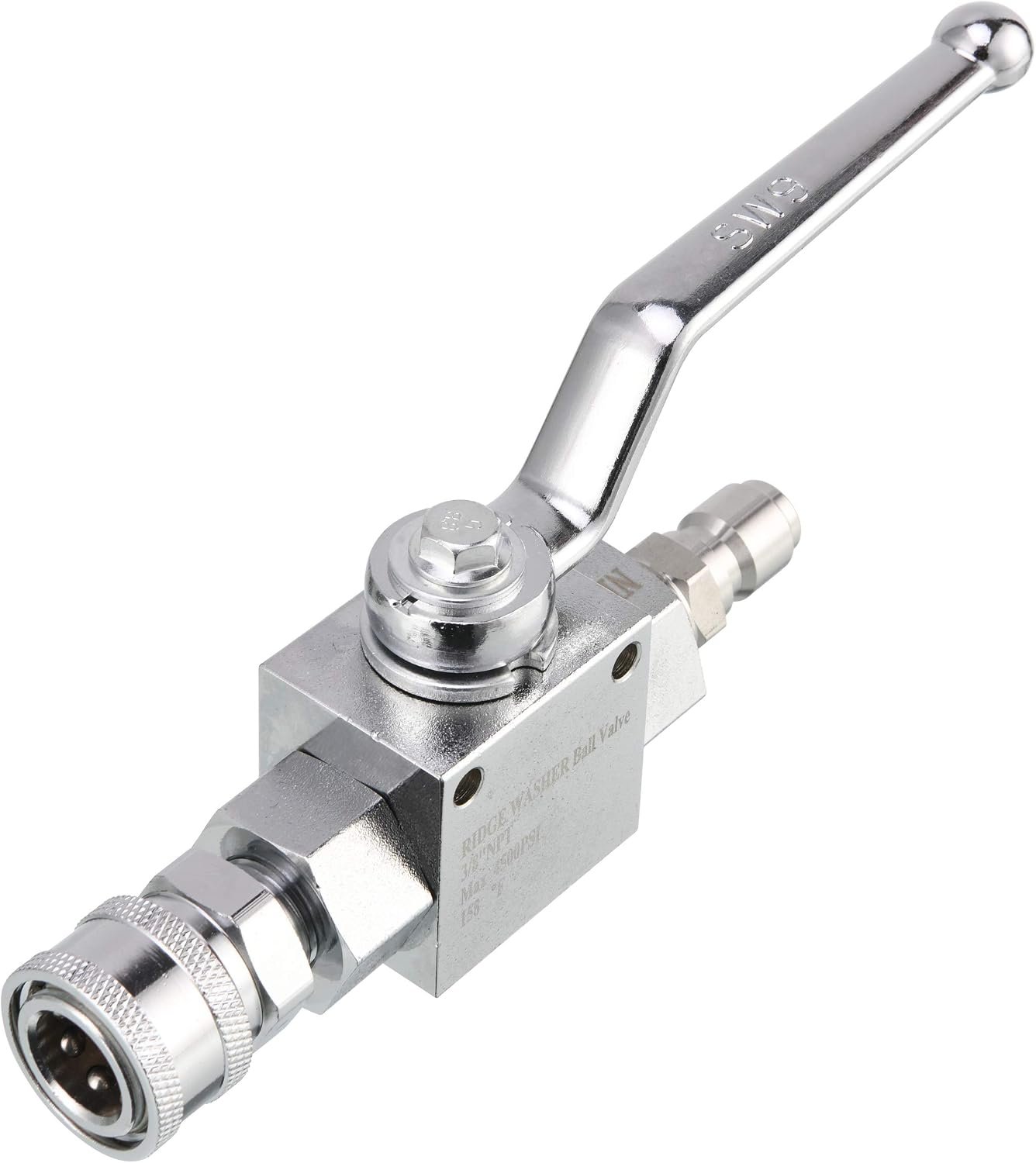
- No More Gun Balancing: Mounts right at the pump outlet. Open the valve before starting so water dumps freely onto the ground. You no longer have to crouch and awkwardly squeeze the spray gun while pulling the cord.
- Effortless One-Hand Pulls: Drops hydraulic backpressure to zero. The engine turns over smoothly without snapping the rope out of your fingers or jerking your wrist.
- Instant Spray Ready: Once the engine is idling, flick the stainless lever closed with one hand and your spray gun is instantly charged and ready to clean.
- Solid 4,500 PSI Stainless Construction: Machined from forged stainless steel with tight PTFE seals to handle daily pressure spikes without leaking or seizing, featuring standard 3/8-inch quick-connect fittings.
Root Cause 2 — Loose Valve Lash and Compression Release Failure
What if the garden hose is completely disconnected, the pump is empty, and the starter cord still jerks your arm back on every pull? When that happens, the problem is not in the water pump—it is inside the engine's valvetrain.
Popular small engines (like Honda GX series, Predator 212, Kohler, and Briggs & Stratton) have high cylinder compression. If you had to pull the piston through its compression stroke against a completely sealed cylinder, it would take tremendous force, and pull cords would snap regularly.
How the Automatic Decompression System Works
To keep the starter cord easy to pull, manufacturers build a tiny automatic decompression mechanism right onto the engine camshaft:
- During Cranking: A small spring-loaded flyweight holds a tiny metal pin sticking up slightly on the camshaft.
- Bleeding the Pressure: As you pull the starter rope, this tiny pin nudges the exhaust valve open just a fraction of a millimeter. That lets roughly half the trapped air escape out the muffler so you can pull the rope smoothly.
- Once Running: The second the engine fires and spins up to idle speed, centrifugal force flings the flyweight outward. The tiny pin drops out of the way, giving the engine full compression to produce full working power.
Why Loose Valve Lash Causes Violent Recoil Kickback
Valve lash is simply the tiny mechanical gap between the rocker arm and the top of the valve stem. On small engines, this gap should be about 0.005 inches (0.13 mm)—roughly the thickness of a business card. Over time, vibration and heat wear these parts and loosen the adjustment nut. If this gap widens to 0.010 or 0.015 inches, the extra looseness completely swallows the tiny bump from the decompression pin. The rocker arm never touches the valve during cranking. Because the valve stays tightly closed, you are forced to pull against 100% of the engine's compression stroke. The cord violently jerks out of your hand and snaps back against the starter housing.
How to Adjust Valve Lash in 15 Minutes
You only need a 10mm socket, a small wrench, and an inexpensive feeler gauge set:
- Remove the Valve Cover: Let the engine cool completely. Disconnect the spark plug wire, remove the spark plug, and remove the four 10mm bolts holding the metal valve cover in place.
- Find Top Dead Center (TDC): Slowly pull the recoil cord until both rocker arms are loose and relaxed (neither valve is being pressed down). Look into the spark plug hole or insert a clean wooden pencil/dowel until the piston reaches its highest point.
- Rotate Slightly Past TDC: Once at top dead center, turn the flywheel about 1/4-inch further past top dead center. This ensures the decompression pin on the camshaft has completely cleared the exhaust lifter.
- Check the Gap: Slide a 0.005-inch feeler gauge blade between the rocker arm pad and the top of the valve stem. It should slide through with light, smooth friction—like pulling a playing card from a deck.
- Adjust the Nut: If the gauge is loose or won't fit, hold the lower pivot nut with a wrench and loosen the locknut. Adjust the nut until the 0.005-inch gauge drags with light friction, then hold it steady while tightening down the locknut.
- Double-Check: Verify with a 0.004-inch gauge (should slip in easily) and a 0.007-inch gauge (should not fit). Bolt the valve cover back on with its gasket and reinstall the spark plug.
Root Cause 3 — Cylinder Hydro-Lock from Gas Flooding
If the pull cord is frozen solid—meaning you cannot pull it even a single inch, as if the engine block is welded together—you likely have liquid fuel hydro-lock. Unlike trapped water in the pump (which usually gives an inch or two before stopping) or loose valves (which resist during the compression stroke), hydro-lock creates a hard mechanical stop that will not budge.
This almost always happens after storage when the fuel shutoff valve is left open. Gravity pulls gasoline from the gas tank into the carburetor bowl. If old gas residue or dirt keeps the carburetor float needle from sealing, fuel overflows continuously.
The excess gas spills into the carburetor throat, runs down the intake tube, slips past an open intake valve, and pools directly on top of the engine piston. When you go to pull the starter cord, the piston rises to compress air, but hits a solid puddle of liquid gasoline instead. Because liquid cannot compress, the piston stops dead in its tracks.
Warning — Do Not Force a Locked Pull Cord
Never plant your feet on the frame and yank on a locked cord with both hands. Small engine connecting rods are made of aluminum. Forcing the piston against a wall of liquid gas can bend the connecting rod, damage the piston wrist pin, or break the starter pulley. If the cord feels rock solid, stop immediately and pull the spark plug.
How to Clear a Flooded Cylinder Safely
If fuel has locked your engine, use this 4-step process to clear it out safely:
- Turn Off Fuel and Pull the Plug: Close the fuel valve under the gas tank. Pull off the spark plug wire and unscrew the spark plug. If the plug tip is dripping with gasoline, the cylinder is flooded.
- Clear the Gas: Hold a thick shop rag directly over the open spark plug hole. Gently pull the starter rope 5 to 6 times. The piston will shoot the trapped liquid gas out into the towel. Once empty, the cord will pull smoothly and easily.
- Check the Engine Oil (Crucial Step): Pull the oil dipstick and smell it. When gasoline floods a cylinder, it seeps past the piston rings directly into the engine oil sump. If the oil smells like gas or reads way above the full line, do not run the engine. Gas-thinned oil cannot lubricate the engine bearings and will ruin the motor within minutes. Drain the crankcase and refill with fresh oil.
- Clean the Carburetor Float: Remove the carburetor bowl, wipe out any dirt or gummy varnish, and make sure the float needle moves freely. If the engine has been sitting with old gas, check our guide on fixing a pressure washer that only runs on choke, and read about whether you can safely run a pressure washer with the choke on.
Diagnostic Guide — Quick Comparison Table
Use this guide to match how your cord feels with the right fix:
| Symptom & How It Feels | Underlying Cause | Water Supply Connected? | Quick 30-Second Test | How to Fix It |
|---|---|---|---|---|
| Pulls a few inches, then hits a wall and kicks back | Trapped water pressure in pump manifold | YES (Only happens with water on) | Squeeze spray gun trigger; cord immediately pulls freely | Hold gun trigger while pulling or add a 3/8" High Pressure Ball Valve |
| Jerky, stiff pull with harsh recoil every stroke | Exhaust valve lash is too loose | NO (Happens dry with water disconnected) | Disconnect water hose; starter rope still kicks back at TDC | Adjust valve lash to 0.004–0.006" with a feeler gauge |
| Locked 100% solid, won't move even a fraction of an inch | Gasoline flooded in cylinder (hydro-lock) | NO (Happens dry after storage) | Remove spark plug; raw gasoline shoots out when pulled | Discharge fuel with a rag, check/change oil, clean float needle |
| Rope sticks halfway out, grinds, or won't retract | Recoil starter assembly damaged or jammed | NO (Happens even with spark plug out) | Remove 3 recoil shroud bolts and pull starter off the engine | Clean starter pulley, lube ratchet pawls, or replace recoil unit |
| Completely stuck rope with plug out and pump unbolted | Engine internal seizure or pump plunger freeze | NO (Mechanical freeze) | Unbolt pump from engine shaft to see which unit is frozen | Inspect pump ceramic plungers or engine crankcase for internal damage |
PSI and Bar Pressure Converter Tool
Need to check the burst pressure ratings on your bypass hoses, fittings, or ball valves? Use our free converter to switch between PSI, bar, and megapascals in seconds.
OPEN PSI & BAR CONVERTERShop Rule — Easy Cold-Start Checklist
To protect your starter cord and save your wrists from painful kickback, follow this straightforward routine every time you start:
- Hook up the garden hose, turn the water tap fully on, and hold the gun trigger for 30 seconds until water flows smoothly without sputtering air.
- Turn the engine switch to ON, fuel valve to ON, and choke to FULL.
- Open your high-pressure ball valve, or wrap a velcro strap around the gun trigger to hold it open.
- Pull the starter cord gently until you feel the starter teeth catch, then pull firmly through a full stroke. The engine will catch cleanly without kicking back.