
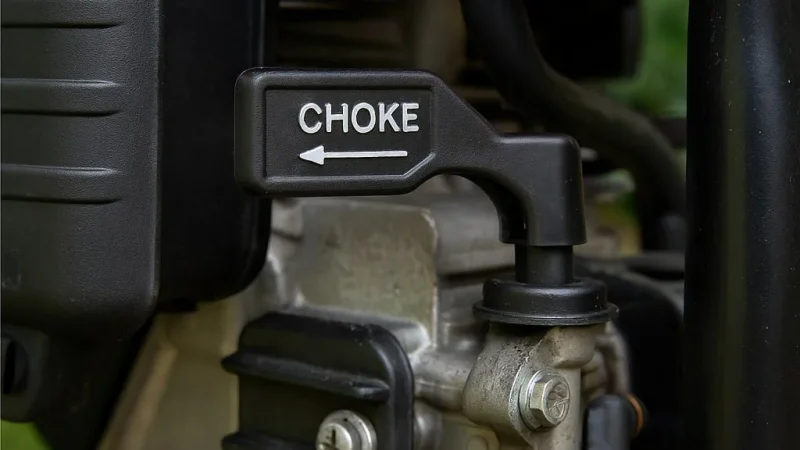
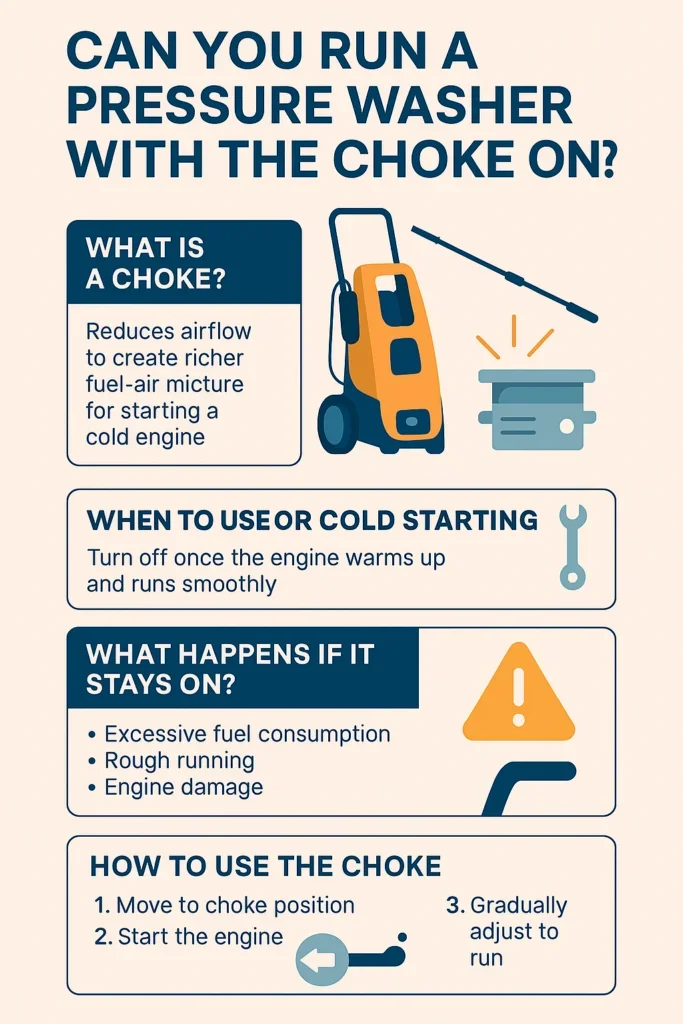
No, never run your pressure washer with the choke on after the engine fires up. The choke plate has one job: blocking intake airflow to force an ultra-rich fuel mixture into a cold block. Leave that lever closed while you work, and bad things happen fast. You'll foul the spark plug, strip lubricating oil right off the cylinder sleeve, and wash raw gasoline into the crankcase.
Your choke belongs closed for only 10 to 30 seconds. The instant the engine catches and settles into an idle, flip the lever wide open to RUN. Never pull the spray gun trigger until that choke is open and the governor stabilizes.
Najam's 30-Second Choke Rule
The choke is a cold-start tool, not a throttle. Close the plate to fire a cold engine. Let it catch and find its legs for 10 to 30 seconds. Then slide the lever straight to RUN. If the engine dies the moment you open it, your fuel jets are plugged. Use our workbench guide on how to fix a pressure washer that only runs on choke to clear them out.
How a Carburetor Choke Works Mechanically
Small engines like a Honda GX200, Predator 212, or Kohler SH265 rely on a precise air-to-fuel balance inside the combustion chamber. When an engine runs at normal temperature, that target ratio is 14.7 parts air to 1 part fuel. Mechanical engineers call this the stoichiometric balance. At this ratio, every drop of atomized gasoline burns cleanly, delivering full engine torque with minimal exhaust soot.
A dead-cold block throws two major thermodynamic hurdles at you:
- Poor Fuel Vaporization: Cold gas won't vaporize easily. Liquid droplets hit cold aluminum intake walls and puddle instead of turning into combustible mist.
- Heavy Intake Air Density: Dense cold air needs extra fuel vapor near the spark plug to ignite that first stroke.
Closing the choke plate seals off about 80% of the carburetor intake bore. When the piston travels downward on the intake stroke, manifold vacuum spikes dramatically. That intense vacuum draws a heavy slug of liquid fuel through the main and pilot jets. You get a rich 8:1 to 10:1 mixture that sparks easily on your first or second pull.
5 Serious Mechanical Failures From Running on Choke
Leaving the choke closed while washing forces the engine to run drowning in fuel. That constant rich mixture wrecks five critical engine components:
1. Cylinder Bore Wash (Piston Ring Scoring)
This is the fastest way to scrap a small engine block. Excessive liquid gasoline acts like an industrial solvent inside the cylinder. It washes away the thin boundary layer of motor oil lubricating the cast-iron cylinder sleeve. Piston rings then drag metal-on-metal against the bare bore. Within an hour, friction scores the cylinder wall, tears up compression, and causes irreversible blow-by.
2. Spark Plug Carbon Fouling and Misfires
Incomplete combustion dumps heavy, wet carbon soot all over the spark plug electrode and ceramic insulator. This soot conducts electricity. It creates a path for voltage to bleed straight to engine ground instead of jumping the plug gap. Your engine sputters, pops, and dies the second you squeeze the spray gun trigger.
3. Crankcase Oil Dilution
Unburned gas trapped above the piston has to go somewhere. High cylinder pressure forces that liquid fuel right past the piston rings into the crankcase. Gasoline tears motor oil apart. It destroys viscosity and strips the oil of shear strength. Run it like that, and you'll spin a connecting rod bearing or wipe out the crankshaft. If your dipstick smells like gas or reads overfilled, dump the oil. Check our Honda pressure washer oil recommendations to refill with the proper viscosity.
4. Exhaust Black Smoke and Spark Arrestor Clogging
Without enough oxygen, raw gasoline cannot burn. It exits the exhaust valve as dense black smoke packed with unburned carbon particulates. That carbon cakes against the fine wire mesh of the muffler spark arrestor. The screen plugs up tight. Exhaust backpressure spikes, choking engine power and driving head temperatures through the roof.
5. Power Loss Under Hydraulic Pump Load
A triplex or axial cam pump demands full governed engine speed—typically 3,400 to 3,600 RPM—to spin the swash plate and cycle the ceramic pistons. Running rich starves the engine of real brake horsepower. When you squeeze the gun trigger, pump backpressure loads the crankshaft. A choked engine bogs hard, water pressure falls off a cliff, and the unloader valve chatters violently from RPM flutter.
Choke Position Comparison: CHOKE vs. RUN
The table below details how carburetor air-fuel ratios, engine dynamics, and equipment performance compare across both positions:
| Engine Parameter | Choke Lever: CLOSED (CHOKE) | Choke Lever: OPEN (RUN) |
|---|---|---|
| Carburetor Butterfly Flap | Restricts air passage by ~80% | Fully open; 100% unrestricted airflow |
| Air-Fuel Ratio | Extra-rich (8:1 to 10:1 mixture) | Balanced stoichiometric (~14.7:1 mixture) |
| Intended Purpose | Initial cold startup ignition only | Continuous pressure washing operation |
| Maximum Safe Duration | 10 to 30 seconds maximum | Continuous for entire work session |
| Exhaust Characteristics | Raw gas smell; intermittent black smoke | Clear, clean exhaust stream |
| Engine RPM & Working Pressure | Erratic, low RPM; stalls under pump load | Full 3,400 to 3,600 RPM; full rated PSI/GPM |
| Long-Term Mechanical Impact | Fouled plug, scored cylinder, thinned oil | Clean combustion, normal engine longevity |
The Real Problem: Why Does My Pressure Washer ONLY Run on Choke?
Does your engine die the moment you open the choke to RUN? That means you're dealing with an unmetered lean fuel condition. When the choke opens, the carburetor lets in full intake air, but restricted fuel circuits can't deliver enough gasoline. Starved of fuel, the fire goes out. Flipping the choke lever closed chokes off the air, artificially dragging the air-fuel ratio back into a combustible range. It keeps the motor running, but it's just masking a clogged jet.
Here is how that fuel starve happens, followed by the four most common culprits in the shop:
1. Clogged Carburetor Pilot Jet
Standard pump gas carries up to 10% ethanol (E10). Leave that gas sitting in the float bowl for a month, and the light ends evaporate away. What's left is a gummy, amber varnish. That sludge plugs the tiny 0.015-inch orifice inside the pilot jet and idle emulsion tube. The idle circuit goes dry. Open the choke plate, and the engine stalls instantly. To pull that jet and clean it clean, follow our guide on how to fix a pressure washer that only runs on choke.
2. Stale Ethanol Fuel and Phase Separation
Ethanol is hygroscopic. It pulls moisture right out of humid ambient air. After 30 to 60 days of storage, water binds with the alcohol and drops to the bottom of the fuel tank. That bottom layer won't burn. Your carburetor jet draws straight from the bottom of the float bowl, feeding dead water instead of gas. To protect your fuel system, read our guide on what gas to use in a 4-stroke pressure washer.
3. Intake Gasket Vacuum Air Leaks
Engine vibration rattles carburetor mounting studs loose over time. If a nut backs off or the paper gasket between the carb and cylinder head tears, outside air gets sucked in behind the throttle plate. That false air leans out the mixture so severely that only a closed choke can keep the engine firing.
4. Plugged Fuel Tank Cap Vent
Fuel tank caps use a tiny one-way vent to let air in as gas drains into the engine. When dirt or dried fuel crust plugs that vent, a vacuum locks the tank. Gravity stops pulling fuel down into the float bowl. The engine starves and dies after a couple of minutes. Back the gas cap off half a turn. If the engine perks right up, you found your culprit.
The Correct Cold-Start & Running Sequence
Want clean starts without flooding the plug or fighting the recoil starter rope? Follow this shop-proven starting routine:
- Relieve Pump Head Pressure: Check engine oil, hook up your garden hose, and turn the water on full. Always squeeze the spray gun trigger while pulling the recoil cord. That bleeds trapped air and prevents high hydrostatic backpressure from fighting the starter cord.
- Set Choke and Fuel Valves: Switch the engine ignition to ON. Open the fuel valve. Push the throttle lever to MAX, and move the choke lever fully to CHOKE.
- Pull the Starter Cord: Pull the recoil handle out until you feel the starter dogs engage against the flywheel compression stroke. Give it a brisk, smooth pull until the engine catches.
- Step Down to RUN: The moment it fires, slide the choke lever to HALF CHOKE for 5 to 10 seconds. As the block warms up, push the lever all the way to RUN.
- The Warm Restart Rule: If the engine ran within the last 15 minutes, leave the choke alone. Warm cylinders vaporize fuel easily. Choking a hot engine will soak the spark plug and flood it dead.
Rig Setup and Line Sizing
Once your engine runs clean in the RUN position at full governed RPM, make sure the rest of your rig pulls its weight:
- Hose Friction Losses: Long hose lines eat nozzle pressure fast. Check your actual pressure loss and chemical injector limits with our free Hose Friction Loss Calculator.
- Surface Cleaner Matching: Stop leaving zebra stripes across driveways. Match your rotary deck diameter to your pump's true GPM using our Surface Cleaner Size Calculator.
- Coupler Flow Restrictions: Don't let undersized quick-connect fittings choke your water flow. Pick the right bore size with our Pressure Washer Fittings Guide.
- Job Estimating: Pricing commercial flatwork or house washes? Dial in square footage, chemical costs, and labor with our Pressure Washing Estimate Calculator.
Frequently Asked Questions
Can I run my pressure washer with the choke on?
No, you should never run a pressure washer with the choke on after the engine starts. The choke restricts air to create an extra-rich fuel mixture needed only for cold starting. Running continuously on choke causes severe spark plug carbon fouling, cylinder bore wash, unburned fuel exhaust, and oil dilution.
Why does my pressure washer only stay running when the choke is on?
If an engine dies immediately when moved to the RUN position, it is suffering from a lean fuel delivery problem. The most common cause is a clogged carburetor pilot (low-speed) jet or main emulsion tube, usually caused by stale ethanol gasoline residue. Choking the air artificially forces fuel through, compensating for the clogged jet.
How long should a pressure washer run on choke before switching to run?
A pressure washer should only remain on full choke for 10 to 30 seconds. As soon as the engine catches and begins running consistently, slide the lever to half-choke for a few seconds, then fully open to the RUN position.
Can running a pressure washer on choke damage the pump?
Indirectly, yes. Running on choke causes incomplete combustion, resulting in erratic RPM drops and engine surging. This irregular drive speed destabilizes the pump unloader valve and axial cam pistons, causing hydraulic pressure spikes and excess pump vibration.
What are the symptoms of an engine running with the choke left on?
Classic symptoms include heavy black soot exhaust smoke, a strong raw gasoline smell, sputtering or surging under trigger load, rapid spark plug electrode fouling, and dark, fuel-diluted engine oil in the crankcase.