Gas pressure washers deliver what electric machines physically cannot: unlimited raw mechanical horsepower untethered from wall outlets. When you jump from a 120-volt electric motor to a 200cc or 390cc four-stroke gas engine, available shaft power jumps from 2 horsepower to 6.5, 13, or even 22 horsepower. That is how commercial rigs push 4.0 gallons per minute (GPM) at 3,500 to 4,000 PSI—enough hydraulic force to strip industrial epoxy, run 20-inch surface cleaners, or blast second-story siding from the ground.
However, that combustion power comes with serious mechanical consequences. Gas engines shake, generate blistering exhaust heat, and rely on brass carburetors that gum up if modern ethanol fuel sits for even thirty days. Inside the pump, ceramic plungers spin at thousands of RPMs, demanding specialized non-foaming oil that behaves completely differently from car motor oil.
This master manual strips away small-engine guesswork. Below, you will find the exact math connecting engine displacement (CC) to true pump output, how direct-drive and belt-drive pumps differ inside, why putting motor oil in a water pump ruins the seals, and step-by-step Standard Operating Procedures (SOPs) to solve carburetor surging and hydrolock.
Thermodynamics & Torque Matching: Sizing Engine CC to Pump Output
The single biggest mistake buyers make when shopping for gas pressure washers is looking only at advertised PSI on the box. In fluid mechanics, pressure is easy to manufacture; high water volume (GPM) is what takes real engine muscle.
Every commercial pressure washing setup obeys the fundamental hydraulic power equation. To find the minimum engine horsepower required to spin a high-pressure pump continuously under full load, engineers use this formula:
Required Engine Horsepower (HP) ≈ [ (Working PSI × Flow Rate GPM) / 1,714 ] × 1.45
Why multiply by 1.45? That multiplier accounts for two real-world mechanical bottlenecks: pump friction losses (roughly 10% to 15%) and small air-cooled engine thermal derating. A small four-stroke engine loses about 10% to 15% of its gross rated power when running in hot outdoor summer air with an air filter, spark arrestor, and muffler installed.
Let's plug in real numbers for a commercial 4.0 GPM at 3,500 PSI surface-cleaning setup:
HP = [ (3,500 × 4.0) / 1,714 ] × 1.45 = 8.16 × 1.45 ≈ 11.83 Net Horsepower
This math explains why a 200cc engine (like a Honda GX200, rated around 5.5 to 6.5 HP) can never run a 4 GPM commercial pump. If you pair a small engine with an oversized pump, pulling the trigger drops the engine RPM off its power curve, causing the motor to bog down, black-smoke from unburnt fuel, and stall.
| Engine Displacement (CC) | Typical Engine Models | Net Horsepower | True Working Output | Crankshaft Specs (SAE J609a) |
|---|---|---|---|---|
| 160cc – 212cc | Honda GX160/GX200, Predator 212, Kohler CH270 | 5.5 – 6.5 HP | 2.3 – 2.5 GPM @ 2,700 – 3,000 PSI | 3/4" Straight Keyed Shaft |
| 270cc | Honda GX270, Kohler CH395 | 8.5 – 9.0 HP | 3.0 – 3.5 GPM @ 3,200 – 3,500 PSI | 1" Straight Keyed Shaft |
| 389cc – 420cc | Honda GX390, Predator 420, Kohler CH440 | 11.7 – 13.0 HP | 4.0 GPM @ 3,500 – 4,000 PSI | 1" Straight Keyed Shaft |
| 688cc V-Twin | Honda GX690, Vanguard 23 HP V-Twin | 22.0 – 23.0 HP | 5.5 – 8.0 GPM @ 3,500 – 4,000 PSI | 1-1/8" Straight Keyed Shaft |
Engineering Deep-Dive: The 4 GPM Commercial Sizing Threshold
Why is 4 GPM considered the mandatory baseline for professional driveway cleaning and commercial surface spinners? Read our full hydraulic breakdown on nozzle orifice sizing and water-supply buffer tank requirements.
READ: 4 GALLONS PER MINUTE PRESSURE WASHER GUIDE →Axial Cam vs. Direct-Drive Triplex vs. Belt-Drive Triplex Pumps
Generating high pressure requires converting an engine's spinning crankshaft into back-and-forth plunger strokes. How that connection is engineered determines whether your pump lasts 200 hours or 3,000 hours.
1. Axial Cam Wobble Pumps (Consumer / Homeowner)
Entry-level gas washers under $400 bolt an axial cam wobble pump directly onto the engine shaft. Much like budget electric units, a tilted wobble plate pushes spring-loaded pistons. These pumps spin at full engine speed (3,400 to 3,600 RPM). Because the pump sits directly below the engine crankcase, engine heat transfers straight into the pump oil. Packings wear quickly, duty cycles stay low, and the pumps are sealed units that cannot be rebuilt when they fail.
2. Direct-Drive Triplex Plunger Pumps (Prosumer & Mobile Rigs)
Mid-tier and commercial-entry gas washers step up to true triplex plunger pumps (from manufacturers like CAT, General Pump, AR, or Comet). Inside, a miniature crankshaft with three connecting rods pushes three solid ceramic plungers through precision brass cylinders.
In a direct-drive setup, the pump's hollow shaft slides directly onto the engine's 1-inch crankshaft. This means the pump plungers cycle at full engine speed (3,400 RPM). Direct-drive triplex units are compact, lightweight, and affordable, but they introduce two physical trade-offs:
- Plunger Speed & Heat: Cycling plungers at 3,400 RPM creates high seal friction. Pump packings and ceramic plungers run hotter and wear out in roughly 500 to 800 hours.
- Zero Suction Lift: Because the cylinders fill and discharge in milliseconds, direct-drive pumps cannot pull water from an unpressurized tank or rain barrel. They require pressurized garden hose tap water (minimum 20 to 40 PSI at the inlet) to prevent vacuum cavitation.
3. Belt-Drive & Gearbox Triplex Pumps (Commercial Rigs)
Full-time exterior cleaning contractors almost exclusively run belt-driven or gear-reduction triplex pumps. In a belt-drive system, a small pulley on the engine drives a large pulley on the pump shaft. This pulley ratio reduces pump speed down to a leisurely 1,450 to 1,750 RPM, while the engine spins at its peak 3,400 RPM power band.
Slowing the pump down transforms its operating physics:
- Thermal Isolation: The pump is mounted completely away from the engine on rubber vibration isolators. Zero engine heat reaches the pump crankcase.
- 3,000+ Hour Lifespan: Lower linear piston velocity cuts seal friction by more than half. Plungers and valves run cool for thousands of operating hours.
- Buffer Tank Suction: Because the pump cycles slowly, the cylinders have plenty of time to draw water. A belt-drive pump can draw water straight out of a stationary 275-gallon IBC tote or truck bed tank without needing an auxiliary 12V transfer pump.
4. The Bypass Trap & Thermal Relief Valves
When you release the spray gun trigger on a running gas machine, the unloader valve redirects water out of the high-pressure line and loops it in a continuous circuit inside the pump head (called bypass mode).
As the pump plungers continue cycling water through that small closed loop at 3,400 RPM, fluid friction rapidly generates heat. Within 60 to 90 seconds of idling in bypass, water temperatures inside the pump can spike past 145°F (63°C). That hot water cooks the rubber U-packing seals, softens plastic check-valve cages, and can thermal-shock ceramic plungers.
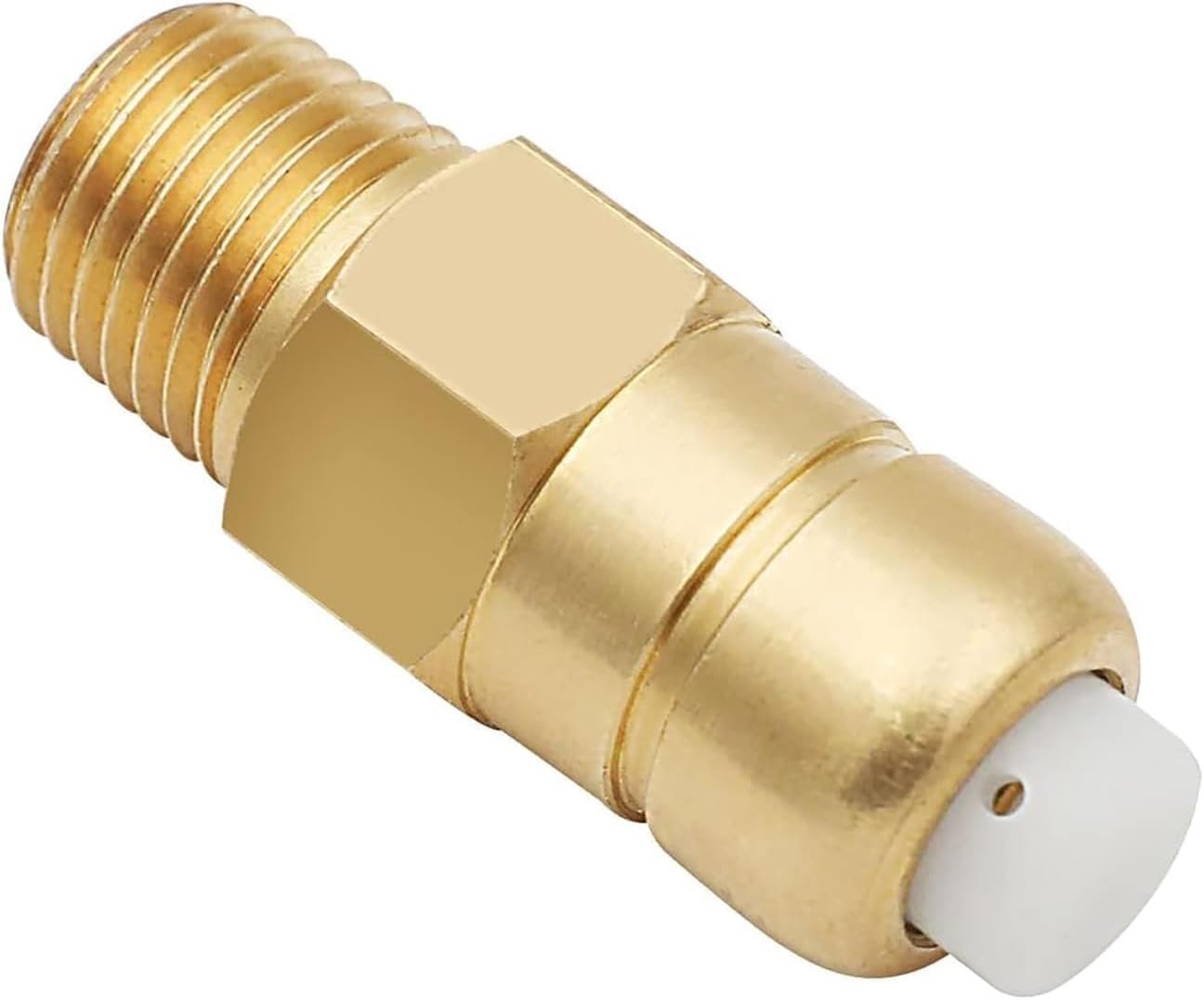
To prevent catastrophic melt-down, commercial pumps feature a 1/4" NPT brass thermal relief valve. When internal water reaches 140°F, an internal wax pellet melts and dumps scalding water onto the ground, allowing cool water from your garden hose to flood the pump. Never plug or disable a weeping thermal relief valve—it is the only thing saving your pump packings from cooking themselves.
Dual-System Tribology: Why Motor Oil Destroys Water Pumps
A gas pressure washer is two completely different machines bolted to the same steel cart: an internal combustion gasoline engine and a positive-displacement water pump. Each machine requires its own specific oil chemistry, and swapping them is a fatal mistake.
1. Engine Crankcase Oil: Detergent Chemistry
Four-stroke small engines (like Honda GX200, GX390, or Briggs & Stratton Vanguard) use splash-dipper lubrication. A small metal dipper on the connecting rod whips through the oil sump, throwing an oil mist across the cylinder wall, crankshaft bearings, and camshaft.
These engines run hot (crankcase temperatures often exceed 220°F) and produce combustion soot and blow-by acids. For this reason, engine oil (typically SAE 10W-30 rated API SN/SP) contains heavy detergent additives and dispersants. Detergents are chemical scavengers: their job is to capture soot and carbon particles and keep them suspended in the liquid oil so they don't form sludge inside the engine block.
2. High-Pressure Pump Oil: Non-Detergent Chemistry
Now look at what happens inside a triplex water pump. The pump crankcase contains no combustion fire, no fuel blow-by, and no carbon soot. What it does encounter is intense mechanical splashing at 3,400 RPM and ambient moisture or high-pressure water seal weeping.
If you pour regular automotive 10W-30 engine oil into your pressure washer pump, those detergent additives immediately create disaster. At 3,400 RPM, detergents trap microscopic air bubbles, turning the oil into a foamy whipped froth. Air cannot lubricate metal. The foam collapses under the load of the crankshaft journals, causing oil cavitation, metal-on-metal contact, and snapped connecting rods.
High-pressure pumps require specialized ISO 68 / SAE 30W non-detergent hydraulic pump oil. Non-detergent oil contains anti-wear additives (ZDDP) and silicone anti-foaming agents. Most importantly, it is demulsifying: instead of suspending moisture, it forces water to separate and settle at the very bottom of the crankcase below the oil sight glass where it can be seen and drained.
3. 4-Stroke Splash Lubrication vs. 2-Stroke Mixed Fuel
Unlike small chainsaws or weed trimmers that require two-stroke oil mixed directly into the gas tank, pressure washer engines are dedicated four-stroke engines with separate oil sumps. Accidentally pouring 50:1 2-stroke mixed gas into your pressure washer fouls spark plugs within minutes, causes sticky intake valve carbon deposits, and generates clouds of blue exhaust smoke.
Explore In-Depth Fluid & Fuel Guides
Master our exact crankcase maintenance walkthroughs and recovery steps for fuel mistakes:
- Honda Pressure Washer Oil Guide — Exact capacities, dipstick checking rules, and drain intervals for GX160 through GX390 engines.
- Does a Pressure Washer Take Mixed Gas? — How to flush mixed 2-stroke fuel from your fuel tank, carb bowl, and spark plug.
Carburetor Stoichiometry, Ethanol Phase Separation & Engine Rescue
Over 80% of gas pressure washer starting failures have nothing to do with spark plugs or ignition coils. They are caused by dirty carburetors poisoned by stale ethanol gasoline.
1. Carburetor Stoichiometry & Jet Micro-Passages
Small engines use simple float-bowl carburetors to meter fuel into rushing intake air. For gasoline to burn efficiently, the engine requires a stoichiometric air-to-fuel ratio of roughly 14.7:1 (14.7 pounds of air for every 1 pound of gasoline).
Fuel enters the carburetor bowl and is drawn up through two precision brass orifices:
- The Main Jet & Emulsion Tube: Controls fuel delivery from roughly 20% throttle up to full governor speed (3,600 RPM). The main jet orifice on a typical 200cc engine is tiny—measuring only 0.028 to 0.032 inches (0.7 to 0.8 mm) in diameter.
- The Pilot / Idle Jet: Feeds fuel during idle and closed-throttle startup. The pilot jet orifice is microscopic—often under 0.014 inches (0.35 mm), roughly the thickness of two human hairs.
2. Why Modern Ethanol Fuel (E10) Ruins Carburetors
Most pump gas sold in North America contains 10% ethanol (E10). Ethanol is an alcohol, which makes it hygroscopic: it actively pulls moisture directly out of humid air. In a vented pressure washer gas tank, ethanol absorbs ambient water over weeks of sitting.
When the alcohol reaches its water saturation limit, it separates from the gasoline in a chemical reaction called phase separation. A corrosive, milky layer of water and alcohol settles directly at the bottom of the float bowl—right where the main jet sits. As the light petroleum fractions evaporate, they leave behind thick green or amber varnish that blocks the tiny 0.014-inch pilot jet passage.
3. Why Your Engine Only Runs on Choke (Lean Surging)
When the microscopic pilot jet or main jet gets partially clogged with varnish, fuel delivery drops. The engine draws plenty of air through the intake, but cannot pull enough fuel. The air-to-fuel ratio leans out from 14.7:1 to a dangerously lean 18:1 or 20:1.
At that lean mixture, gasoline burns too slowly to sustain combustion. The engine begins surging or "hunting": the mechanical governor pulls the throttle wide open, the engine revs up for a second, starved of fuel it almost dies, the governor kicks back in, and the speed oscillates wildly.
Closing the choke plate physically blocks incoming intake air, forcing the engine back toward a burnable mixture so it stays running. But running with the choke on full-time creates a new danger: cylinder wall oil washing. Excess unburnt fuel washes the protective film of lubricating motor oil off the cylinder wall, causing piston ring scoring and loss of compression.
4. Hydrolock Recovery: If Your Pressure Washer Drops in Water
If your pressure washer rolls into a swimming pool, tips off a boat dock, or gets flooded in a heavy downpour, water can enter through the air box or exhaust port and fill the combustion chamber. Because water is an incompressible liquid, attempting to pull the recoil rope while the cylinder is full of water will instantly snap the connecting rod or crack the piston crown (a catastrophic failure called hydrolock).
If your machine is submerged, follow our 7-step forensic engine rescue SOP:
- Do NOT Pull the Cord: Never force the recoil starter if it feels jammed.
- Strip the Air Filter & Muffler: Discard soaked paper air filter elements; remove the muffler and shake standing water out.
- Remove the Spark Plug: Pull the spark plug boot and unscrew the spark plug completely.
- Evacuate the Cylinder: With the spark plug removed, gently pull the recoil starter rope 10 to 15 times. Standing water will erupt out of the spark plug hole like a geyser.
- Drain Fuel & Oil: Drop the carburetor float bowl and drain contaminated water from the gas tank. Drain the engine crankcase completely (milky white oil confirms water contamination).
- Bake the Cylinder: Spray fogging oil or pour two tablespoons of clean motor oil into the spark plug hole. Pull the rope slowly to coat the cylinder walls and prevent flash rusting.
- Refill & Fire: Install a fresh spark plug, pour in fresh 10W-30 engine oil, add clean ethanol-free fuel, and run the engine for 20 minutes under load to boil off residual moisture.
Step-by-Step Diagnostic SOPs
Access our detailed diagnostic flowcharts for carburetors, choke settings, and water submersion:
- Pressure Washer Only Runs on Choke: Carburetor Cleaning Guide — How to clear pilot jet varnish without removing the entire carburetor assembly.
- Can You Run a Pressure Washer with Choke On? — Explaining cylinder washing, spark plug carbon tracking, and fuel waste.
- Pressure Washer Fell in Pool? 7-Step Rescue Protocol — The complete step-by-step procedure to dry, flush, and fire a submerged engine.
Commercial Calculators & Gas Rig Maintenance BOM
Keeping a high-output gas pressure washer operating at peak reliability requires periodic fluid changes and having the right spare hardware on your truck or workbench.
Free Commercial Pressure Washing Engineering Tools
Calculate commercial nozzle orifice sizes, determine friction loss across 100+ feet of high-pressure hose, and price out exterior cleaning jobs with our free web calculators:
Engineer's Gas Pressure Washer Maintenance BOM
These six field-tested components protect commercial triplex pumps from overheating, solve ethanol carburetor surging, and ensure clean lubrication across engine and pump sumps:
| Component | Engineering Spec | Function & Advantage | Recommended Part |
|---|---|---|---|
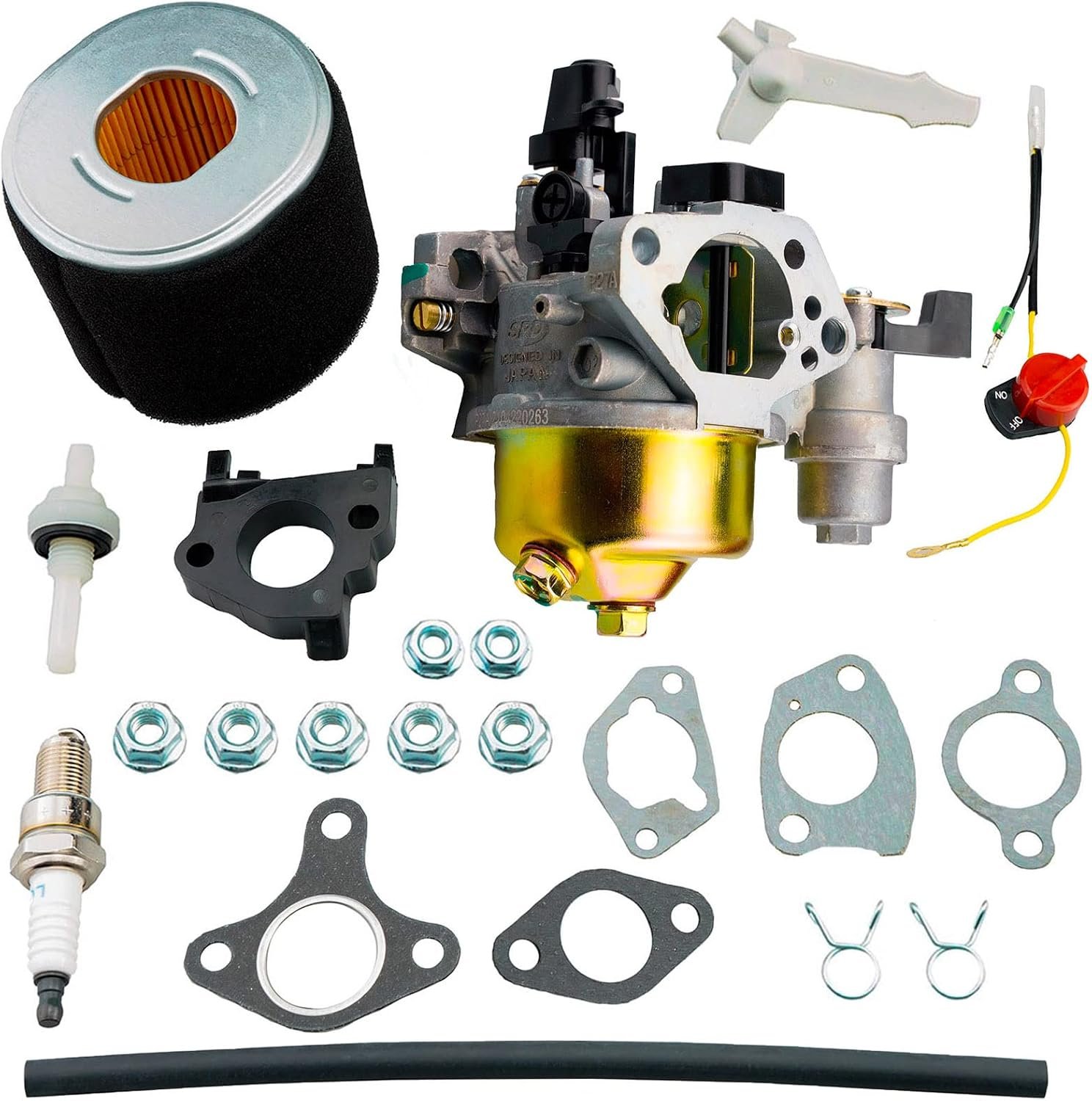
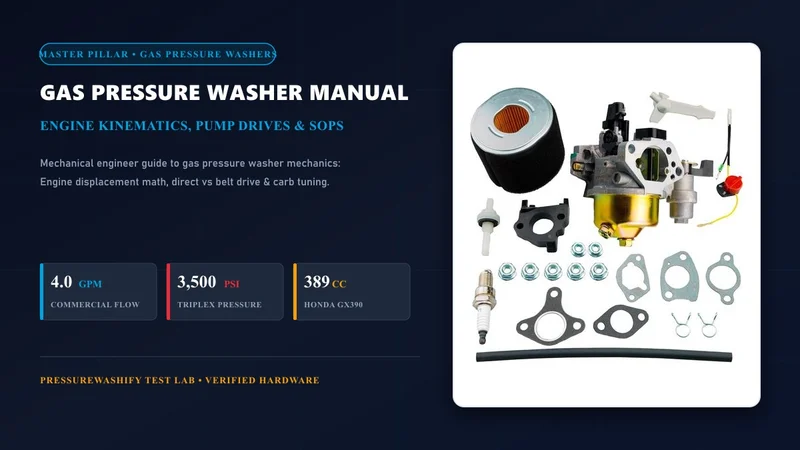
| Ruma GX390 Carburetor Kit | Adjustable Float-Bowl Carb for Honda GX340/GX390 11HP–13HP | Replaces varnish-clogged factory carburetors to instantly cure hunting and lean surging; includes fresh gaskets, fuel line, and spark plug. | |
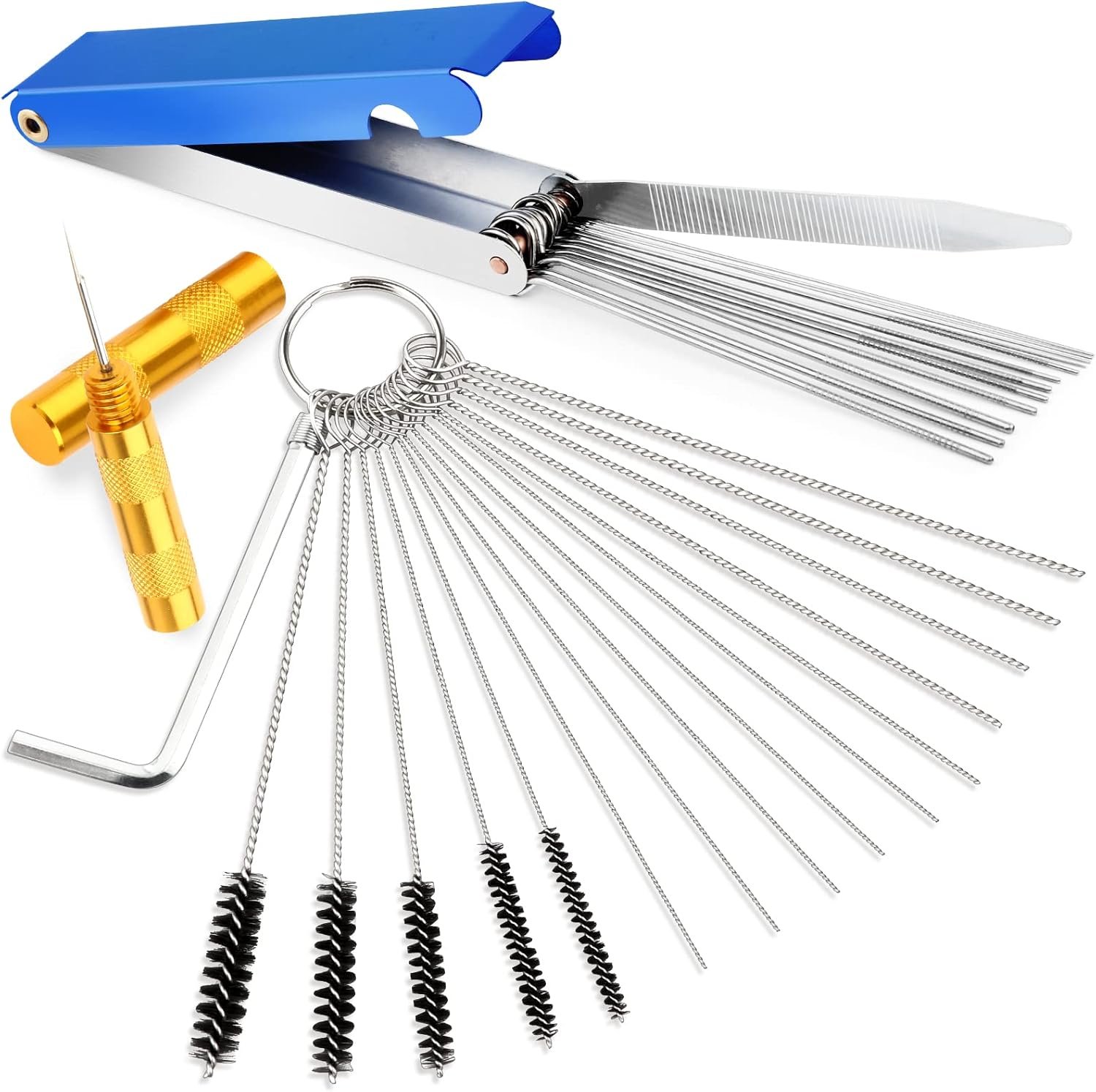
| Carburetor Jet Clean Tool Set | 13 Multi-Size Wire Probes + Miniature Nylon Brushes | Clears baked ethanol varnish from tiny 0.014" pilot jets and emulsion tube air bleeds without enlarging the soft brass orifices. | |
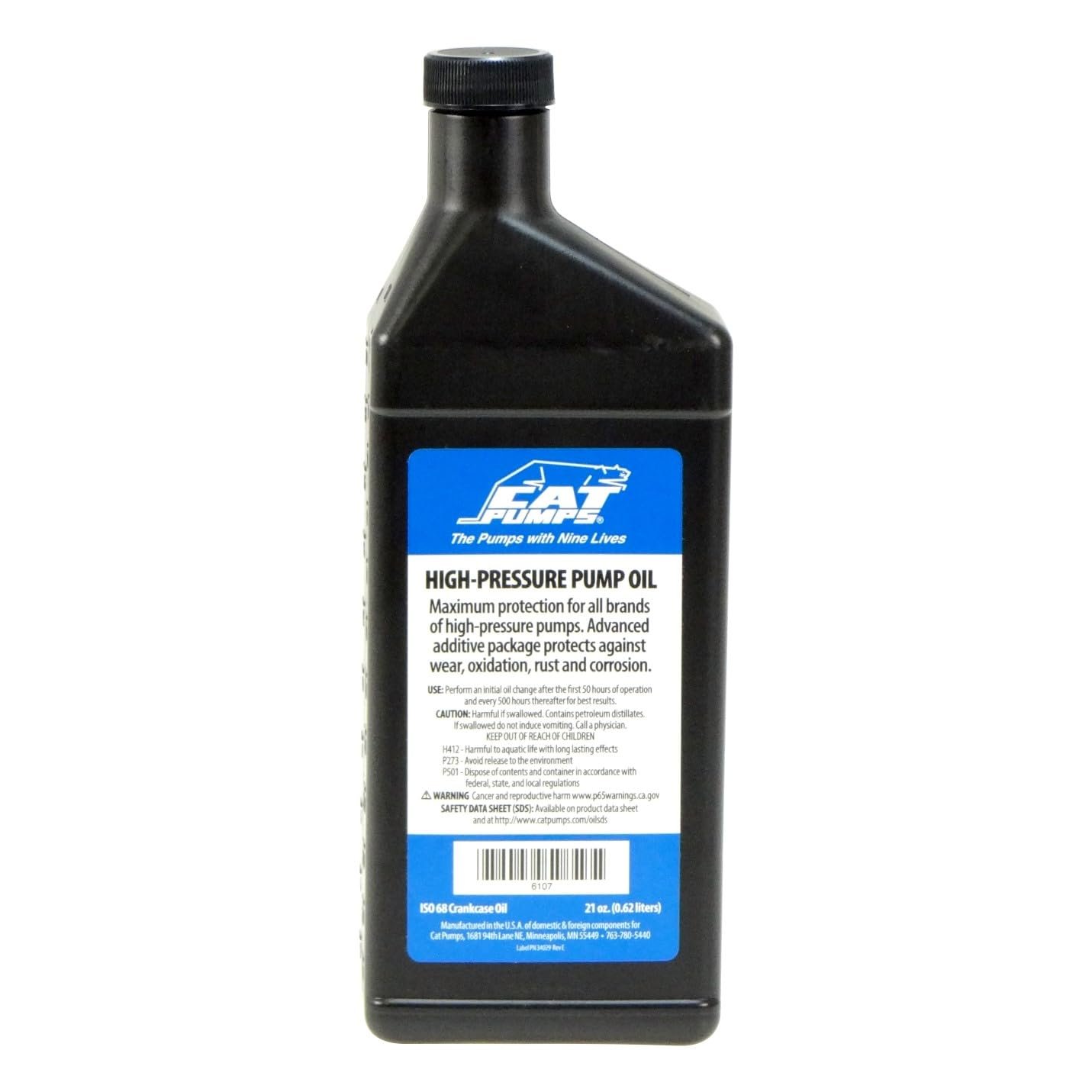
| ISO-68 Non-Detergent Pump Oil | 21 Oz Mineral Oil Formulation, Demulsifying, Anti-Foam | Eliminates oil aeration and crankcase cavitation at 3,400 RPM; protects ceramic plungers and bronze connecting rods inside triplex pumps. | |
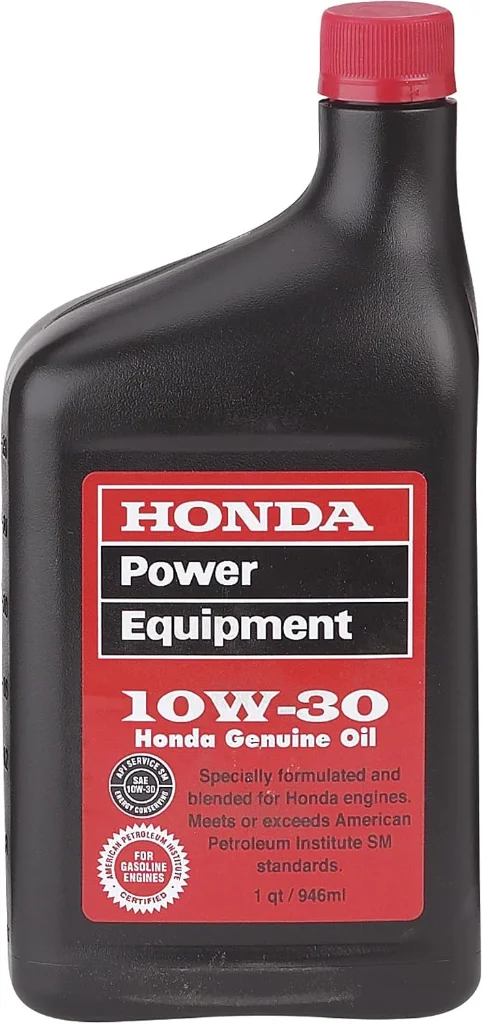
| Genuine Honda 10W-30 Engine Oil | 32 Oz 4-Stroke Detergent Engine Oil, API SP/SN Standard | Engineered for Honda GX160, GX200, and GX390 crankcases; provides high-shear boundary lubrication with ZDDP anti-wear protection. | |
| Timsec 1/4" NPT Thermal Relief Valve | Forged Brass Body, 145°F (63°C) Auto-Purge Wax Pellet | Safeguards pump packings and ceramic pistons by venting boiling water when letting the pressure washer idle in trigger-bypass mode. | |
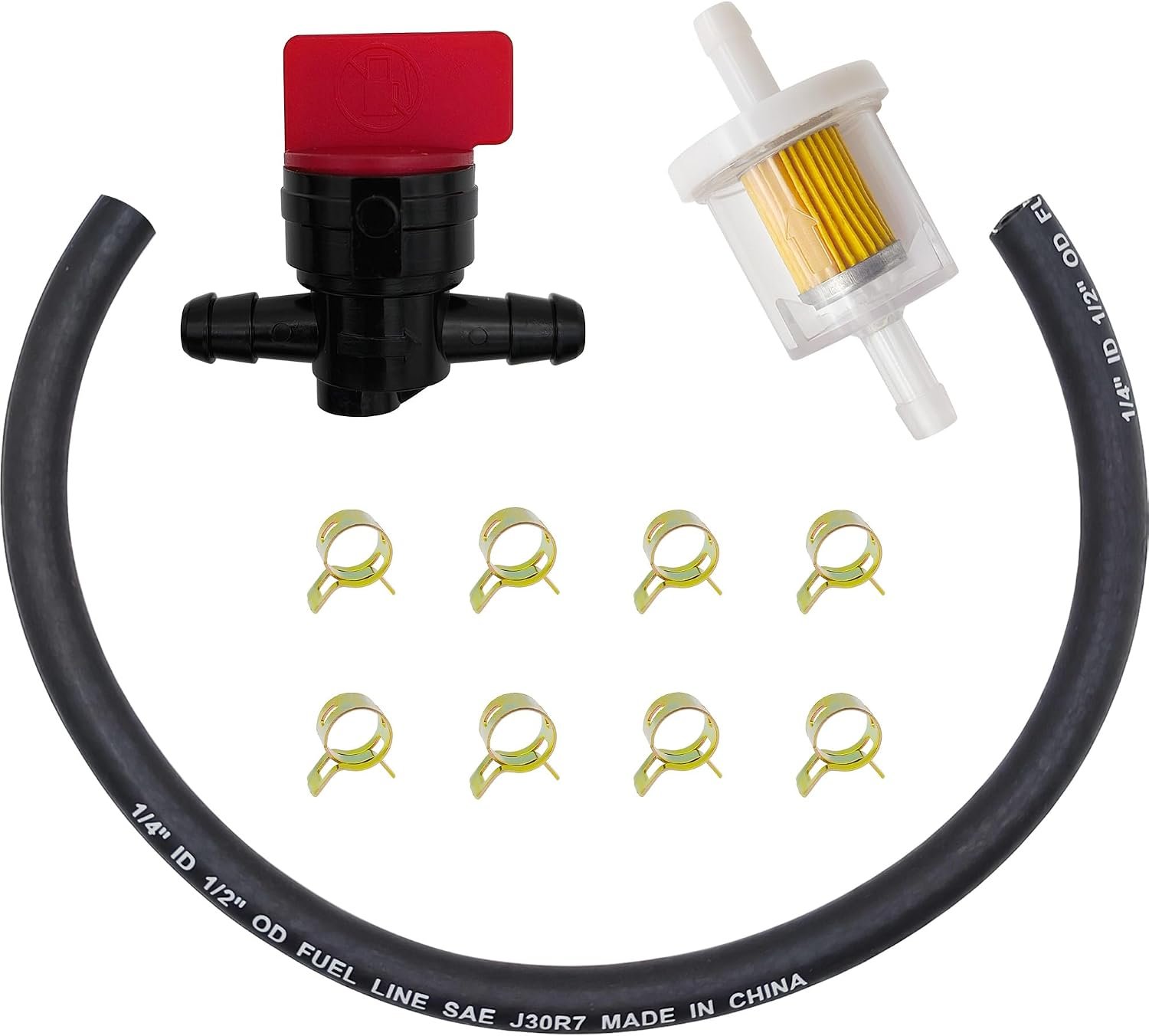
| 791766 Fuel Line & Shut-Off Kit | 1/4" ID Low-Permeation Hose, Inline Shut-Off Valve & Filter | Allows running the carburetor dry before seasonal storage, preventing ethanol phase separation and gummy float bowl varnish. |