Cranking up water pressure to blast away heavy stains is the fastest way to ruin concrete, chew up wood decking, and punch holes in siding. High-pressure water only knocks off the surface dirt. It cannot kill the microscopic mold, algae, and lichen roots anchored deep inside porous masonry. Real surface cleaning isn't about raw blasting power. It comes down to balancing gentle water pressure with the right chemical dwell time.
In this guide, we break down the practical science of surface cleaning: how to match a rotary surface cleaner to your pump so you never leave ugly spiral "tiger stripes," how the exterior pH scale breaks down grease and algae, why pouring bleach into your machine's onboard soap tank destroys the pump, and the simple math needed to mix sodium hypochlorite (SH) safely using downstream injection.
Key Engineering Takeaways for Surface Cleaning & Chemistry
- Chemical Dwell Beats Raw PSI: High pressure only cleans the visible top layer, leaving spores alive inside pores to regrow in weeks. Mild cleaning solutions kill roots at low pressure without pitting the surface.
- The 4-Inches-Per-GPM Sizing Rule: Never run a surface cleaner deck larger than 4 inches per 1.0 GPM of pump capacity. An 18-inch cleaner on a 2.5 GPM washer slows rotation to a crawl and leaves wide spiral zebra stripes.
- Split Orifice Math: A rotary surface cleaner splits flow between two spray tips. If your machine needs an overall #4.0 orifice, you must install two matched #2.0 nozzles on the spinning bar.
- The Exterior pH Spectrum: Acids (pH 1–3) dissolve mineral rust and efflorescence. Neutral soaps (pH 6–8) lift dirt. Sodium hypochlorite (pH 11–12) sterilizes living algae. Caustic degreasers (pH 13–14) dissolve grease.
- Downstream Injection Protects Pumps: Upstream soap tanks pull bleach directly through your pump manifold, eating rubber packings and brass valves. Downstream Venturi injectors draw chemicals after the pump unloader.
1. Mechanical Impact vs. Chemical Dwell: Substrate Yield Limit Matrix
Every surface you clean has a physical breaking point. Push past it with water pressure, and you cause permanent structural damage that no amount of scrubbing or sealing can fix. You can't un-etch scored concrete, smooth out splintered wood decking, or patch blown-out tile grout.
Take concrete as an example. Solid slab concrete can hold thousands of pounds of downward weight, but its smooth outer surface—known as the cement cream—is only a couple millimeters thick. If you hold a 4,000 PSI nozzle four inches away, you cut right through that protective crust. You expose the sand and gravel aggregate underneath, turning a smooth driveway into an abrasive, porous sponge that traps engine oil and cracks during freezing winter weather.
Soft washing takes the opposite approach. Instead of trying to knock dirt off with water force alone, you apply a mild 1% to 2% cleaning mix at low tap pressure (under 150 PSI). The solution penetrates the pores and breaks down algae and mold cell walls within ten minutes. Then you rinse the surface clean with a gentle, wide fan. The concrete stays intact, the spores are dead, and the clean finish lasts months longer.
Substrate Yield Limit & Cleaning Method Matrix
Before pulling the trigger on any material, check its safe pressure envelope, recommended tip fan, and the right cleaning method:
| Substrate Material | Damage Threshold | Max Safe Water PSI | Recommended Tool / Nozzle | Primary Cleaning Method |
|---|---|---|---|---|
| Cured Concrete (3+ Years Old) | Surface cream etches at high pressure | 3,000–3,500 PSI | Rotary Surface Cleaner (25° tips) | Mechanical pass + 2.5% SH post-treatment spray |
| New Concrete (< 1 Year Old) | Soft, green cement paste | 1,500–1,800 PSI | 40° White Tip / Low-PSI Rotary | Chemical dwell; never use aggressive metal spinners |
| Vinyl Siding & Trim | Punctures easily (< 500 PSI) | 150–250 PSI | Downstream J-Rod (0040 / 2540 tip) | Soft-wash 1.0% SH biocide + soap dwell |
| Cedar & Redwood Decking | Wood fibers splinter above 1,000 PSI | 800–1,000 PSI | 40° or 60° fan held 12" away | Percarbonate cleaner + oxalic acid brightener |
| Tile Grout (Patios & Foyers) | Mortar fractures above 1,200 PSI | 800–1,200 PSI | Enclosed spinner wand with vacuum port | Alkaline cleaner dwell to break down grease |
| Schedule 40 PVC Drain Pipes | Joints crack above 2,500 PSI | 2,000–2,500 PSI | Sewer Jetter Nozzle (1 forward, 3 rear jets) | Rear water jets pull the hose through clogs |
In-Depth Guide: Can You Pressure Wash Tile Grout?
Wondering if you can clean indoor tile or patio grout without chipping mortar joints? Read our hands-on review of grout pressure limits and dual-jet extraction wands:
READ TILE GROUT ANALYSIS →Sewer Jetting SOP: Can I Use a Pressure Washer to Unclog a Drain?
Learn how backward-facing thrust nozzles convert water pressure into pulling force to slice through tree roots, grease, and sand in underground drain lines:
READ SEWER JETTING SOP →2. Rotary Surface Cleaner Sizing: The 4-Inches-Per-GPM Rule & Spray Bar Tips
Cleaning a wide concrete driveway with a standard handheld spray wand is grueling work. Your arm swings back and forth, your spray angle keeps shifting, and you inevitably end up with wavy zebra stripes etched across the slab.
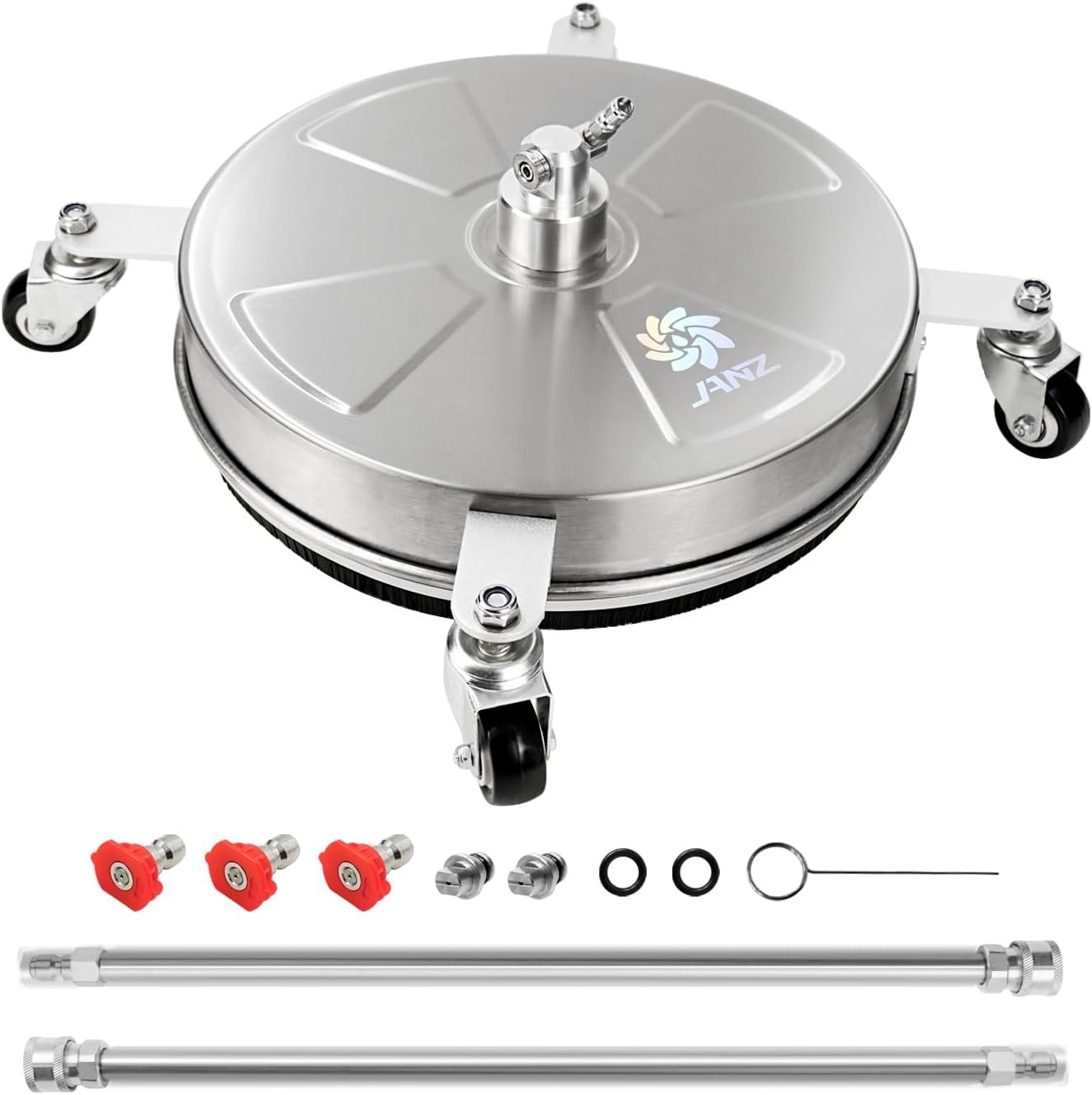
A rotary surface cleaner eliminates that problem. It places two spray nozzles on opposite ends of a metal bar spinning at 1,500 to 2,000 RPM inside a round housing. The bar is spun entirely by water shooting out of the angled nozzles. Because the deck hovers at a constant height above the slab, every square inch gets identical cleaning force in a fraction of the time.
Think of this 4-to-1 rule like pedaling a bicycle. If you try to pedal up a steep hill in 10th gear, your legs bog down and you stop moving. An oversized surface cleaner does the exact same thing to your pressure washer. If you hook an 18-inch cleaner to a small 2.5 GPM washer, your pump can't push enough water to spin that long bar at full speed. The bar slows down, and as you walk forward, the spray tips leave wide spiral streaks of uncleaned grime behind you—classic "tiger stripes."
The Split-Tip Rule: Why Spray Bars Use Half-Size Nozzles
When you buy a replacement nozzle for a handheld spray wand, that single tip handles your machine's entire water flow. But a surface cleaner splits flow down the middle between two nozzles mounted on opposite ends of a spray bar.
Because flow divides in half, each individual tip must be half the size of your machine's total orifice requirement:
If you accidentally put two standard #4.0 nozzles into the spray bar, you effectively create an #8.0 opening. Your working pressure drops from 3,500 PSI down to under 900 PSI, destroying your cleaning power. If you install tips that are too small, water can't get out fast enough. That forces your unloader valve into continuous bypass, overheating your pump in minutes.
Buyer's Guide: 7 Best Pressure Washer Surface Cleaners Tested
Looking for the right surface cleaner for your pressure washer? Read our hands-on test of stainless steel vs. composite decks, commercial swivels, and nozzle jet specs:
READ 7 BEST SURFACE CLEANERS GUIDE →3. The Exterior Cleaning pH Scale: Bleach, Degreasers, Acids & Soaps
Plain water cannot dissolve baked engine oil or kill fungal spores hiding deep inside stone pores. To clean surfaces without gouging them with high pressure, professional washers rely on targeted cleaning chemistry governed by the 0 to 14 pH scale.
The four main chemical groups used in exterior cleaning work through distinct chemical reactions:
- Oxidizers (Sodium Hypochlorite, pH 11.5–12.5): SH is the active ingredient in pool shock and household bleach. When sprayed on siding, shingles, or concrete, hypochlorite ions (OCl-) attack living proteins, breaking down the cell walls of algae (Gloeocapsa magma), black mold, and mildew. It bleaches dark stains clear and sanitizes the pores so organic growth doesn't return in a few weeks.
- Caustic Degreasers (Sodium Hydroxide / KOH, pH 13–14): Heavy alkaline cleaners remove motor oil and food grease through saponification. Hydroxide ions (OH-) react with fatty acids and petroleum residues, turning non-polar oil into water-soluble soap that rinses away easily.
- Mineral & Organic Acids (Oxalic / Muriatic Acid, pH 1–3): Acidic cleaners remove mineral scale, fertilizer stains, and orange battery acid burns through chelation. Oxalic acid bonds with brown iron rust (Fe2O3), turning it into clear, water-soluble iron oxalate. It also neutralizes high-pH wood strippers, restoring soft cedar and redwood to a light honey tone.
- Bleach-Stable Surfactants (Amine Oxides, pH 6.5–8): Surfactants break water's surface tension. They keep cleaning solutions clinging to steep vertical siding and pitched roofs instead of immediately sheeting off into flowerbeds.
Safety Warning: Never Mix Dish Soap with Bleach
Many online videos suggest adding liquid Dawn dish soap to bleach as a cheap foaming agent. Never do this. Most household dish soaps contain ammonia compounds or nitrogen-based surfactants. Mixing ammonia with sodium hypochlorite creates toxic chloramine gas (NH2Cl), which causes immediate lung irritation and chemical bronchitis.
In addition, dish soap is not bleach-stable. The bleach quickly breaks the soap molecules down into useless saltwater within twenty minutes. Always use an authentic, bleach-stable lauramine oxide surfactant made specifically for soft washing.
Chemical Guide: What Kind of Soap to Use in a Pressure Washer
Learn which surfactants survive strong bleach mixtures, how to pick vehicle soaps that won't strip wax, and which chemicals eat through pressure washer pump seals:
READ SOAP COMPATIBILITY GUIDE →4. Mixing Sodium Hypochlorite (SH) & Downstream Venturi Injectors
The fastest way to destroy a pressure washer is pouring bleach into the onboard chemical tank. That tank feeds an upstream siphon, pulling bleach directly into the pump manifold. Within weeks, the harsh chemical eats away rubber packings, pits brass check valves, and ruins ceramic plungers.
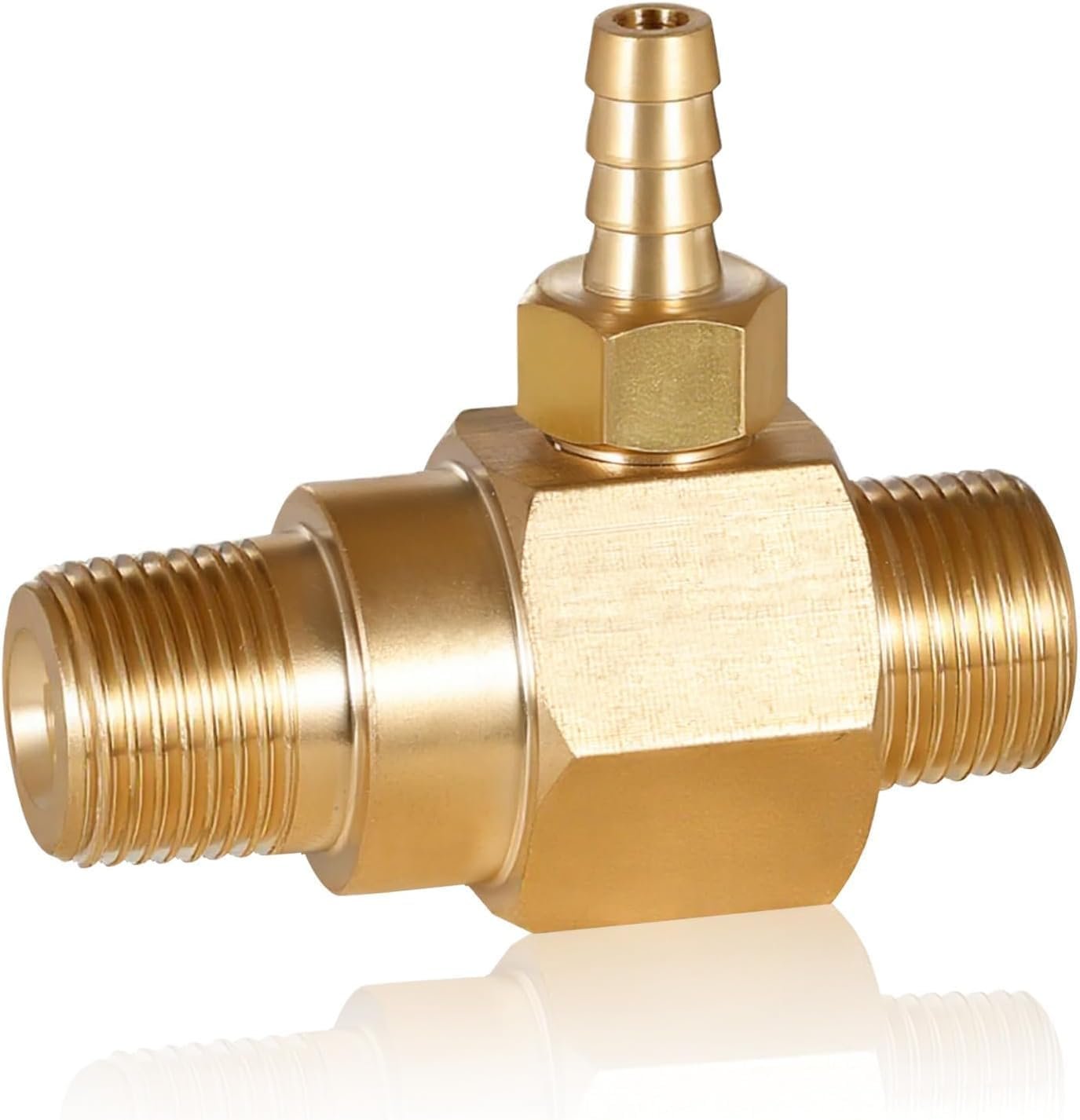
Professional washers exclusively use downstream Venturi injectors. A downstream injector installs after the pump unloader valve, right at the high-pressure water outlet. The chemical never touches your pump.
The Venturi Principle: How Moving Water Pulls Soap
Downstream injectors run on Bernoulli's principle. Inside the brass injector body, water squeezes through a narrow conical jet. As water speeds up through that restriction, its static pressure drops below atmospheric pressure, creating a strong vacuum that draws chemical concentrate up through the pickup tube:
Standard commercial downstream injectors (such as the General Pump high-draw model) operate at approximately a 10:1 to 15:1 draw ratio (meaning 10 to 15 parts water to 1 part chemical concentrate). Here is the target chemical strength you want landing on the surface:
Sodium Hypochlorite (SH) Dilution Batch Lookup Matrix
| Cleaning Job | Target Strength on Wall | Stock Bleach Strength | Bucket Mix (Water : SH : Surfactant) | Dwell Time & Plant Care |
|---|---|---|---|---|
| House Wash (Vinyl / Aluminum) | 0.8%–1.0% SH | 10.0% Pool Shock | Straight shock through 10:1 downstream injector | 5–8 min dwell; soak nearby plants with clean water first. |
| House Wash (Heavy Green Algae) | 1.2%–1.5% SH | 12.5% Industrial SH | Straight shock through 10:1 downstream injector | 8–10 min dwell; do not let dry on windows or hot siding. |
| Concrete Flatwork Post-Treat | 2.5%–3.0% SH | 12.5% Industrial SH | Requires dedicated 12V pump (or X-Jet 4:1) | Spray after surface cleaning; let dry to kill deep spores. |
| Asphalt Shingle Roof Cleaning | 3.5%–4.0% SH | 12.5% Industrial SH | Requires dedicated 12V pump (or X-Jet 3:1) | Dissolves black algae streaks without scraping off shingle granules. |
The 150-Foot Hose Backpressure Limit
Why does a downstream injector suddenly stop pulling soap when you click a standard spray nozzle into your wand? Because of hose line backpressure. A downstream injector only creates a vacuum when the pressure in the hose is low (under 250 PSI). When you insert a tight high-pressure tip (like a green or yellow nozzle), water backs up down the hose, equalizing pressure and slamming the injector's check ball shut.
To start pulling chemical, you must insert a wide nozzle—such as a black soap nozzle (65° angle, #40 orifice) or a soft-wash J-rod. Additionally, running more than 150 feet of hose creates enough internal friction to stall the Venturi vacuum on its own. If your injector stops pulling soap, shorten your hose run or upgrade from a narrow 1/4" line to a commercial 3/8" hose.
SH Guide: What is SH in Pressure Washing? (Mix Ratios & Safety)
Looking for batch calculations for 5-gallon pails, plant protection steps, and bleach-neutralizing rinses? Read our complete guide to sodium hypochlorite:
READ FULL SH DILUTION GUIDE →Cross-System Plumbing: Pressure Washer Hose Repair & Friction Limits
Having issues with downstream injectors stalling from hose friction? Review our guide on hose line loss, inner diameters, and field repair fittings:
READ HOSE REPAIR & FRICTION GUIDE →5. Soft-Wash & Surface Restoration Hardware BOM
Upgrading your pressure washer for professional surface cleaning and chemical restoration requires heavy-duty hardware that can handle corrosive oxidizers, maintain high rotor RPM, and prevent hose stalls. The five tools below form the standard commercial soft-wash and flatwork setup used by contractors:
| Component | Engineering Spec | Function & Advantage | Recommended Hardware |
|---|---|---|---|
| General Pump Fixed Chemical Injector 100776 | 2.1mm Orifice, 3/8" Quick Connect, High Draw Up to 20% (5–8 GPM), Gold | Siphons concentrated sodium hypochlorite and detergents downstream of the pump; ceramic check ball and Hastelloy spring resist harsh bleach oxidation. | |
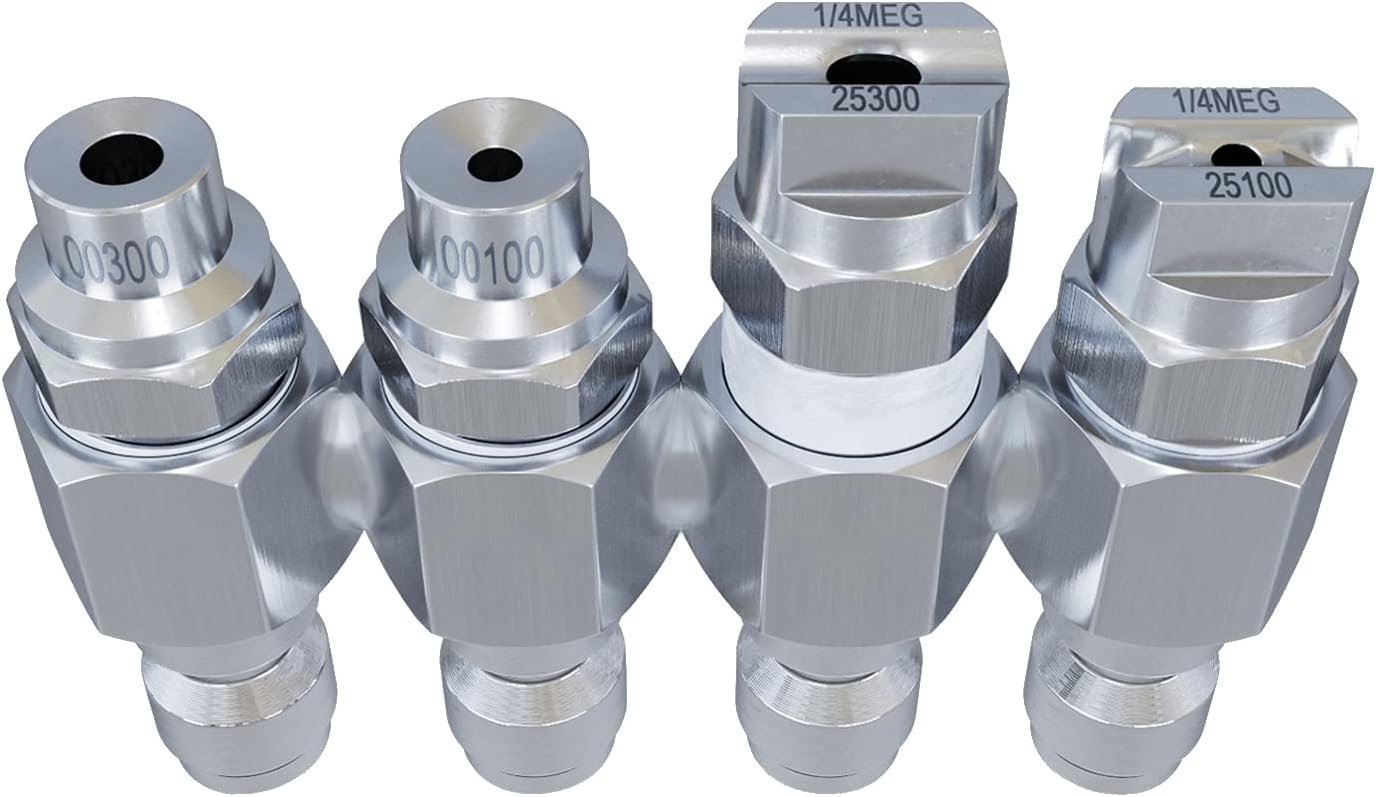
| Jariko J-Rod 4-Way Soft Wash Nozzle Kit | Stainless Steel Quad-Manifold (2–3 GPM & 4 GPM Sized Tips) | Welded quad-tip manifold provides instant switching between long-range soap stream, wide rinse fan, and low-pressure soft wash without swapping loose tips. | |
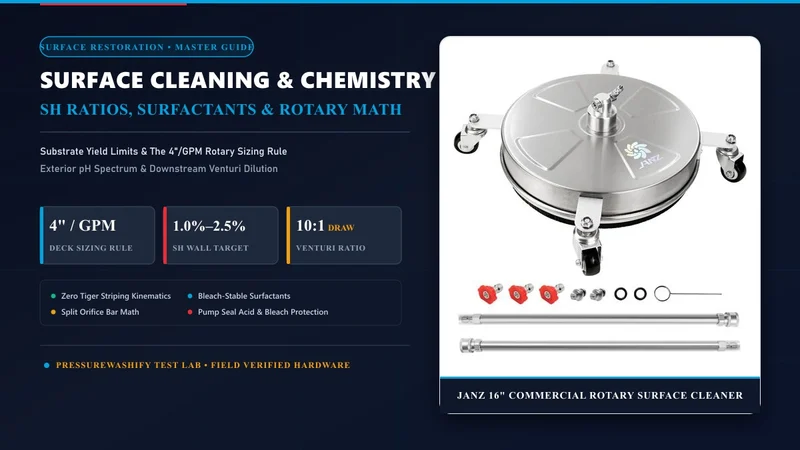
| JANZ 16'' Stainless Steel Surface Cleaner | Heavy-Duty Dual-Bearing Swivel, Dual Spray Bar, 4,000 PSI | Cleans driveways and concrete flatwork up to four times faster than a standard wand; maintains a locked standoff height for uniform passes with zero tiger striping. | |
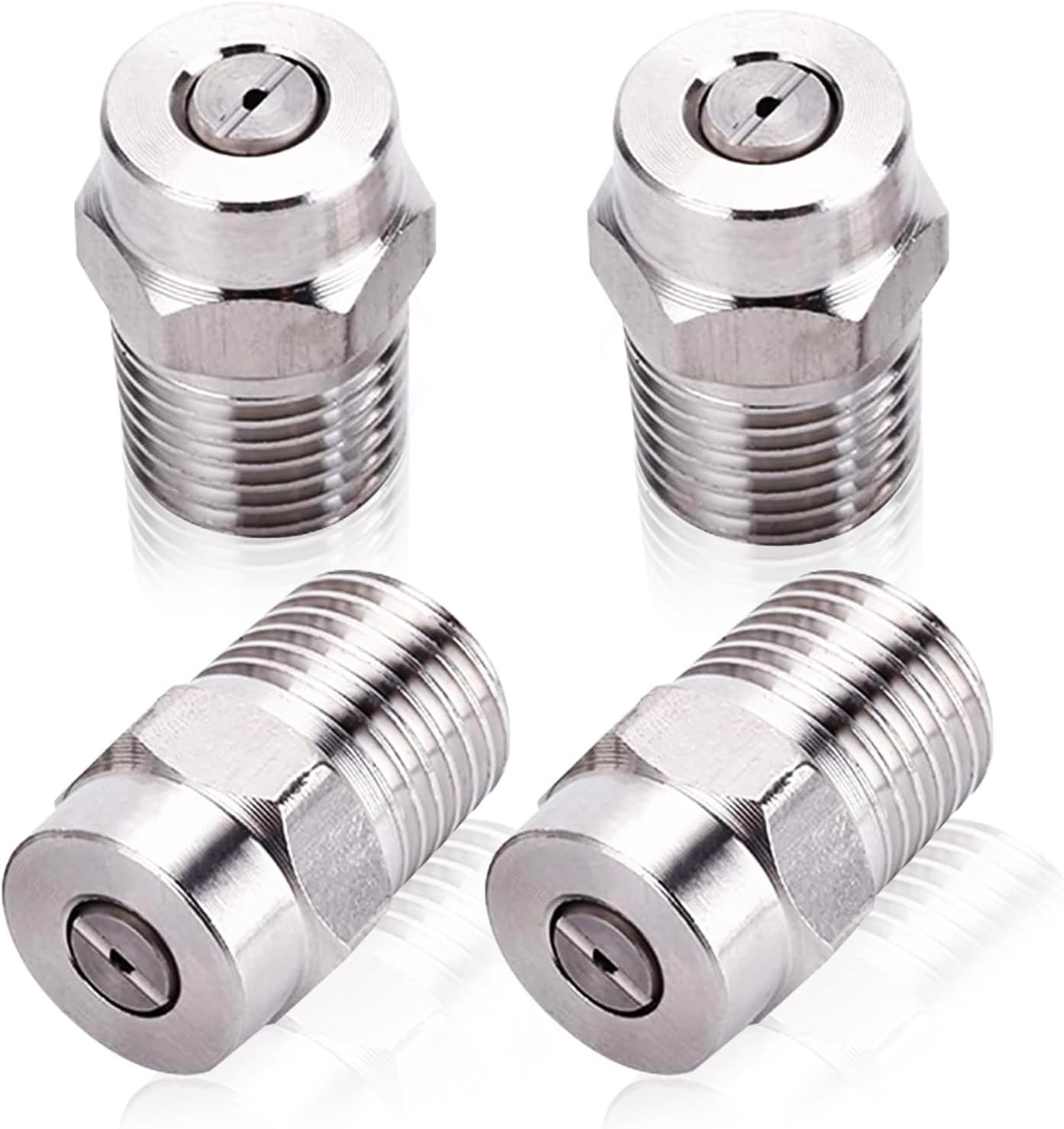
| MEANLIN 25° Surface Cleaner Tips (10-Pack) | 1/4" NPT Male, #2.5 Orifice, 4,000 PSI Threaded Stainless Tips | Calibrated replacement nozzle pack for rotary surface cleaners; balanced orifice pairing keeps rotation smooth and prevents hand-numbing vibration. | |
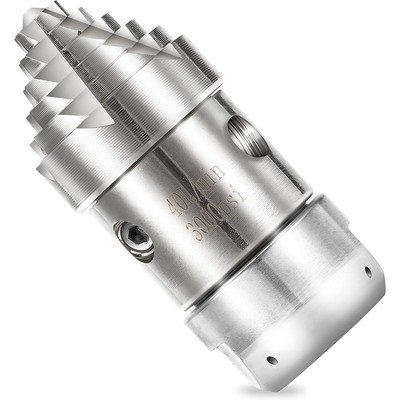
| Sewer Jetter Kit 50FT (5,800 PSI) | 1/4" NPT Rotating & Button Nose Nozzles, Spanner & Waterproof Tape | Clears blocked residential main drains, French drains, and downspouts using rear-thrust hydraulic jets that pull the hose through clogs. |