
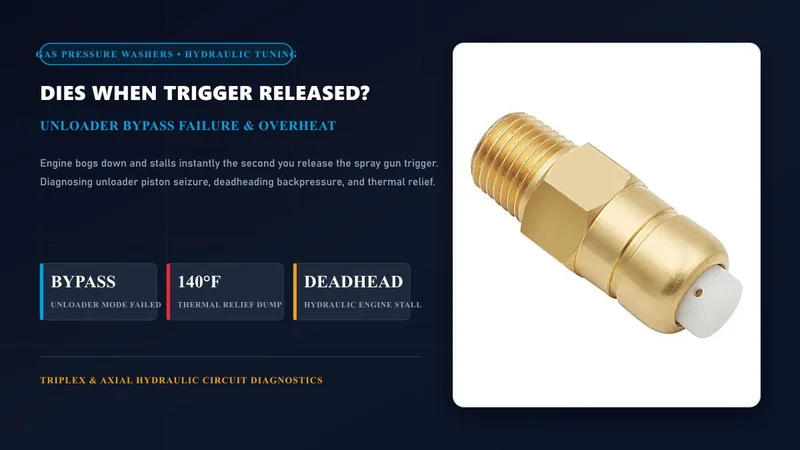
When a gas pressure washer dies the instant you release the spray trigger, the unloader valve has failed to enter bypass mode. This deadheads the pump against an unyielding water load, demanding more horsepower than the engine can supply and stalling it immediately.
It feels backward. The machine runs smoothly at 3,600 RPM while spraying a driveway, but the second you let go of the wand trigger, the engine bogs down and dies. If you try to pull the starter cord right away, it feels locked solid.
This is rarely an ignition failure or bad gas. It is a hydraulic lock inside the pump head. Here is how the unloader valve works, why it stalls your engine, and how to fix it on your workbench.
Hydraulic Power Calculator for Pump and Engine Sizing
Want to see whether your engine has enough horsepower to run your pump without stalling? Enter your working PSI and nozzle GPM to check required brake horsepower (BHP) and stall limits.
CALCULATE HYDRAULIC HORSEPOWERWhy Positive Displacement Pumps Never Idle
To understand why releasing the trigger stalls the engine, you need to look at how pressure washer pumps differ from common water pumps. A garden hose pump or pool pump uses a spinning impeller. If you block the outlet, water simply spins around inside the impeller housing. Pressure rises slightly, but the engine keeps turning easily.
Pressure washer pumps are positive displacement pumps. Each turn of the crankshaft forces three pistons through a fixed stroke. If the engine spins at 3,400 RPM, those pistons push 2.5 gallons of water forward every minute whether the spray gun is open or closed.
Flow (GPM) = (Piston Area × Stroke Length × RPM × Plungers) / 231
Water does not compress like air. If the spray gun closes and water has nowhere to escape, pressure inside the pump head jumps past 5,000 PSI in under 20 milliseconds.
The Hydraulic Horsepower Spike
The power required to pump water under pressure follows a straightforward formula:
Hydraulic HP = (Pressure [PSI] × Flow [GPM]) / 1,714
Accounting for typical drivetrain and pump friction losses (around 85% efficiency):
Engine BHP = (PSI × GPM) / (1,714 × 0.85)
Here is what happens on a typical 3,000 PSI, 2.5 GPM pressure washer with a 196cc to 208cc engine (delivering about 5.5 net horsepower under load):
- While Spraying (Trigger Pulled):
Engine BHP = (3,000 × 2.5) / 1,457 = 5.15 HP.
The engine runs smoothly at 3,600 RPM. Power output matches pump resistance. - When Stuck in Deadhead (Trigger Released, Bypass Jammed):
With the gun closed and the bypass closed, pressure spikes past 5,000 PSI.
Engine BHP = (5,000 × 2.5) / 1,457 = 8.58 HP.
A 5.5 HP engine cannot supply 8.6 horsepower. The sudden load acts like slamming on a mechanical brake, dropping engine speed and killing it within two revolutions.
Unloader Valve and Bypass Operation
The diagram below shows how fluid flows during normal spraying, normal bypass, and a stuck deadhead stall:
Pressure-Trapped vs Flow-Actuated Unloaders
Most gas pressure washers under 4,000 PSI use one of two unloader valve designs. Knowing which type is on your pump helps you find the problem fast.
Pressure-Trapped Unloaders
This design is on 95% of consumer and prosumer machines, including Simpson, Generac, Honda-powered units, and DeWalt. It uses an internal check valve ball and a spring-loaded piston:
- While spraying: Water pushes the check valve open and flows out to the wand. Line pressure drops slightly, and a heavy spring holds the bypass valve shut.
- When releasing the trigger: The gun valve closes, trapping pressure in the hose. That trapped pressure pushes against the unloader piston, compressing the spring and opening a bypass passage back to the pump inlet.
- The failure point: Hard water deposits, mineral scale, or torn rubber O-rings can cause the piston to stick. When the trigger closes, the bypass passage cannot open. Pressure spikes instantly, and the engine stalls.
Flow-Actuated Unloaders
Common on commercial high-volume machines featured in our 4 GPM pressure washer guide, flow unloaders do not trap static pressure in the hose line:
- How it works: It senses water movement across an internal restrictor. When water flows through the wand, the bypass stays closed. When water stops moving, a calibrated spring shifts the valve and opens the bypass loop.
- Operator benefit: Because the hose is not under high pressure when idling, the hose stays flexible and there is no sudden kickback when pulling the trigger again.
- The failure point: Flow unloaders are sensitive to debris. A tiny grain of sand or mineral flake stuck inside can keep the bypass from opening, stalling the engine when you release the trigger.
Troubleshooting Unloader, Governor, and Carburetor Issues
Before taking the pump apart, make sure your stall is actually a water pressure problem and not a carburetor issue. Use this guide to match your symptoms to the cause:
| Problem | Symptoms | Physical Cause | Diagnostic Check | How to Fix It |
|---|---|---|---|---|
| Stuck Unloader Piston | Engine dies the instant the trigger is released. Manifold shudders. Starter cord feels locked solid. | Mineral scale or corrosion jams the piston in its sleeve. Bypass cannot open, causing pressure to spike over 5,000 PSI. | Disconnect the high-pressure hose and start the engine on garden hose flow. If it runs without stalling, the unloader bypass is stuck. | Take the unloader cartridge apart, soak it in 50% vinegar to remove scale, polish the bore, and install fresh Viton O-rings with silicone grease. |
| Torn Unloader O-Ring | Engine bogs down and dies. Water drips or weeps from the unloader spring adjustment cap. | Rubber O-ring tears or flattens under pressure, letting water leak behind the piston and holding it shut. | Remove the unloader stem and inspect O-rings for cuts, flattening, or splits. | Replace damaged seals with 90-durometer Viton or polyurethane O-rings. |
| Unloader Spring Over-Tightened | Engine bogs down hard and stalls. Hose kicks violently. Knob was previously cranked down tight to chase more PSI. | The adjustment knob is bottomed out, compressing the spring solid so the bypass valve has no room to open. | Check the adjustment shaft. If the brass nut is screwed all the way down, the valve cannot move. | Loosen the nut. Attach an inline pressure gauge and adjust the spring to allow a 10% pressure jump when releasing the trigger. |
| Clogged Carburetor Idle Jet | Runs fine while spraying, but sputters and dies when the trigger is released, even with low bypass pressure. | Main jet supplies fuel at high throttle, but a varnished pilot jet starves the engine when the governor eases back at idle. | Hold the throttle open slightly by hand when letting go of the trigger. If it stays running, the issue is fuel delivery. | Clean the pilot jet and idle passage using aerosol carb cleaner and fine wire, as shown in our carburetor cleaning guide. |
| Sticking Governor Linkage | Engine surges between high and low RPM or stalls when transitioning between spray and idle. | Dirt or rust on the governor linkage slows its response to sudden changes in engine load. | With the engine off, move the throttle linkage by hand to feel for drag, binding, or a stretched spring. | Clean linkage pivot points with carb cleaner and lubricate with dry PTFE spray. Check spring tension. |
| Overheated Packings and Plungers | Engine stalls with burning smell from pump. Hot water leaks from weep holes. Starter rope hard to pull. | Running in bypass too long overheated the trapped water, melting seals and galling the pump plungers. | Feel the pump head. If it is too hot to touch, the pump has overheated. Check pump oil for milky discoloration. | Replace melted packings and damaged plungers. Change the oil and install a brass thermal relief valve on the inlet. |
Why Leaving a Washer in Bypass Overheats the Pump
Even when your unloader works perfectly, leaving the engine running while you are not spraying quickly overheats the pump.
When the unloader opens, the pump recirculates the same small amount of water (about 12 ounces in an axial pump) in a closed loop at 100 to 150 PSI. The spinning pistons generate friction, heating that trapped water by 15°F to 20°F every 30 seconds:
- 0 to 30 Seconds: Water warms from tap temperature to around 85°F. Everything is fine.
- 60 Seconds: Water climbs past 110°F. The pump head feels noticeably warm, and internal pump oil thins out.
- 90 to 120 Seconds: Water reaches 140°F. Standard rubber seals begin to soften and lose shape.
- 180 Seconds: Water exceeds 160°F. When you finally pull the trigger, cold tap water hits the hot ceramic plungers. The sudden temperature shock can crack the plungers, destroying the pump.
Thermal Relief Valve Protection
To keep pump seals and plungers from overheating during bypass, pumps use a thermal relief valve. If yours does not have one, or if the old one is jammed with mineral scale, replacing it is simple insurance for your pump.
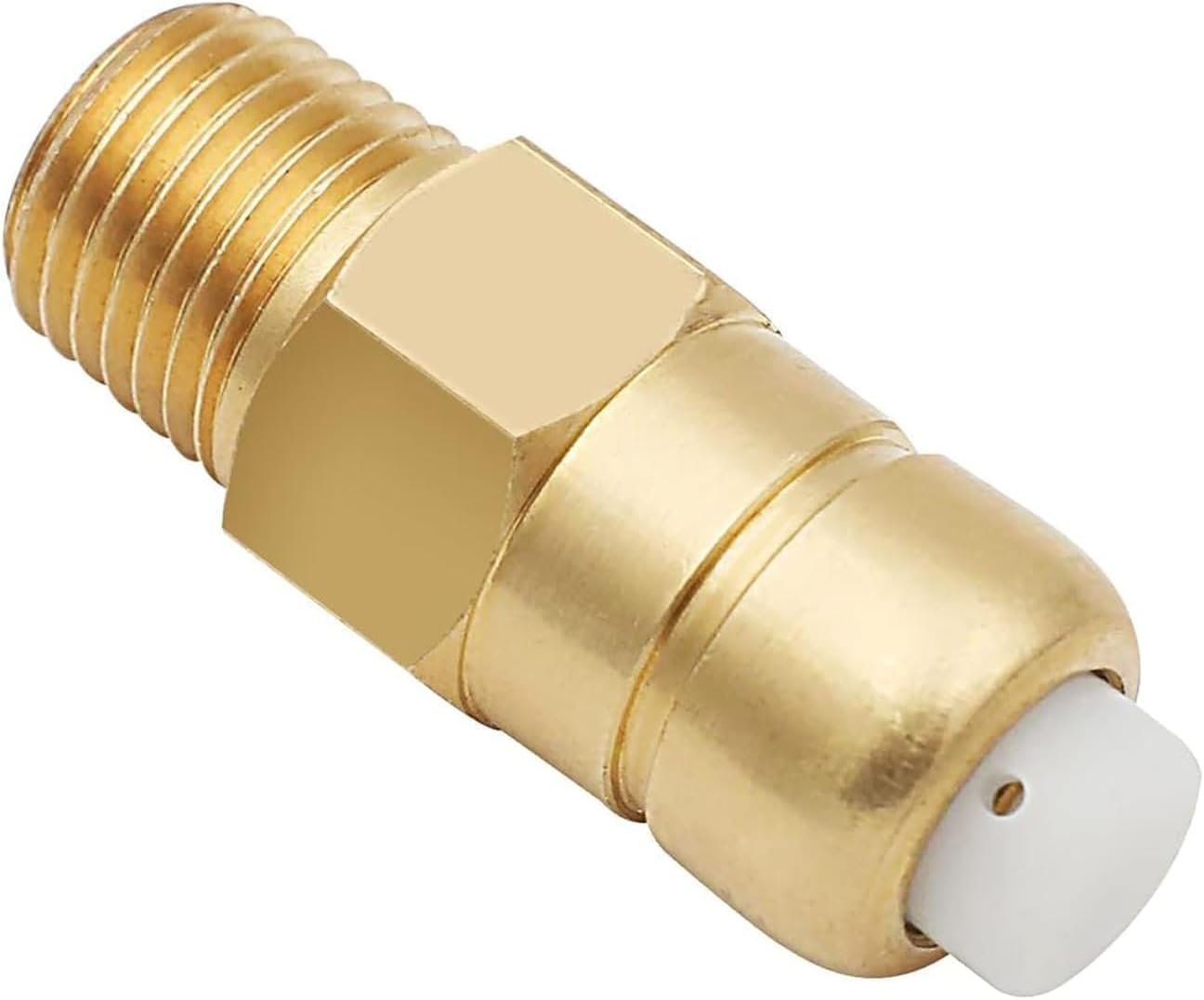
- 140°F Automatic Thermal Dump: Internal wax element opens at 140°F, discharging hot recirculating water and drawing in fresh cool water before seals soften.
- Solid Brass 5,000 PSI Rating: CNC-machined brass built to withstand high pressure without cracking.
- Standard 1/4" NPT Male Threads: Direct screw-in replacement for Simpson, Generac, Honda, Cat, AR, and Comet pumps. Fits adapters shown in our pressure washer fittings guide.
How to Rebuild and Adjust the Unloader Valve
If your unloader valve is sticking and stalling your engine, you usually do not need a whole new pump. In most cases, cleaning off mineral scale, installing fresh O-rings, and setting the spring tension solves the problem. Here are the steps:
Step 1. Disconnect Fuel and Water Pressure
Turn off the fuel valve. Disconnect the spark plug boot so the engine cannot fire accidentally. Turn off the garden hose, disconnect the water supply, and pull the wand trigger once to release all trapped water pressure. Never loosen pump fittings under pressure.
Step 2. Remove the Adjustment Knob and Spring
Locate the unloader valve on your pump manifold:
- Loosen the top locknut on the adjustment knob with a wrench.
- Count and write down how many threads show beneath the nut. This helps you return to the same baseline during reassembly.
- Unscrew the knob and remove the heavy spring and washer. Check the spring for cracks or uneven coils.
Step 3. Remove the Shuttle Piston
Use a socket to unscrew the main unloader body from the pump manifold. Carefully slide out the internal piston assembly. Inside is a stainless-steel piston stem, check valve ball, and brass seat.
Gently push the piston out using a wooden dowel or brass punch. Never use steel screwdrivers or pliers on the brass sealing surfaces, as any scratch will prevent a watertight seal.
Step 4. Clean and Polish the Bore
Tap water leaves calcium scale inside the valve body, causing the piston to stick. Soak the brass and stainless parts (without rubber O-rings) in 50% warm white vinegar for 30 minutes to dissolve mineral build-up.
Wipe the parts clean. Look inside the unloader bore with a light. If you see light scoring or deposits, wrap 1500-grit wet/dry emery paper around a wooden dowel, add a drop of lubricant, and polish the bore until smooth.
Step 5. Replace O-Rings and Apply Silicone Grease
Remove the old O-rings using a plastic pick. Install fresh 90-durometer Viton or polyurethane O-rings. Standard 70-durometer hardware store rubber is too soft and can tear under pressure.
Coat all O-rings and sliding brass surfaces with pure high-viscosity silicone grease. Never use automotive motor oil or bearing grease, which damages rubber seals.
Step 6. Set the Pressure Spike
Reassemble the cartridge, thread it into the pump manifold, and tighten the main hex body. Put the spring, washer, and knob back on. Setting the spring tension correctly is essential.
Do not crank the adjustment knob down as far as it goes. Tightening the knob does not create more pressure—it only eliminates bypass travel and guarantees the engine will stall when you let go of the trigger. Nozzle tip size dictates your working pressure.
- Install a 0–5,000 PSI pressure gauge between the pump outlet and hose.
- Hook up water, purge all air through the wand until solid water flows, and start the engine with the spray trigger held open.
- While spraying, turn the unloader knob clockwise until your gauge reaches the machine's rated working pressure (e.g., 3,000 PSI). Stop turning.
- Release the wand trigger while watching the gauge.
- The pressure should rise briefly by 10% to 15% above working pressure (e.g., 3,300 to 3,450 PSI) before the unloader opens and bypasses water at low pressure.
- If the pressure spikes higher or the engine stumbles, turn the knob counter-clockwise by half a turn to reduce spring tension.
- Once the bypass transition is smooth and the engine idles steadily, tighten the locknut against the knob to secure your setting.
Key Takeaways for Safe Operation
A stalling pressure washer is often an easy fix once you understand the unloader bypass mechanism:
- Shut the Engine Off When Not Spraying: If you stop spraying for more than 60 seconds, turn the engine off. Recirculating bypass water heats up fast and cooks pump packings.
- Protect with Pump Lubricant Before Storage: Running pump protector through your machine before winter coats the unloader in oil and keeps minerals from cementing the piston over months of storage.
- Keep the 10% Pressure Spike Margin: Do not tighten the unloader knob to chase higher pressure. Use the right nozzle orifice size, allow the valve to bypass freely, and your pump will last for years.
Frequently Asked Questions
Why does my pressure washer run fine while spraying but die the moment I release the wand trigger?
When you let go of the spray trigger, the closed gun forces all water back into the pump manifold. If the unloader valve shuttle piston is stuck or its bypass passage is calcified, the pump deadheads against an incompressible water column. Pressure spikes instantaneously past 4,500 PSI, requiring over 8 to 9 brake horsepower from an engine rated for only 5 to 6.5 HP. The resulting torque shock stalls the crankshaft immediately.
How do I know if my unloader valve is bad or just needs adjustment?
Install an inline pressure gauge between your pump outlet and high-pressure hose. Run the engine and check the spike pressure when releasing the trigger. If the spike is only 10% to 15% above working pressure (e.g., 3,000 PSI jumps to 3,300 PSI), the unloader simply needs calibrated spring adjustment. If the gauge spikes off-scale past 4,500 PSI or does not bypass at all, the internal shuttle piston has seized or the O-rings have blown, requiring rebuild or replacement.
Can a dirty carburetor cause the engine to stall when letting go of the trigger?
Yes. When you release the trigger, a properly functioning unloader drops pump load to under 1 horsepower, causing the engine governor to pull the throttle plate back toward idle. If the carburetor idle pilot jet or low-speed emulsion tube is gummed with stale fuel varnish, the engine starves for fuel the moment the throttle butterfly closes, causing an immediate stall that mimics an unloader failure.
What happens to a pressure washer pump if you leave it running off-trigger without a thermal relief valve?
During bypass mode, the pump plungers continuously churn the same small volume of trapped water, generating extreme fluid friction. Water temperature rises by roughly 20°F every 30 seconds. Without a thermal relief valve to automatically dump boiling water at 140°F, trapped temperatures cross 160°F within two minutes, melting high-pressure V-packings, warping brass check valve seats, and causing ceramic plungers to shatter from thermal shock on the next cold trigger pull.
Can I adjust the unloader valve knob to get more pressure out of my washer?
No. The unloader valve regulates bypass transition pressure; it does not generate hydraulic output. Maximum working pressure is strictly dictated by the engine horsepower, pump displacement volume, and spray nozzle orifice size. Cranking the unloader spring down to coil-bind will not increase spray force—it only eliminates bypass clearance, spikes deadhead pressure to destructive levels, and guarantees an engine stall the second you let go of the trigger.