
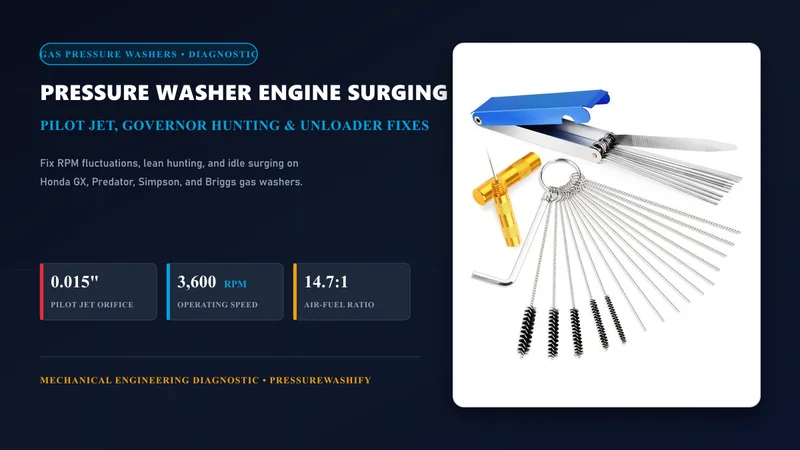
When a gas pressure washer engine revs up and down continuously—surging every second or two like a heartbeat—it is trapped in a lean-fuel hunting loop. A microscopic speck of dried ethanol varnish clogs the carburetor pilot jet, starving the engine of fuel. As the engine stumbles and drops RPM, the mechanical governor panics and yanks the throttle wide open to save it, overshooting engine speed before slamming the throttle shut and starting the entire cycle over again.
Small engine mechanics call this rhythmic revving "hunting." It is hands-down the most common headache on small OHV utility engines—including Honda GX series, Predator 212 and 301, Kohler, and Briggs & Stratton. Most owners assume they have a bent governor linkage or a fouled spark plug. But the governor is actually doing its job: it is frantically trying to keep a starving engine running because liquid gasoline cannot squeeze through a brass orifice narrower than a sewing needle.
Before you bend linkages or replace good parts, you can isolate the exact failure in two minutes flat right in your driveway.
The 60-Second Triage — Isolating Fuel vs Governor vs Pump Load
- Test 1 — Squeeze the spray gun trigger under water pressure. If the engine immediately settles down and runs strong while you spray, your main jet and governor are working fine. The restriction is 100% confined to your tiny pilot jet or idle passage.
- Test 2 — Flip the choke lever to half-choke. If setting the choke lever halfway smooths out the engine idle, you have confirmed a lean air-fuel condition. Restricting incoming air restores the proper combustible ratio to compensate for starved fuel flow. If the engine dies the moment you turn the choke off, see our guide on fixing a pressure washer that only runs on choke.
- Test 3 — Watch what happens when you let go of the trigger. If the engine surges only when you release the spray trigger, and water pulses out of the pump bypass port, you are dealing with a sticking pump unloader valve, not an engine carburetor problem. Read our teardown on why pressure washers stall when releasing the trigger.
How Engine Surging Happens (The Fuel vs Governor Tug-of-War)
To understand why an engine hunts, look at the mechanical tug-of-war between the carburetor and the engine governor. Small utility engines are built to run at a steady 3,600 RPM without load. That exact speed ensures the high-pressure water pump spins at its designed drive speed to produce rated flow and working pressure.
Inside the engine crankcase, a pair of spring-loaded centrifugal flyweights spins against a pushrod. When the engine is at 3,600 RPM, centrifugal force flings the weights outward, balancing against a stiff governor spring outside the block. If engine speed drops, the weights collapse inward, and that exterior spring pulls the throttle shaft open to feed more fuel and air.
When dried ethanol fuel clogs the carburetor pilot jet, the engine cannot draw enough liquid gasoline to sustain combustion at idle. Here is the chain reaction that plays out every single second:
- The Lean Stumble — With the spray trigger released, the throttle plate rests against the idle stop. The engine depends entirely on the tiny pilot jet (orifice diameter roughly 0.012 to 0.015 inches). Because fuel cannot squeeze through, the air-fuel mixture leans out beyond 18:1. Combustion falters and RPM plummets toward 1,800 RPM.
- The Governor Overreaction — As crankshaft speed collapses, the internal flyweights fold in. The stiff governor spring immediately pulls the throttle arm wide open.
- The Main Jet Dump — Opening the throttle plate uncovers the large main nozzle. High-velocity intake air vacuums a heavy gulp of fuel straight from the float bowl. The engine roars back to life with a sharp spike past 3,800 RPM.
- The Sudden Cutback — Sensing the overspeed condition, the centrifugal governor violently snaps the throttle plate back down to the idle stop. Because the pilot jet is still clogged, the engine starves again, and the entire cycle repeats endlessly.
Technical Schematic — The Mechanical Governor Hunting Cycle
The 4 Primary Causes of Pressure Washer Engine Surging
A gummed-up carburetor causes over 80% of surging complaints, but three other mechanical bottlenecks can trigger the exact same symptom. Work through these four failure points in order:
1. Clogged Carburetor Pilot Jet (Low-Speed Circuit)
This is the number one cause of engine surging on pressure washers. Standard pump gasoline contains up to 10% ethanol (E10). When gas sits in a carburetor float bowl for more than three or four weeks, the alcohol evaporates and attracts ambient moisture, leaving behind a gummy amber or green varnish.
While the main jet down in the bowl has a generous opening (around 0.030 inches), the pilot jet tucked directly under the plastic idle stop screw is tiny—typically between 0.012 and 0.015 inches (0.30 to 0.38 mm). A single flake of rust or varnish film chokes off idle fuel flow completely. The engine starves at idle, the governor steps in, and the cyclic hunting begins.
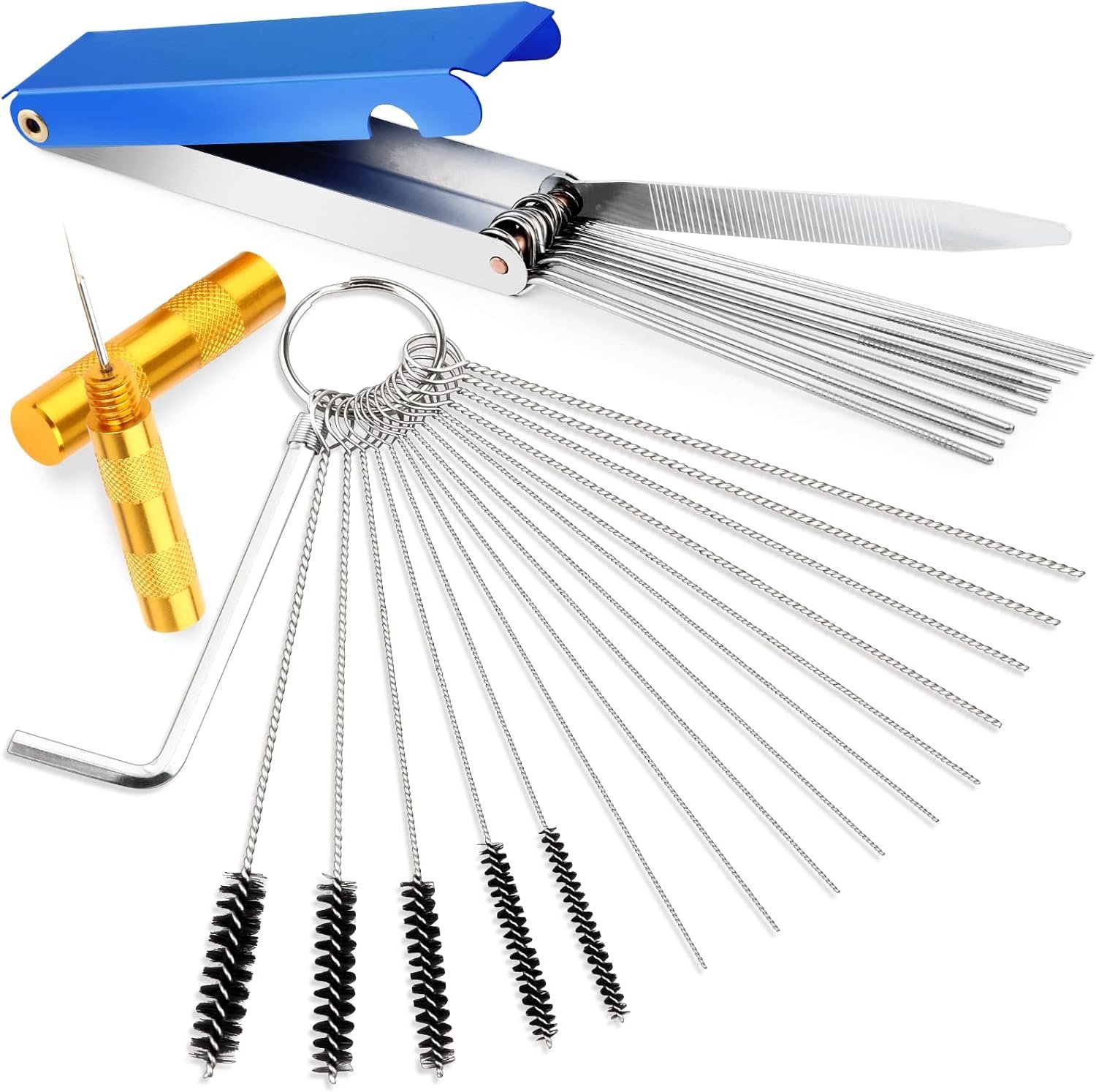
- Micro-wire picks down to 0.012 inches — Clean stubborn ethanol varnish out of pilot jets without gouging or enlarging the soft brass orifice.
- Clean right on the engine — Pull and clean the top-mounted pilot jet and emulsion tube cross-holes in 15 minutes without unbolting the carburetor.
- Protective aluminum case — Keeps spiral wires organized and straight alongside miniature nylon bore brushes for scrubbing fuel passages.
- Fits all common small engines — Works on Honda GX160/GX200/GX390, Predator 212/301/420, Kohler, Briggs & Stratton, and Generac pressure washers.
2. Air Leaks at the Intake Manifold Gasket
If outside air sneaks into the engine between the carburetor and cylinder head, it leans out the air-fuel mixture just like a clogged jet. The two most common problem spots:
- Cracked plastic heat insulator — Small OHV engines use a black phenolic plastic spacer between the cylinder head and carburetor to prevent fuel from boiling. If someone overtightened the carburetor mounting nuts, this block cracks easily.
- Torn or backward gaskets — The intake stack uses three separate paper gaskets. If any gasket is torn, brittle, or flipped backward, unmetered air bypasses the carburetor throat entirely.
The quick spray test — Start the engine and let it surge. Carefully spray a quick 1-second burst of carburetor cleaner around the intake manifold gaskets and plastic insulator block. If the engine RPM instantly smooths out, the spray temporarily sealed the vacuum leak. Replace the paper gaskets and plastic spacer block.
3. Pump Unloader Valve Sticking or Cycling in Bypass
Unlike a lawnmower that spins a blade in free air, your pressure washer engine is mechanically connected to a positive-displacement water pump. When you release the spray gun trigger, the pump continues pushing water. The unloader valve must immediately divert this pressurized stream into a bypass loop.
If the unloader valve piston is corroded, jammed with grit, or suffering from torn internal O-rings, it may rapidly switch between full bypass and partial pressure. Every time the unloader cycles, it drops a sudden 1,500 to 3,000 PSI hydraulic load on the engine crankshaft, pulling engine speed down. When the unloader slips open again, the load disappears and the engine revs up. If your pull cord is also difficult to pull during startup, inspect pump backpressure using our troubleshooting guide for a hard-to-pull pressure washer pull cord.
4. Worn, Stretched, or Binding Governor Linkage Springs
The mechanical governor linkage connects the internal crankcase governor arm to the carburetor throttle shaft. It consists of a solid wire rod surrounded by a very fine, coiled anti-lash spring running parallel to it.
If that fine anti-lash spring is missing, stretched, or rubbing against the throttle bracket, the linkage develops physical "slop." The governor cannot make tiny micro-adjustments to throttle angle, causing it to overcorrect continuously. Check that the small coil spring fits snugly over the rod and that the throttle butterfly pivots freely without friction.
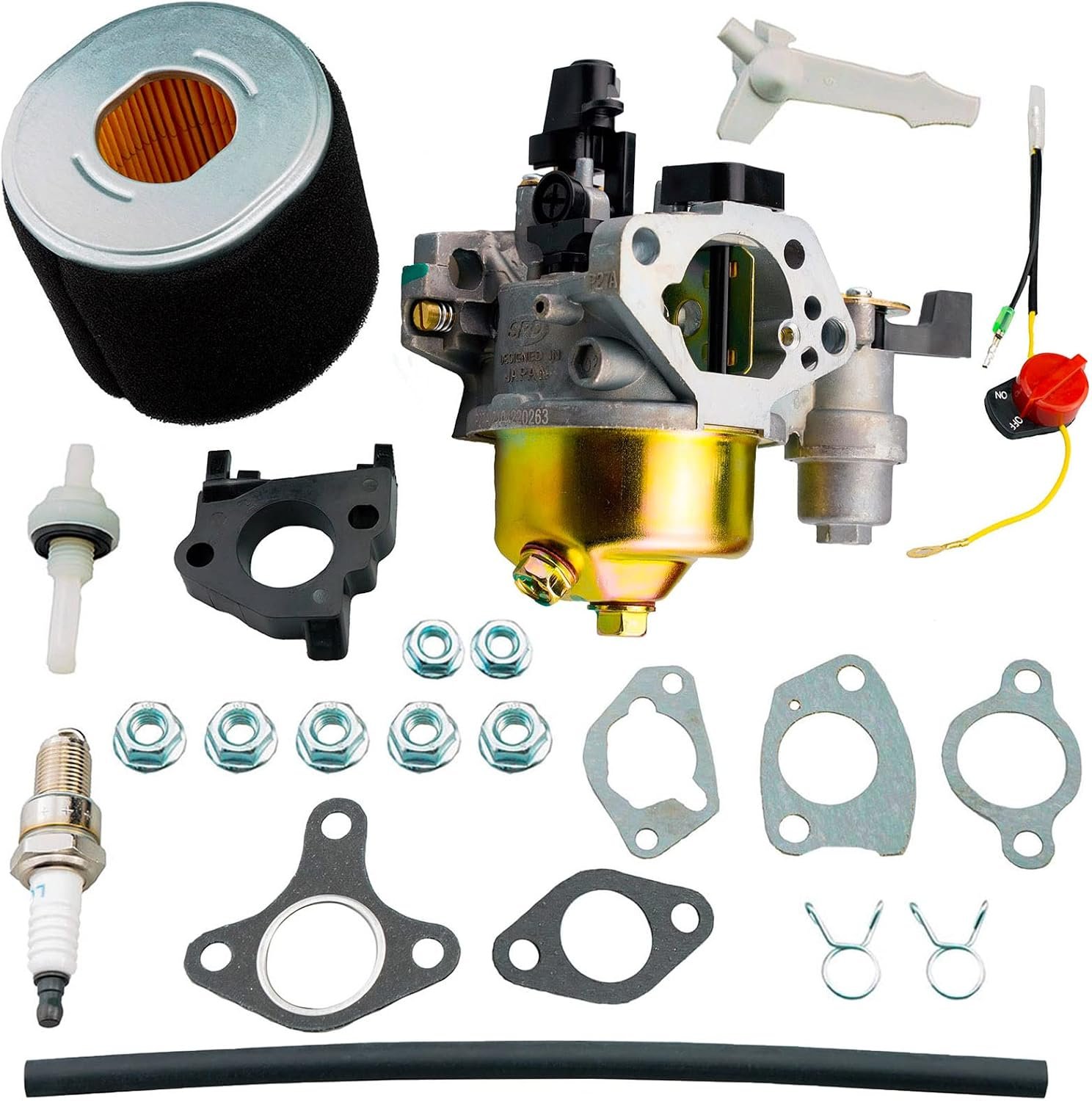
- Fixes severe internal corrosion — When water sitting in the float bowl pits the aluminum body or corrodes internal fuel passages, ultrasonic cleaning won't work. A drop-in replacement carburetor restores factory fuel ratios instantly.
- Complete installation package — Includes fresh intake manifold gaskets, fuel line, hose clamps, insulator spacers, and an inline fuel filter to stop dirt before it reaches the bowl.
- Pre-calibrated jets — Ready to run out of the box with balanced idle and high-speed circuits tuned for commercial 3,600 RPM operation.
- Available for popular engines — Direct OEM fitment for Honda GX series, Predator 212/301/420, Simpson, DeWalt, and Generac pressure washers.
Step-by-Step Guide — How to Clean the Pilot Jet in 15 Minutes
On 90% of surging pressure washers, you do not need to remove the carburetor from the engine or disassemble the throttle linkages. You can pull and clear the pilot jet directly from the top of the carburetor body:
- Pull the air filter housing — Turn off the fuel petcock. Spin off the wing nuts or 10mm nuts holding the plastic air filter housing, remove the foam/paper filter element, and set them aside to get clean access to the top of the carburetor.
- Back out the idle stop screw — Look directly on top of the carburetor body. You will see a black plastic Phillips-head screw that acts as the throttle idle stop. Count the turns as you back it all the way out so you can reinstall it in the exact same spot.
- Pop out the pilot jet collar — Underneath the screw sits the black plastic pilot jet collar. Take a small flathead screwdriver or pocket pry tool, place it under the lip of the collar, and gently pry straight upward. It pops out of the carburetor bore with a small rubber O-ring attached.
- Check the microscopic orifice — Look closely at the bottom tip of this plastic jet. In the center is a tiny brass insert with an opening no thicker than a single guitar wire. If you hold it up to a shop light and cannot see a crisp pinhole of daylight, the jet is blocked.
- Ream the jet clean — Grab a 0.012-inch or 0.014-inch cleaning wire from your jet tool set (or an electric guitar high-E string). Gently push the wire through the center hole until it slides freely. Spray aerosol carburetor cleaner through the hole, ensuring a clean, straight stream exits the bottom.
- Flush the carburetor well — Place the straw of your carburetor cleaner directly into the hole where the pilot jet was seated and blast cleaner for 3 seconds. Fluid should spray out of the tiny transition holes inside the carburetor venturi throat.
- Reinstall and test — Inspect the tiny rubber O-ring on the pilot jet for tears. Press the jet firmly back down into its well until it clicks flush. Thread the plastic idle screw back in to its original position, reinstall the air filter, turn on your water supply, and start the engine. The surge will be completely gone.
Diagnostic Table — Surging Symptoms vs Root Causes
Use the matrix below to match how and when your engine surges with the exact mechanical cause:
| Surge Symptom | When It Occurs | Underlying Cause | Quick 30-Second Verification | Mechanical Fix |
|---|---|---|---|---|
| Rhythmic Hunting (Rev-Die-Rev) | Idle / Trigger Released | Clogged pilot jet / idle circuit | Squeeze spray trigger; engine instantly runs smooth | Remove idle screw, pop out pilot jet, clear with 0.014" wire |
| Smooths Out on Half-Choke | Idle and Mid-Throttle | Severe lean air-fuel ratio | Engine dies immediately when choke moved to RUN | Clear main jet, emulsion tube, and pilot jet; flush stale fuel |
| Surges While Actively Spraying | Trigger Squeezed (Under Load) | Main jet partial obstruction or fuel tank venting | Loosen gas cap; if surge stops, cap vent is plugged | Drop float bowl, clean brass main jet hex screw, check tank filter |
| Erratic RPM Shakes with Water Spikes | Trigger Released (Pump in Bypass) | Unloader valve cycling or leaking | Water pulses out pump bypass port rhythmically | Disassemble unloader valve, replace scarred O-rings or poppet |
| Violent Governor Arm Vibration | All Speeds | Missing or stretched anti-lash spring | Manually hold throttle arm steady; engine runs smoothly | Replace fine governor linkage spring; remove dirt around pivots |
Nozzle Sizing & Pressure Calibration Tool
Did you know that an undersized nozzle tip puts excessive backpressure on your pump, causing premature unloader cycling and engine strain? Use our free nozzle calculator to match your exact GPM and PSI ratings.
CALCULATE NOZZLE ORIFICE SIZEShop Rule — The 3 Rules to Prevent Engine Surging Forever
To keep your carburetor pilot jet and idle passages clean season after season, follow these three rules:
- Run Non-Ethanol Gas (REC-90): Whenever possible, run ethanol-free fuel. Ethanol attracts water and forms gelatinous varnish in small orifices in as little as 3 weeks. Check our guide on gasoline fuel selection for pressure washers.
- Treat Every Can with Fuel Stabilizer: If ethanol pump gas is your only option, add fuel stabilizer to your gas can the day you fill it up, not after the fuel sits in your garage.
- Dry the Bowl Before Storage: Close the fuel petcock with the engine running and let the engine stall out on its own. This empties the carburetor float bowl and pilot well so no gas remains inside to evaporate and leave varnish deposits.